


Respiratory motor function in individuals with centronuclear myopathies
- PMID: 26351754
- PMCID: PMC4718843
- DOI: 10.1002/mus.24899
Respiratory motor function in individuals with centronuclear myopathies
Erratum in
-
Erratum: Respiratory Motor Function in Individuals with Centronuclear Myopathies.Muscle Nerve. 2016 Jun;53(6):1000. doi: 10.1002/mus.25139. Epub 2016 May 9. Muscle Nerve. 2016. PMID: 27198894 No abstract available.
Abstract
I NTRODUCTION: Individuals with X-linked myotubular myopathy (XLMTM) and other centronuclear myopathies (CNMs) frequently have profound respiratory insufficiency that requires support early in life. Still, few quantitative data exist to characterize respiratory motor function in CNM.
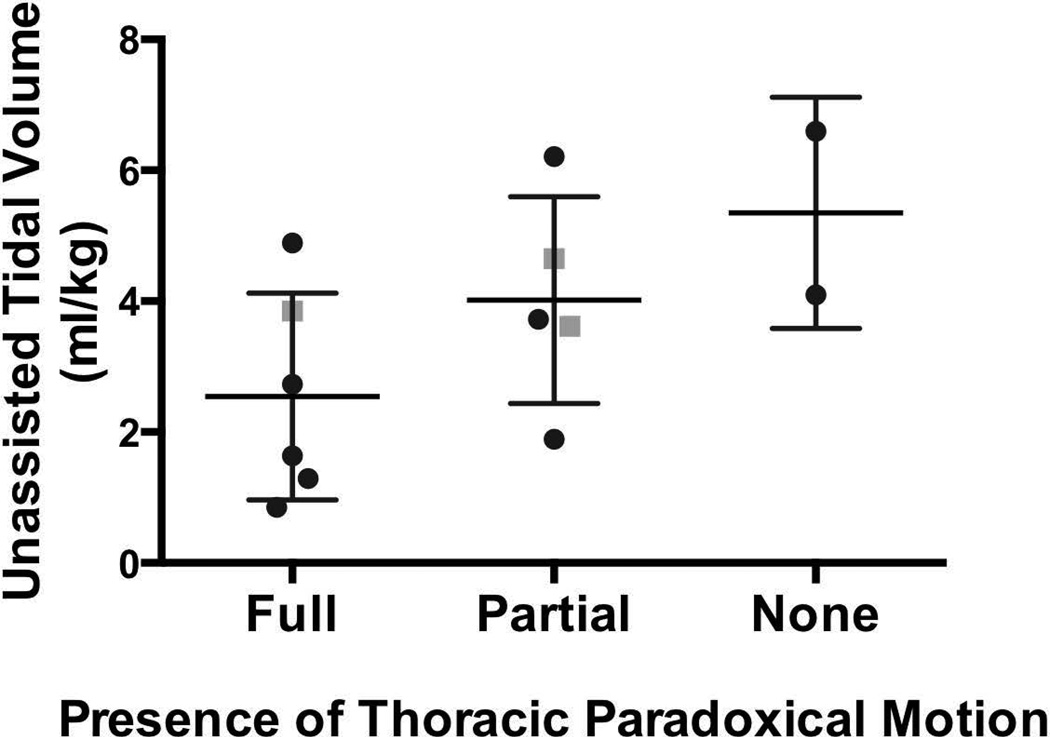
Methods: We evaluated the reliance upon mechanical ventilation (MV), ventilatory kinematics, unassisted tidal volumes, and maximal respiratory pressures in 14 individuals with CNMs, including 10 boys with XLMTM.
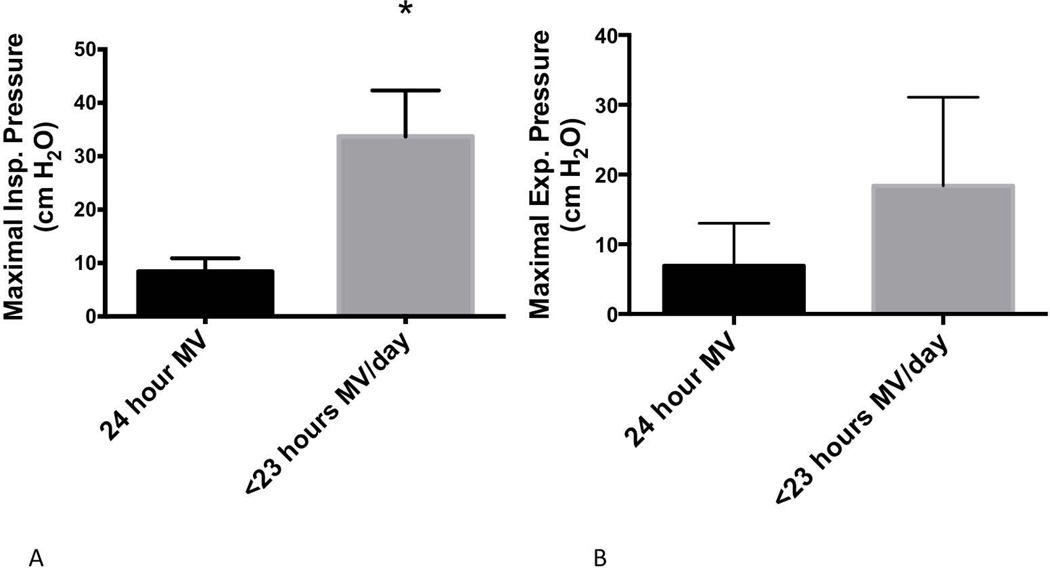
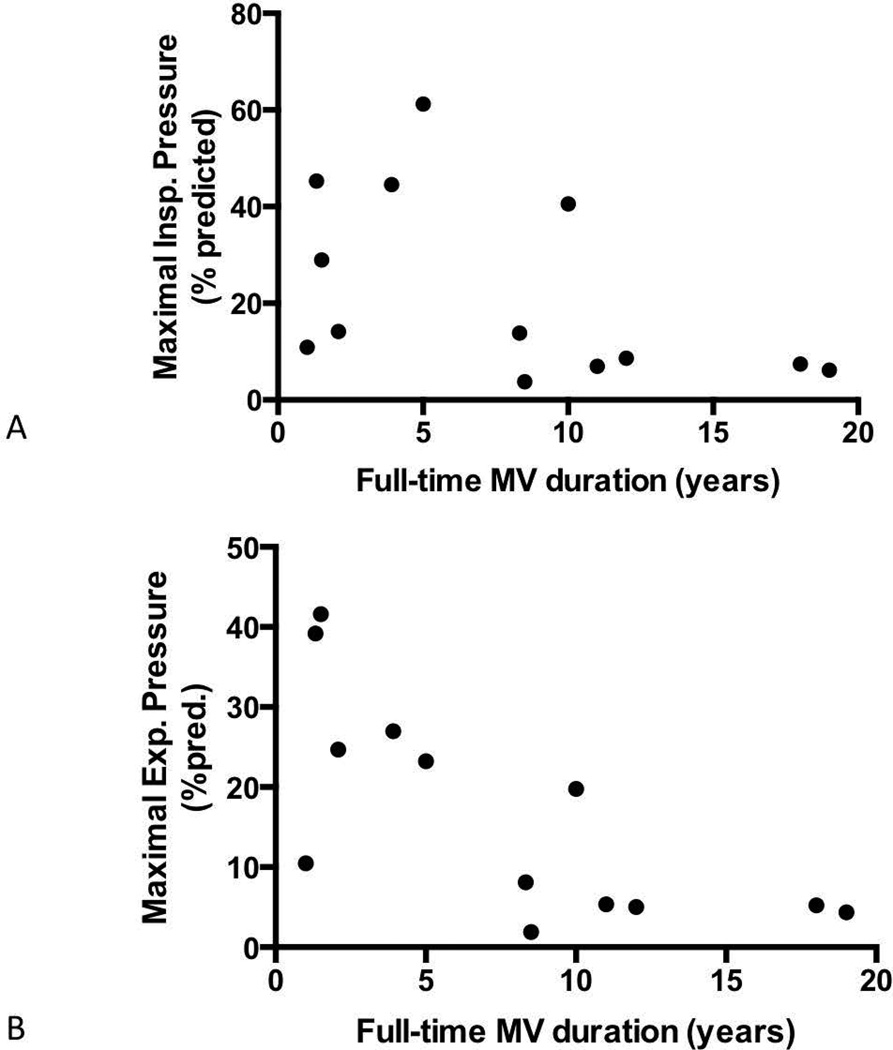
Results: Thirteen participants required full-time, invasive MV. Maximal inspiratory pressures were higher in subjects who breathed unsupported at least 1 hour/day as compared with 24-hour MV users [33.7 (11.9-42.3) vs. 8.4 (6.0-10.9) cm H(2)O, P < 0.05]. Years of MV dependence correlated significantly with MEP (r = -0.715, P < 0.01).
Conclusions: Respiratory function in CNMs may be related to deconditioning from prolonged MV and/or differences in residual respiratory muscle strength. Results from this study may assist in evaluating severe respiratory insufficiency in neuromuscular clinical care and research.
Keywords: centronuclear myopathy; clinical trial design; mechanical ventilation; myotubular myopathy; respiratory function.
© 2015 Wiley Periodicals, Inc.
Conflict of interest statement
None of the authors have conflicts of interest to report.
Figures
Comment in
-
Reply: Respiratory motor function in centronuclear myopathy.Muscle Nerve. 2016 Apr;53(4):660-1. doi: 10.1002/mus.24961. Epub 2015 Dec 29. Muscle Nerve. 2016. PMID: 26561983 No abstract available.
-
Continuous noninvasive ventilatory support as an alternative to invasive TMV.Muscle Nerve. 2016 Apr;53(4):660. doi: 10.1002/mus.24967. Epub 2016 Jan 5. Muscle Nerve. 2016. PMID: 26562745 No abstract available.
References
-
- Romero NB. Centronuclear myopathies: a widening concept. Neuromuscul Disord. 2010;20(4):223–228. - PubMed
-
- Jungbluth H, Wallgren-Pettersson C, Laporte JF, Centronuclear myopathy C. Neuromuscul Disord; 198th ENMC International Workshop: 7th Workshop on Centronuclear (Myotubular) myopathies; 31st May – 2nd June 2013; Naarden, The Netherlands. 2013. pp. 1033–1043. - PubMed
-
- Buj-Bello A, Biancalana V, Moutou C, Laporte J, Mandel JL. Identification of novel mutations in the MTM1 gene causing severe and mild forms of X-linked myotubular myopathy. Hum Mutat. 1999;14(4):320–325. - PubMed
-
- McEntagart M, Parsons G, Buj-Bello A, Biancalana V, Fenton I, Little M, Krawczak M, Thomas N, Herman G, Clarke A, Wallgren-Pettersson C. Genotype-phenotype correlations in X-linked myotubular myopathy. Neuromuscul Disord. 2002;12(10):939–946. - PubMed
-
- Herman GE, Finegold M, Zhao W, de Gouyon B, Metzenberg A. Medical complications in long-term survivors with X-linked myotubular myopathy. J Pediatr. 1999;134(2):206–214. - PubMed
Publication types
MeSH terms
Grants and funding
LinkOut - more resources
Full Text Sources
Other Literature Sources
