Case Reports
. 2015 Sep 9:15:624.
doi: 10.1186/s12885-015-1620-3.

Case report of severe Cushing's syndrome in medullary thyroid cancer complicated by functional diabetes insipidus, aortic dissection, jejunal intussusception, and paraneoplastic dysautonomia: remission with sorafenib without reduction in cortisol concentration

Affiliations
Case Reports

Case report of severe Cushing's syndrome in medullary thyroid cancer complicated by functional diabetes insipidus, aortic dissection, jejunal intussusception, and paraneoplastic dysautonomia: remission with sorafenib without reduction in cortisol concentration

Muhammad M Hammami et al. BMC Cancer. .

Abstract

Background: Normalization of cortisol concentration by multikinase inhibitors have been reported in three patients with medullary thyroid cancer-related Cushing's syndrome. Aortic dissection has been reported in three patients with Cushing's syndrome. Diabetes insipidus without intrasellar metastasis, intestinal intussusception, and paraneoplastic dysautonomia have not been reported in medullary thyroid cancer.

Case presentation: An adult male with metastatic medullary thyroid cancer presented with hyperglycemia, hypernatremia, hypokalemia, hypertension, acne-like rash, and diabetes insipidus (urine volume >8 L/d, osmolality 190 mOsm/kg). Serum cortisol, adrenocorticoitropic hormone, dehydroepiandrostenedione sulfate, and urinary free cortisol were elevated 8, 20, 4.4, and 340 folds, respectively. Pituitary imaging was normal. Computed tomography scan revealed jejunal intussusception and incidental abdominal aortic dissection. Sorafenib treatment was associated with Cushing's syndrome remission, elevated progesterone (>10 fold), normalization of dehydroepiandrostenedione sulfate, but persistently elevated cortisol concentration. Newly-developed proximal lower limb weakness and decreased salivation were associated with elevated ganglionic neuronal acetylcholine receptor (alpha-3) and borderline P/Q type calcium channel antibodies.

Conclusion: Extreme cortisol concentration may have contributed to aortic dissection and suppressed antidiuretic hormone secretion; which combined with hypokalemia due cortisol activation of mineralocorticoid receptors, manifested as diabetes insipidus. This is the first report of paraneoplastic dysautonomia and jejunal intussusception in medullary thyroid cancer, they may be related to medullary thyroid cancer's neuroendocrine origin and metastasis, respectively. Remission of Cushing's syndrome without measurable reduction in cortisol concentration suggests a novel cortisol-independent mechanism of action or assay cross-reactivity. Normalization of dehydroepiandrostenedione sulfate and elevation of progesterone suggest inhibition of 17-hydroxylase and 21-hydroxylase activities by sorafenib.


Figures

Fig. 1
Fig. 1
Major radiological findings. a Trans axial images of enhanced computed tomography (CT) of the abdomen showing: hypodense liver lesions in both lobes (the largest is located in segment IV adjacent to porta hepatis, white arrow), and bilateral adrenal hyperplasia (black arrows). b Aortic dissection below the level of renal arteries (white arrow head) extending to the left and right common iliac arteries (white arrows). c FDG PET-CT scan showing multiple hyper metabolic liver lesions (white arrow head), lung metastasis involving the left paracardiac area (black arrow), and diffuse bilateral hyper metabolic activity within the adrenal gland (white arrows). d Sagittal and axial (post contrast) T1 weighted MRI images showing normal pituitary gland. e Trans axial image of enhanced computed CT of the abdomen showing jeujenal intussusception
Fig. 2
Fig. 2
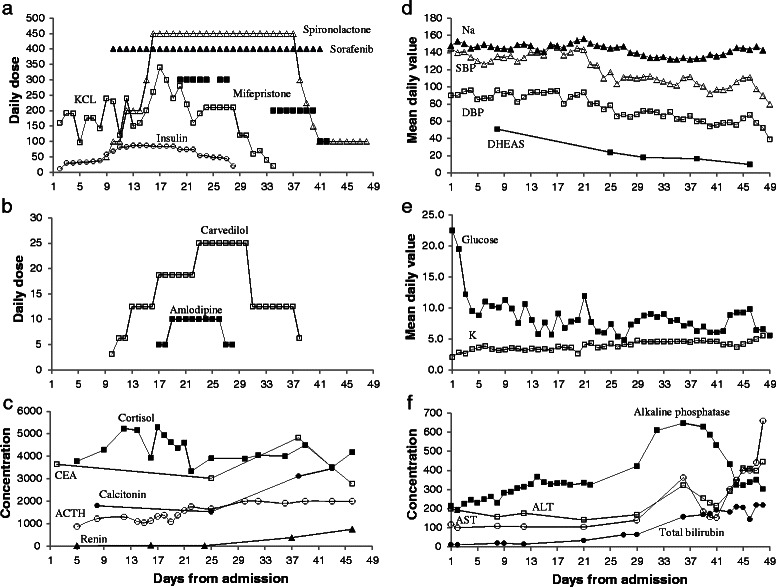
Main treatments and clinical and laboratory findings over the course of hospitalization. a Daily doses of spironolactone (mg, open triangles), sorafenib (mg, closed triangles), mifepristone (mg, closed squares), potassium chloride (mmol potassium, open squares), and insulin (units, open circles). b Daily doses of carvedilol (mg, open squares) and amlodipine (mg, closed squares). c Concentrations of cortisol (nmol/L, closed squares), carcinoembryonic antigen (CEA, μg/L, open squares), calcitonin (pmol/L, closed circles), adrenocorticoitropic hormone (ACTH, ng/L, open circles; values greater than 2000 ng/dL are reported as 2000 ng/L; multiply by 0.22 to convert to pmol/L), and renin (mU/L, closed triangles). Aldosterone was < 8 and < 4 ng/L (multiply by 0.277 to convert to nmol/L) on days 5 and 36, respectively. d Mean daily concentration of sodium (mmol/L, closed triangles), mean daily measurements of systolic (mmHg, open triangles) and diastolic blood pressure (mmHg, open squares), and concentration of dehydroepiandrosterone sulfate (DHEAS, closed squares, μmol/L). Dehydroepiandrosterone (DHEA) was 12 and 3.9 ng/mL on days 8 and 25, respectively (multiply by 3.47 to convert to nmol/L). Progesterone was 40.4 and 42.2 nmol/L on days 40 and 43, respectively. 17-hydroxyprogestrone was 6.2 nmol/L on day 40. e Mean daily concentration of glucose (mmol/L, closed squares) and potassium (mmol/L, open squares). f Concentrations of alkaline phosphatase (U/L, closed squares), alanine aminotransaminase (ALT, U/L, open squares), aspartate aminotransferase (AST, U/L, open circles), and total bilirubin (μmol/L, closed circles). Prothrombin time was 15.4, 17.4, 22.1, 31.5, and 37.6 s on days 16, 27, 36, 43, 48, respectively. Albumin was 35, 32, and 19.7 g/L on days 1, 21, and 41, respectively

References

    1. Boscaro M, Arnaldi G. Approach to the patient with possible Cushing’s syndrome. J Clin Endocrinol Metab. 2009;94:3121–31. doi: 10.1210/jc.2009-0612. - DOI - PubMed
    1. Isidori AM, Kaltsas GA, Pozza C, Frajese V, Newell-Price J, Reznek RH, Jenkins PJ, Monson JP, Grossman AB, Besser GM. The ectopic adrenocorticotropin syndrome: clinical features, diagnosis, management, and long-term follow up. J Clin Endocrinol Metab. 2006;91(2):371–7. doi: 10.1210/jc.2005-1542. - DOI - PubMed
    1. Ilias I, Torpy DJ, Pacak K, Mullen N, Wesley RA, Nieman LK. Cushing’s syndrome due to ectopic corticotropin secretion: twenty years’ experience at the National Institutes of Health. J Clin Endocrinol Metab. 2005;90(8):4955–62. doi: 10.1210/jc.2004-2527. - DOI - PubMed
    1. Williams MD, Asa SL, Fuller GN. Medullary thyroid carcinoma metastatic to the pituitary gland: an unusual site of metastasis. Ann Diagn Pathol. 2008;12:199–203. doi: 10.1016/j.anndiagpath.2006.08.007. - DOI - PubMed
    1. Santarpia L, Gagel RF, Sherman SI, Sarlis NJ, Evans DB, Hoff AO. Diabetes insipidus and panhypopituitarism due to intrasellar metastasis from medullary thyroid cancer. Head Neck. 2009;31:419–23. doi: 10.1002/hed.20911. - DOI - PubMed

Publication types

MeSH terms