


Sepsis-associated pulmonary complications in emergency department patients monitored with serial lactate: An observational cohort study
- PMID: 26362864
- PMCID: PMC4648355
- DOI: 10.1016/j.jcrc.2015.07.031
Sepsis-associated pulmonary complications in emergency department patients monitored with serial lactate: An observational cohort study
Abstract
Purpose: Patients with severe sepsis and septic shock are at high risk for development of pulmonary complications, including acute respiratory distress syndrome (ARDS). Serial lactate monitoring is a useful tool to gauge global tissue hypoxia in emergency department (ED) patients with sepsis. We hypothesized that patients undergoing serial lactate monitoring (SL) would demonstrate a decreased incidence of pulmonary complications.
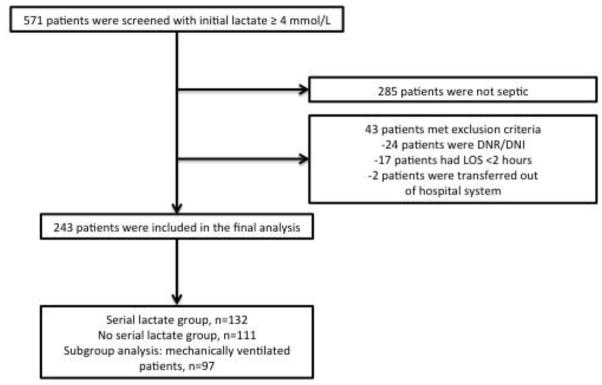
Methods: This is a retrospective observational cohort study of adult severe sepsis and septic shock patients with elevated lactate presenting to a large academic ED. A total of 243 patients were assigned to SL (n=132) or no serial lactate monitoring (NL; n=111). The primary outcome was a composite of pulmonary complications: (1) ARDS development and (2) respiratory failure.
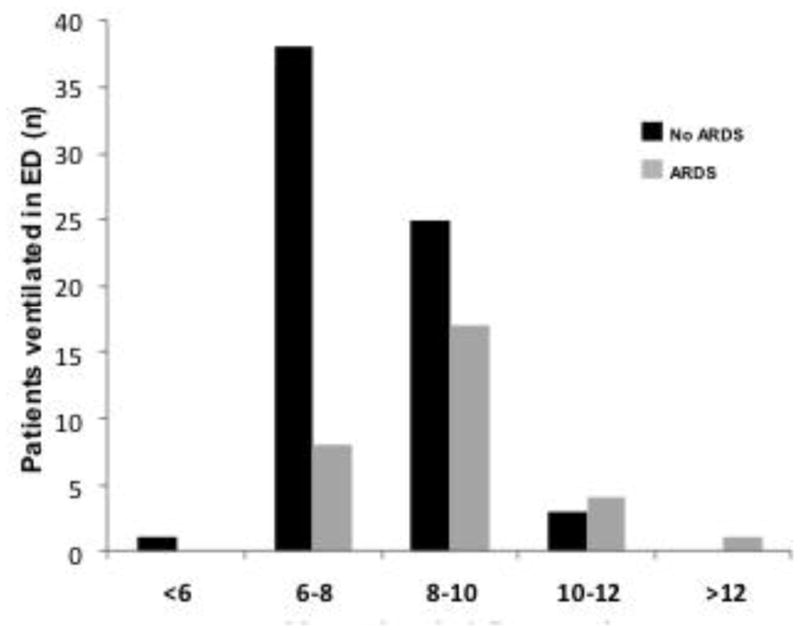
Results: Twenty-eight patients (21%) in the SL group and 37 patients (33%) in the NL group developed the primary outcome (P=.03). Multivariate analysis demonstrated an association between the NL group and development of pulmonary complications (adjusted odds ratio [aOR], 2.1; confidence interval [CI], 1.15-3.78). Emergency department mechanical ventilation was independently associated with development of ARDS (aOR, 3.5; 1.8-7.0). In the a priori subgroup of patients mechanically ventilated in the ED (n=97), those who developed ARDS received higher tidal volumes compared to patients who did not develop ARDS (8.7 mL/kg predicted body weight [interquartile range, 7.6-9.5] vs 7.6 [interquartile range, 6.8-9.0]; P<.01).
Conclusions: Serial lactate monitoring is associated with a decrease in major pulmonary complications in severe sepsis and septic shock. Acute respiratory distress syndrome incidence is also influenced by ED-based mechanical ventilation. These results provide 2 potentially modifiable variables to be targeted in future studies to prevent pulmonary complications in this patient subset.
Keywords: ARDS; Emergency department; Lactate; Sepsis.
Copyright © 2015 Elsevier Inc. All rights reserved.
References
-
- Rubenfeld GD, Caldwell E, Peabody E, et al. Incidence and outcomes of acute lung injury. N Engl J Med. 2005;353(16):1685–1693. - PubMed
Publication types
MeSH terms
Substances
Grants and funding
LinkOut - more resources
Full Text Sources
Other Literature Sources
Medical
