


Mammalian pre-implantation chromosomal instability: species comparison, evolutionary considerations, and pathological correlations
- PMID: 26366555
- PMCID: PMC7857118
- DOI: 10.3109/19396368.2015.1073406
Mammalian pre-implantation chromosomal instability: species comparison, evolutionary considerations, and pathological correlations
Abstract
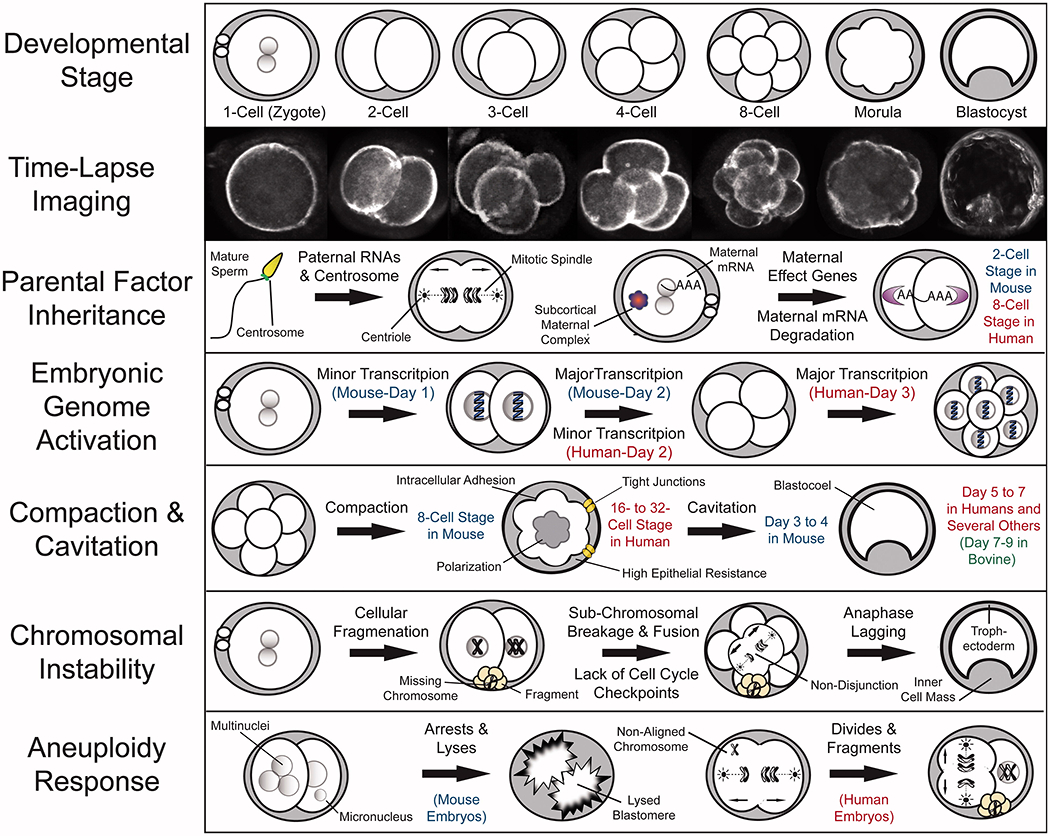
Pre-implantation embryo development in mammals begins at fertilization with the migration and fusion of the maternal and paternal pro-nuclei, followed by the degradation of inherited factors involved in germ cell specification and the activation of embryonic genes required for subsequent cell divisions, compaction, and blastulation. The majority of studies on early embryogenesis have been conducted in the mouse or non-mammalian species, often requiring extrapolation of the findings to human development. Given both conserved similarities and species-specific differences, however, even comparison between closely related mammalian species may be challenging as certain aspects, including susceptibility to chromosomal aberrations, varies considerably across mammals. Moreover, most human embryo studies are limited to patient samples obtained from in vitro fertilization (IVF) clinics and donated for research, which are generally of poorer quality and produced with germ cells that may be sub-optimal. Recent technical advances in genetic, epigenetic, chromosomal, and time-lapse imaging analyses of high quality whole human embryos have greatly improved our understanding of early human embryogenesis, particularly at the single embryo and cell level. This review summarizes the major characteristics of mammalian pre-implantation development from a chromosomal perspective, in addition to discussing the technological achievements that have recently been developed to obtain this data. We also discuss potential translation to clinical applications in reproductive medicine and conclude by examining the broader implications of these findings for the evolution of mammalian species and cancer pathology in somatic cells.
Keywords: Aneuploidy; IVF; cancer; chromothripsis; embryo; evolution; fragmentation; micronuclei; preimplantation.
Conflict of interest statement
Declaration of interest
The authors report no conflicts of interest.
Figures
References
-
- Alikani M, Cohen J, Tomkin G, Garrisi GJ, Mack C and Scott RT (1999) Human embryo fragmentation in vitro and its implications for pregnancy and implantation. Fertil Steril 71:836–842. - PubMed
-
- Alizadeh Z, Kageyama S and Aoki F (2005) Degradation of maternal mRNA in mouse embryos: Selective degradation of specific mRNAs after fertilization. Mol Reprod Dev 72:281–290. - PubMed
-
- Alper MM, Brinsden P, Fischer R and Wikland M (2001) To blastocyst or not to blastocyst? That is the question. Hum Reprod 16:617–619. - PubMed
-
- Antczak M and Van Blerkom J (1999) Temporal and spatial aspects of fragmentation in early human embryos: Possible effects on developmental competence and association with the differential elimination of regulatory proteins from polarized domains. Hum Reprod 14:429–447. - PubMed
-
- Baart EB, Martini E, van den Berg I, Macklon NS, Galjaard RJ, Fauser BC, et al. (2006) Preimplantation genetic screening reveals a high incidence of aneuploidy and mosaicism in embryos from young women undergoing IVF. Hum Reprod 21:223–233. - PubMed
Publication types
MeSH terms
Grants and funding
LinkOut - more resources
Full Text Sources
