


Temporal Associations Among Chronic PTSD Symptoms in U.S. Combat Veterans
- PMID: 26367017
- PMCID: PMC6785199
- DOI: 10.1002/jts.22039
Temporal Associations Among Chronic PTSD Symptoms in U.S. Combat Veterans
Abstract
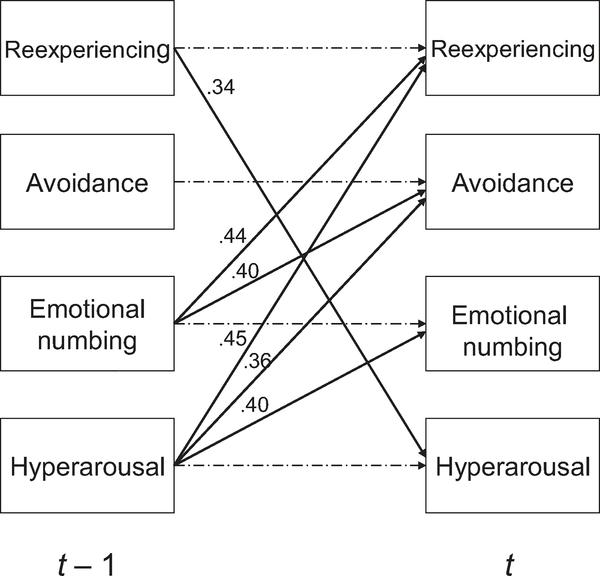
The present study examined fluctuation over time in symptoms of posttraumatic stress disorder (PTSD) among 34 combat veterans (28 with diagnosed PTSD, 6 with subclinical symptoms) assessed every 2 weeks for up to 2 years (range of assessments = 13-52). Temporal relationships were examined among four PTSD symptom clusters (reexperiencing, avoidance, emotional numbing, and hyperarousal) with particular attention to the influence of hyperarousal. Multilevel cross-lagged random coefficients autoregression for intensive time series data analyses were used to model symptom fluctuation decades after combat experiences. As anticipated, hyperarousal predicted subsequent fluctuations in the 3 other PTSD symptom clusters (reexperiencing, avoidance, emotional numbing) at subsequent 2-week intervals (rs = .45, .36, and .40, respectively). Additionally, emotional numbing influenced later reexperiencing and avoidance, and reexperiencing influenced later hyperarousal (rs = .44, .40, and .34, respectively). These findings underscore the important influence of hyperarousal. Furthermore, results indicate a bidirectional relationship between hyperarousal and reexperiencing as well as a possible chaining of symptoms (hyperarousal → emotional numbing → reexperiencing → hyperarousal) and establish potential internal, intrapersonal mechanisms for the maintenance of persistent PTSD symptoms. Results suggested that clinical interventions targeting hyperarousal and emotional numbing symptoms may hold promise for PTSD of long duration.
Published 2015. This article is a US Government work and is in the public domain in the USA. View this article online at wileyonlinelibrary.com.
Figures
References
-
- Abt Associates. (2014). Initial findings: National Vietnam veteran study reveals long-term course of PTSD and link to chronic health conditions. Retrieved from http://abtassociates.com/newsreleases/2014/initial-findings-national-vie...
-
- American Psychiatric Association. (1980). Diagnostic and statistical manual of mental disorders (3rd ed.). Washington, DC: Author.
-
- American Psychiatric Association. (1987). Diagnostic and statistical manual of mental disorders (3rd ed., rev.). Washington, DC: Author.
-
- American Psychiatric Association. (1994). Diagnostic and statistical manual of mental disorders (4th ed.). Washington, DC: Author.
-
- American Psychiatric Association. (2013). Diagnostic and statistical manual of mental disorders (5th ed.). Washington, DC: Author.
Publication types
MeSH terms
Grants and funding
LinkOut - more resources
Full Text Sources
Other Literature Sources
Medical
Research Materials
