


Immediate post-defeat infusions of the noradrenergic receptor antagonist propranolol impair the consolidation of conditioned defeat in male Syrian hamsters
- PMID: 26367452
- PMCID: PMC4633315
- DOI: 10.1016/j.physbeh.2015.09.010
Immediate post-defeat infusions of the noradrenergic receptor antagonist propranolol impair the consolidation of conditioned defeat in male Syrian hamsters
Abstract
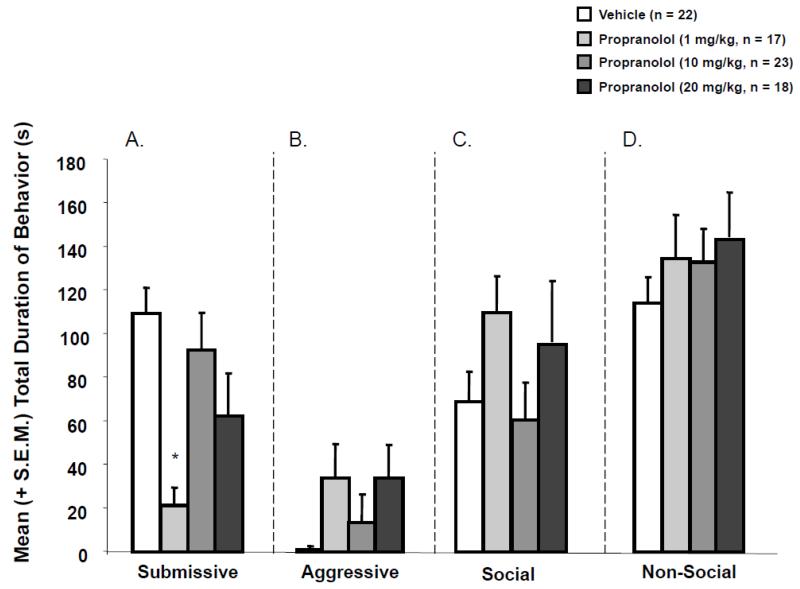
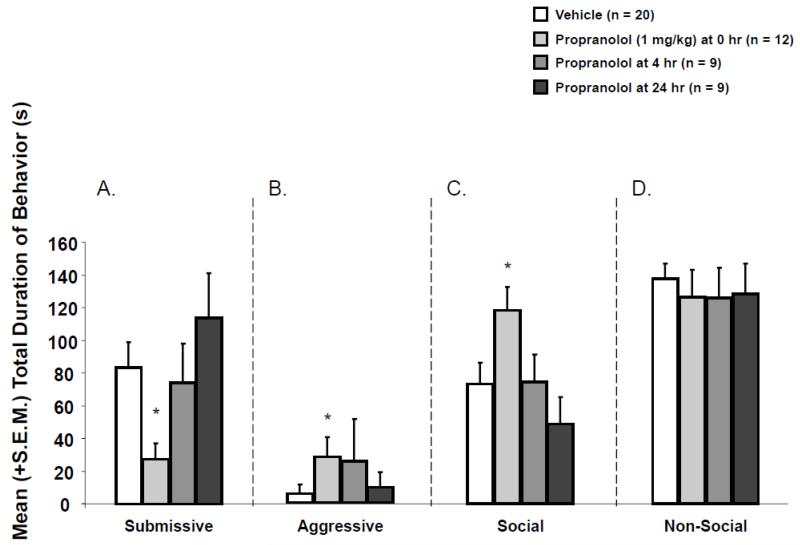
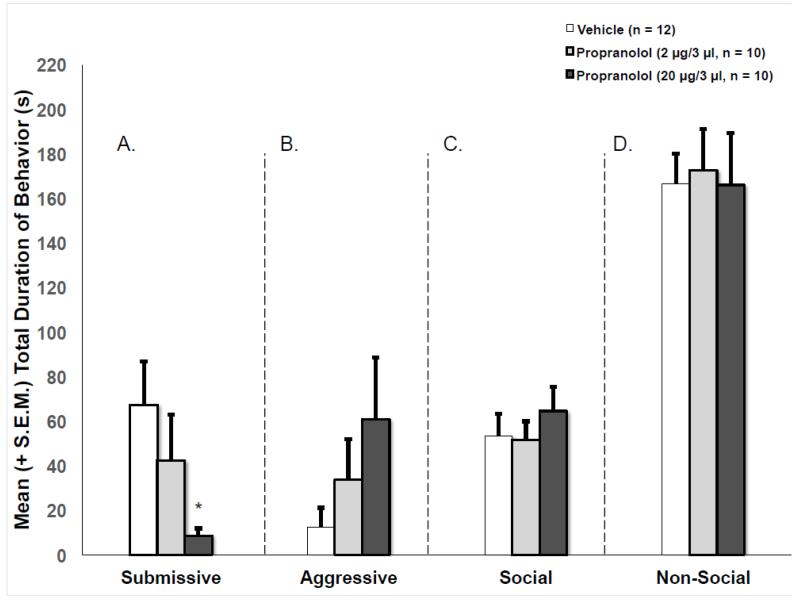
Social defeat occurs when an animal is attacked and subjugated by an aggressive conspecific. Following social defeat, male Syrian hamsters fail to display species-typical territorial aggression and instead exhibit submissive or defensive behaviors even when in the presence of a non-aggressive intruder. We have termed this phenomenon conditioned defeat (CD). The mechanisms underlying CD are not fully understood, but data from our lab suggest that at least some of the mechanisms are similar to those that mediate classical fear conditioning. The goal of the present experiment was to test the hypothesis that noradrenergic signaling promotes the consolidation of CD, as in classical fear conditioning, by determining whether CD is disrupted by post-training blockade of noradrenergic activity. In Experiment 1, we determined whether systemic infusions of the noradrenergic receptor antagonist propranolol (0, 1.0, 10, or 20mg/kg) given immediately after a 15 min defeat by a resident aggressor would impair CD tested 48 h later. Hamsters that were given immediate post-training infusions of propranolol (1.0, but not 10 or 20mg/kg) showed significantly less submissive behavior than did those given vehicle infusions supporting the hypothesis that there is noradrenergic modulation of the consolidation of a social defeat experience. In Experiment 2, we demonstrated that propranolol (1.0mg/kg) given immediately, but not 4 or 24h, after defeat impaired CD tested 48 h after defeat indicating that the window within which the memory for social defeat is susceptible to beta-adrenergic modulation is temporary. In Experiment 3, we examined whether central blockade of noradrenergic receptors could recapitulate the effect of systemic injections by giving an intracerebroventricular infusion of propranolol immediately after defeat and examining the effect on CD 24h later. Centrally administered propranolol (20 μg/3 μl but not 2 μg/3 μl) was also effective in dose-dependently reducing consolidation of CD. Collectively, the present results indicate that noradrenergic activity promotes the consolidation of CD and suggest that CD is a valuable model to study the processes by which emotion and stress modulate memory in an ethologically relevant context. These data also suggest that the popular conception in the clinical literature that the anxiolytic effect of propranolol is primarily due to the drug's peripheral effects may need to be reconsidered.
Keywords: Beta-adrenergic receptors; Beta-blockers; Fear conditioning; Memory consolidation; Norepinephrine; Social defeat.
Copyright © 2015 Elsevier Inc. All rights reserved.
Figures
References
-
- Albers HE, et al. Role of V1a vasopressin receptors in the control of aggression in Syrian hamsters. Brain Res. 2006;1073-1074:425–30. - PubMed
-
- Angrini M, Leslie JC, Shephard RA. Effects of propranolol, buspirone, pCPA, reserpine, and chlordiazepoxide on open-field behavior. Pharmacol Biochem Behav. 1998;59:387–97. - PubMed
-
- Audi EA, de Oliveira RM, Graeff FG. Microinjection of propranolol into the dorsal periaqueductal gray causes an anxiolytic effect in the elevated plus-maze antagonized by ritanserin. Psychopharmacology (Berl) 1991;105:553–7. - PubMed
-
- Blanchard DC, Blanchard RJ. Innate and conditioned reactions to threat in rats with amygdaloid lesions. J Comp Physiol Psychol. 1972;81:281–90. - PubMed
-
- Blanchard DC, et al. Visible burrow system as a model of chronic social stress: behavioral and neuroendocrine correlates. Psychoneuroendocrinology. 1995;20:117–34. - PubMed
Publication types
MeSH terms
Substances
Grants and funding
LinkOut - more resources
Full Text Sources
Other Literature Sources
Miscellaneous
