


Global summary of maternal and newborn vitamin D status - a systematic review
- PMID: 26373311
- PMCID: PMC6860156
- DOI: 10.1111/mcn.12210
Global summary of maternal and newborn vitamin D status - a systematic review
Abstract
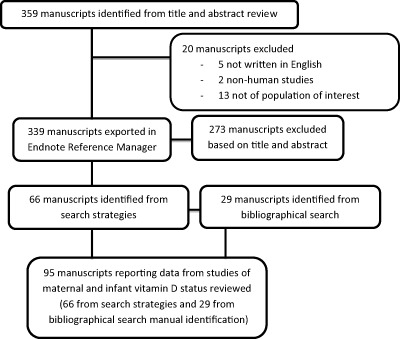
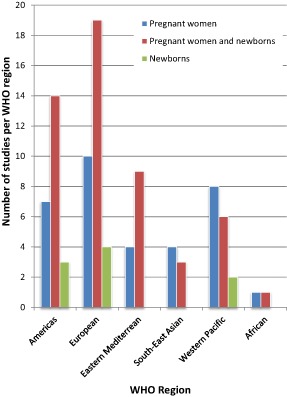
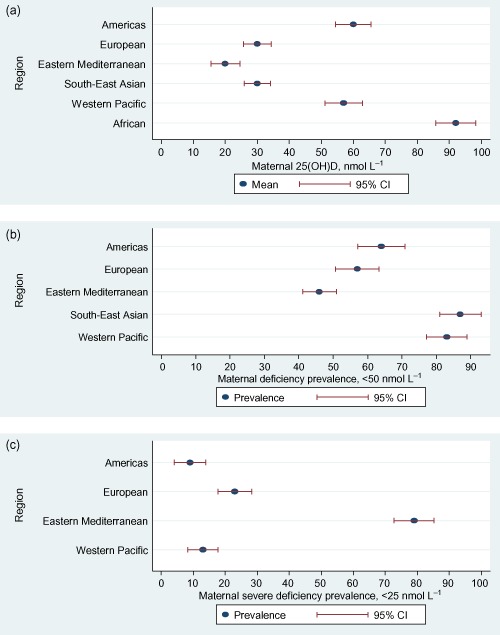
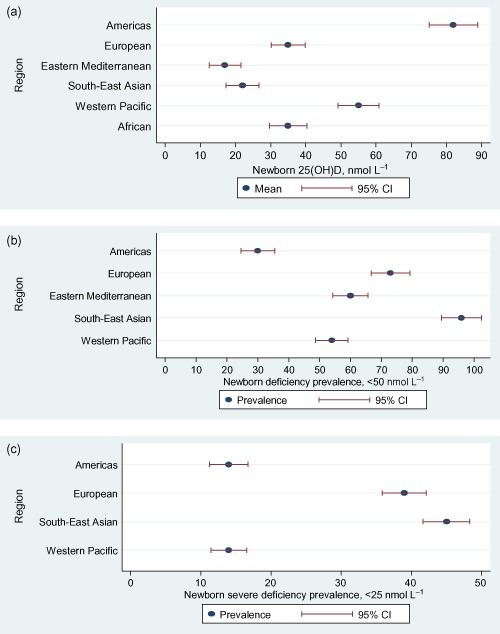
Pregnant women and newborns are at increased risk of vitamin D deficiency. Our objective was to create a global summary of maternal and newborn vitamin D status. We completed a systematic review (1959-2014) and meta-analysis of studies reporting serum 25-hydroxyvitamin D [25(OH)D] concentration in maternal and newborn populations. The 95 identified studies were unevenly distributed by World Health Organization (WHO) region: Americas (24), European (33), Eastern Mediterranean (13), South-East Asian (7), Western Pacific (16) and African (2). Average maternal 25(OH)D concentrations (nmol L(-1) ) by region were 47-65 (Americas), 15-72 (European), 13-60 (Eastern Mediterranean), 20-52 (South-East Asian), 42-72 (Western Pacific) and 92 (African). Average newborn 25(OH)D concentrations (nmol L(-1) ) were 35-77 (Americas), 20-50 (European), 5-50 (Eastern Mediterranean), 20-22 (South-East Asian), 32-67 (Western Pacific) and 27-35 (African). The prevalences of 25(OH)D <50 and <25 nmol L(-1) by WHO region in pregnant women were: Americas (64%, 9%), European (57%, 23%), Eastern Mediterranean (46%, 79%), South-East Asian (87%, not available) and Western Pacific (83%, 13%). Among newborns these values were: Americas (30%, 14%), European (73%, 39%), Eastern Mediterranean (60%, not available), South-East Asian (96%, 45%) and Western Pacific (54%, 14%). By global region, average 25(OH)D concentration varies threefold in pregnant women and newborns, and prevalence of 25(OH)D <25 nmol L(-1) varies eightfold in pregnant women and threefold in newborns. Maternal and newborn 25(OH)D concentrations are highly correlated. Addressing vitamin D deficiency in pregnant women and newborns should be a global priority. To protect children from the adverse effects of vitamin D deficiency requires appropriate interventions during both pregnancy and childhood.
Keywords: 25-hydroxyvitamin D; newborn; pregnancy; prevalence; vitamin D; vitamin D deficiency.
© 2015 John Wiley & Sons Ltd.
Conflict of interest statement
The authors declare that they have no conflicts of interest.
Figures
References
-
- Aghajafari F., Nagulesapillai T., Ronksley P., Tough S., O'Beirne M. & Rabi D. (2013) Association between maternal serum 25‐hydroxyvitamin D level and pregnancy and neonatal outcomes: systematic review and meta‐analysis of observational studies. British Medical Journal 346, 1–14. - PubMed
-
- Ainy E., Ghazi A. & Azizi F. (2006) Changes in calcium, 25(OH)D3 and other biochemical factors during pregnancy. Journal of Endocrinological Investigation 29, 303–307. - PubMed
-
- Ala‐Houhala M., Koskinen T., Parviainen M. & Visakorpi J. (1988) 25‐Hydroxyvitamin D and vitamin D in human milk: effects of supplementation and season. American Journal of Clinical Nutrition 48, 1057–1060. - PubMed
-
- Amukele T.K., Soko D., Katundu P., Kamanga M., Sun J., Kumwenda N.I. et al (2013) Vitamin D levels in Malawian infants from birth to 24 months. Archives of Disease in Childhood 98, 180–183. - PubMed
-
- Andiran N., Yordam N. & Ozon A. (2002) Risk factors for vitamin D deficiency in breast‐fed newborns and their mothers. Nutrition (Burbank, Los Angeles County, Calif.) 18, 47–50. - PubMed
Publication types
MeSH terms
Substances
LinkOut - more resources
Full Text Sources
Other Literature Sources
Medical
