


Sugar consumption, metabolic disease and obesity: The state of the controversy
- PMID: 26376619
- PMCID: PMC4822166
- DOI: 10.3109/10408363.2015.1084990
Sugar consumption, metabolic disease and obesity: The state of the controversy
Abstract
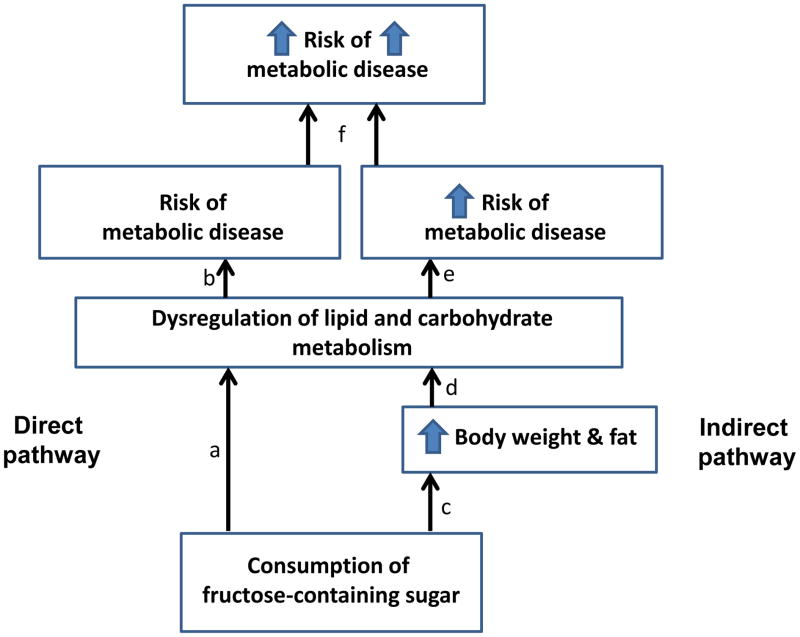
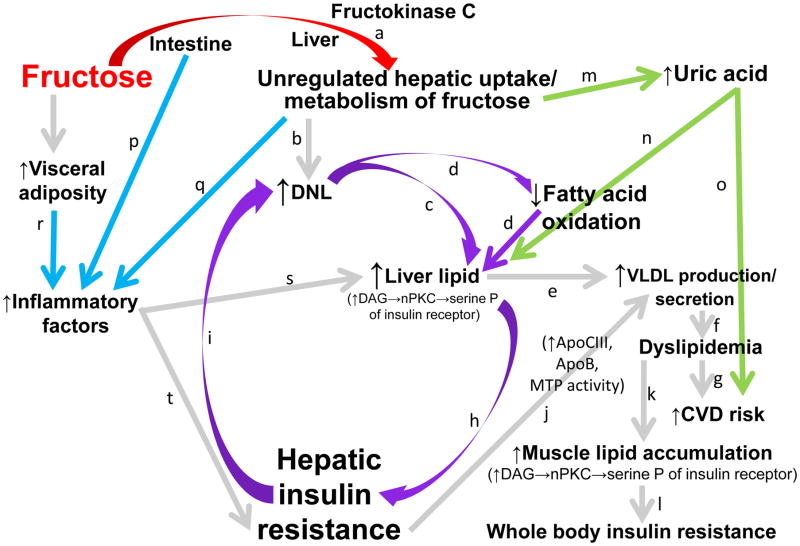
The impact of sugar consumption on health continues to be a controversial topic. The objective of this review is to discuss the evidence and lack of evidence that allows the controversy to continue, and why resolution of the controversy is important. There are plausible mechanisms and research evidence that supports the suggestion that consumption of excess sugar promotes the development of cardiovascular disease (CVD) and type 2 diabetes (T2DM) both directly and indirectly. The direct pathway involves the unregulated hepatic uptake and metabolism of fructose, leading to liver lipid accumulation, dyslipidemia, decreased insulin sensitivity and increased uric acid levels. The epidemiological data suggest that these direct effects of fructose are pertinent to the consumption of the fructose-containing sugars, sucrose and high fructose corn syrup (HFCS), which are the predominant added sugars. Consumption of added sugar is associated with development and/or prevalence of fatty liver, dyslipidemia, insulin resistance, hyperuricemia, CVD and T2DM, often independent of body weight gain or total energy intake. There are diet intervention studies in which human subjects exhibited increased circulating lipids and decreased insulin sensitivity when consuming high sugar compared with control diets. Most recently, our group has reported that supplementing the ad libitum diets of young adults with beverages containing 0%, 10%, 17.5% or 25% of daily energy requirement (Ereq) as HFCS increased lipid/lipoprotein risk factors for CVD and uric acid in a dose-response manner. However, un-confounded studies conducted in healthy humans under a controlled, energy-balanced diet protocol that enables determination of the effects of sugar with diets that do not allow for body weight gain are lacking. Furthermore, recent reports conclude that there are no adverse effects of consuming beverages containing up to 30% Ereq sucrose or HFCS, and the conclusions from several meta-analyses suggest that fructose has no specific adverse effects relative to any other carbohydrate. Consumption of excess sugar may also promote the development of CVD and T2DM indirectly by causing increased body weight and fat gain, but this is also a topic of controversy. Mechanistically, it is plausible that fructose consumption causes increased energy intake and reduced energy expenditure due to its failure to stimulate leptin production. Functional magnetic resonance imaging (fMRI) of the brain demonstrates that the brain responds differently to fructose or fructose-containing sugars compared with glucose or aspartame. Some epidemiological studies show that sugar consumption is associated with body weight gain, and there are intervention studies in which consumption of ad libitum high-sugar diets promoted increased body weight gain compared with consumption of ad libitum low- sugar diets. However, there are no studies in which energy intake and weight gain were compared in subjects consuming high or low sugar, blinded, ad libitum diets formulated to ensure both groups consumed a comparable macronutrient distribution and the same amounts of fiber. There is also little data to determine whether the form in which added sugar is consumed, as beverage or as solid food, affects its potential to promote weight gain. It will be very challenging to obtain the funding to conduct the clinical diet studies needed to address these evidence gaps, especially at the levels of added sugar that are commonly consumed. Yet, filling these evidence gaps may be necessary for supporting the policy changes that will help to turn the food environment into one that does not promote the development of obesity and metabolic disease.
Keywords: Cardiovascular disease; diet; high fructose corn syrup; metabolic syndrome; sucrose; triglyceride; type 2 diabetes; uric acid.
Conflict of interest statement
Dr. Stanhope has no conflicts of interest to report.
The studies conducted by Drs. Havel and Stanhope’s research group were supported with funding from NIH grants R01 HL-075675, 1R01 HL-091333, 1R01 HL-107256 and a Multi-campus Award from the University of California, Office of the President (UCOP #142691). These projects also received support from Grant Number UL1 RR024146 from the National Center for Research Resources (NCRR), a component of the National Institutes of Health (NIH), and NIH Roadmap for Medical Research. Dr. Stanhope is supported by a Building Interdisciplinary Research Careers in Women’s Health award (K12 HD051958) funded by the National Institute of Child Health and Human Development (NICHD), Office of Research on Women’s Health (ORWH), Office of Dietary Supplements (ODS), and the National Institute of Aging (NIA).
Figures
References
-
- Kahn R, Sievenpiper JL. Dietary sugar and body weight: have we reached a crisis in the epidemic of obesity and diabetes?: we have, but the pox on sugar is overwrought and overworked. Diabetes Care. 2014;37(4):957–62. - PubMed
-
- Are All Calories Created Equal? An Analysis of the Coca-Cola Company’s Communication in the Fight Against Obesity2014. 2015 Jun 4; Available from: http://www.awpagesociety.com/wp-content/uploads/2014/03/Coca-Cola_CaseSt....
-
- Coca-Cola Joins America’s Beverage Companies and the Alliance for a Healthier Generation in Landmark Partnership to Promote Healthy Lifestyles 2014. 2015 Jun 4; Available from: http://www.coca-colacompany.com/coca-cola-unbottled-old/coca-cola-joins-....
Publication types
MeSH terms
Substances
Grants and funding
LinkOut - more resources
Full Text Sources
Other Literature Sources
Medical
