. 2015 Sep 16:15:197.
doi: 10.1186/s12862-015-0477-z.

Limited genomic divergence between intraspecific forms of Culex pipiens under different ecological pressures

Affiliations

Limited genomic divergence between intraspecific forms of Culex pipiens under different ecological pressures

Bruno Gomes et al. BMC Evol Biol. .

Abstract

Background: Divergent selection can be a major driver of ecological speciation. In insects of medical importance, understanding the speciation process is both of academic interest and public health importance. In the West Nile virus vector Culex pipiens, intraspecific pipiens and molestus forms vary in ecological and physiological traits. Populations of each form appear to share recent common ancestry but patterns of genetic differentiation across the genome remain unknown. Here, we undertook an AFLP genome scan on samples collected from both sympatric and allopatric populations from Europe and the USA to quantify the extent of genomic differentiation between the two forms.

Results: The forms were clearly differentiated but each exhibited major population sub-structuring between continents. Divergence between pipiens and molestus forms from USA was higher than in both inter- and intra-continental comparisons with European samples. The proportion of outlier loci between pipiens and molestus (≈3 %) was low but consistent in both continents, and similar to those observed between sibling species of other mosquito species which exhibit contemporary gene flow. Only two of the outlier loci were shared between inter-form comparisons made within Europe and USA.

Conclusion: This study supports the molestus and pipiens status as distinct evolutionary entities with low genomic divergence. The low number of shared divergent loci between continents suggests a relatively limited number of genomic regions determining key typological traits likely to be driving incipient speciation and/or adaptation of molestus to anthropogenic habitats.


Figures

Fig. 1
Fig. 1
Bayesian cluster analysis conducted by STRUCTURE [21]. a analysis with the eight populations of Cx. pipiens s.s. b analysis within the populations of each form. M_Ch: molestus from Chicago; M_Al: molestus from Alqueva; M_CS: molestus from Comporta, collected inside shelters; M_Sa: molestus from Sandim; P_Ch: pipiens from Chicago; P_CC: pipiens from Comporta, collected in trees by CDC light traps; P_CS: pipiens from Comporta, collected inside shelters; P_Wi: pipiens from Wirral. Columns correspond to the multilocus genotype of each individual, partitioned in different colours representing the probability of ancestry (q i) to each cluster. Individuals were grouped according to their geographic location. Lines indicate the q i = 0.50
Fig. 2
Fig. 2
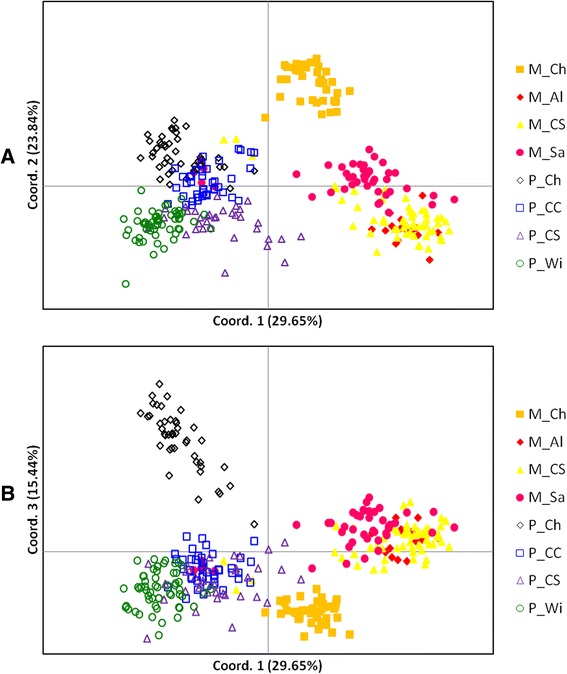
Principal Coordinates Analysis of the eight Cx. pipiens s.s. samples conducted by GENALEX 6.41 [22]. a two-dimensional plots of principal coordinates 1 and 2; b two-dimensional plots of principal coordinates 1 and 3. M_Ch: molestus from Chicago; M_Al: molestus from Alqueva; M_CS: molestus from Comporta, collected inside shelters; M_Sa: molestus from Sandim; P_Ch: pipiens from Chicago; P_CC: pipiens from Comporta, collected in trees by CDC light traps; P_CS: pipiens from Comporta, collected inside shelters; P_Wi: pipiens from Wirral. Coord: coordinate (percentage of variation explained by each coordinate)
Fig. 3
Fig. 3
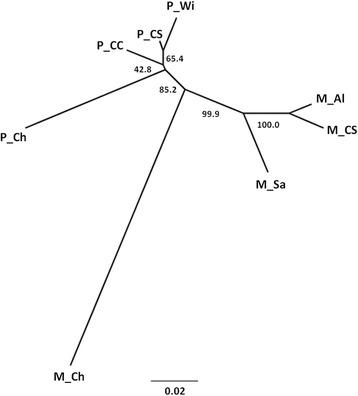
Unrooted Neighbour-joining tree based on F ST values. Bootstrap (%) support of each branch is given. M_Ch: molestus from Chicago; M_Al: molestus from Alqueva; M_CS: molestus from Comporta, collected inside shelters; M_Sa: molestus from Sandim; P_Ch: pipiens from Chicago; P_CC: pipiens from Comporta, collected in trees by CDC light traps; P_CS: pipiens from Comporta, collected inside shelters; P_Wi: pipiens from Wirral
Fig. 4
Fig. 4
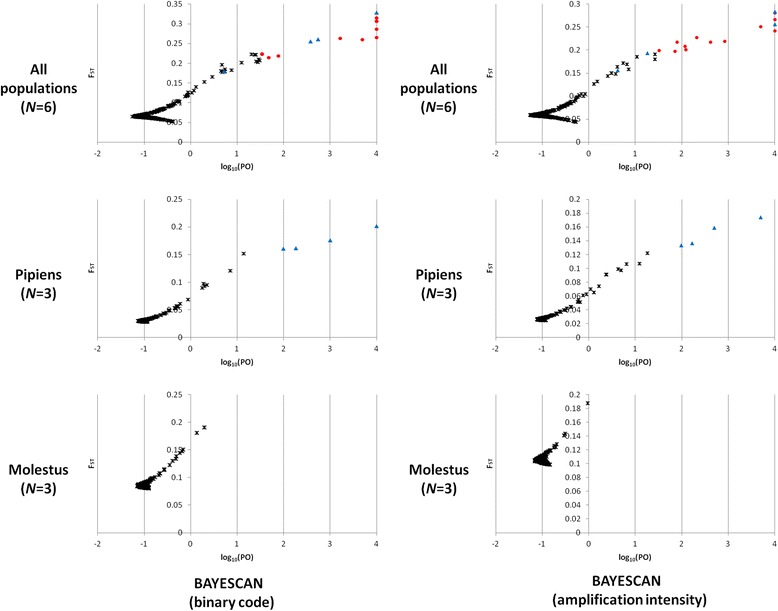
Outlier detection results from BAYESCAN [25, 26] analyses of European populations. N: number of samples; Black asterisks: non-outlier loci (log10(PO) < 1.5); Blue triangle: outlier loci within form analysis (log10(PO) ≥ 1.5); Red dot: outlier loci between pipiens and molestus (log10(PO) ≥ 1.5 only for all populations outlier analysis). Note that logarithm of Posterior Odds to base 10 (log10(PO)) is arbitrarily fixed to 4 when the posterior probability is 1 (should be infinity)
Fig. 5
Fig. 5
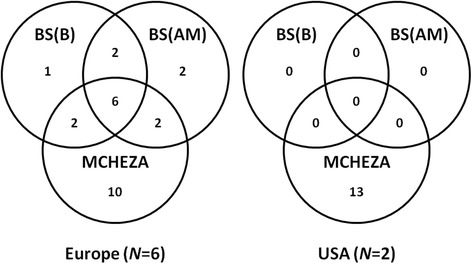
Number of loci detected as outliers in Europe and USA by each method and replicated as outliers in multiple methods. BS(B): BAYESCAN with binary code [25]; BS(AM) BAYESCAN with amplification intensity matrix [26]; MCHEZA: MCHEZA with binary code [27]; N: number of samples

References

    1. Hopkins R, Rausher MD. Identification of two genes causing reinforcement in the Texas wildflower Phlox drummondii. Nature. 2011;469:411–4. doi: 10.1038/nature09641. - DOI - PubMed
    1. Nosil P. Degree of sympatry affects reinforcement in Drosophila. Evolution. 2012;67:868–72. doi: 10.1111/j.1558-5646.2012.01817.x. - DOI - PubMed
    1. Nosil P, Harmon LJ, Seehausen O. Ecological explanations for (incomplete) speciation. Trends Ecol Evol. 2009;24:145–56. doi: 10.1016/j.tree.2008.10.011. - DOI - PubMed
    1. Wu C-I. The genic view of the process of speciation. J Evol Biol. 2001;14:851–65. doi: 10.1046/j.1420-9101.2001.00335.x. - DOI
    1. Michel AP, Sim S, Powell THQ, Taylor MS, Nosil P, Feder JL. Widespread genomic divergence during sympatric speciation. Proc Natl Acad Sci U S A. 2010;107:9724–9. doi: 10.1073/pnas.1000939107. - DOI - PMC - PubMed

Publication types

LinkOut - more resources