


Four-dimensional flow magnetic resonance imaging-based characterization of aortic morphometry and haemodynamics: impact of age, aortic diameter, and valve morphology
- PMID: 26377908
- PMCID: PMC4955292
- DOI: 10.1093/ehjci/jev228
Four-dimensional flow magnetic resonance imaging-based characterization of aortic morphometry and haemodynamics: impact of age, aortic diameter, and valve morphology
Abstract
Aims: Four-dimensional (4D) flow magnetic resonance imaging (MRI) was employed for the simultaneous assessment of morphometry and flow parameters along the thoracic aorta to investigate associations between flow, age, aorta diameter, and aortic valve morphology.
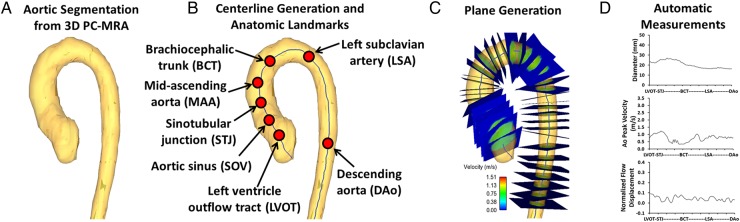
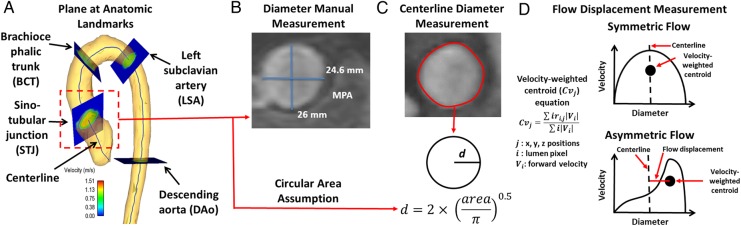
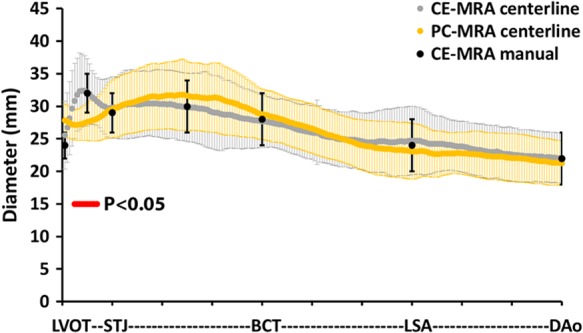
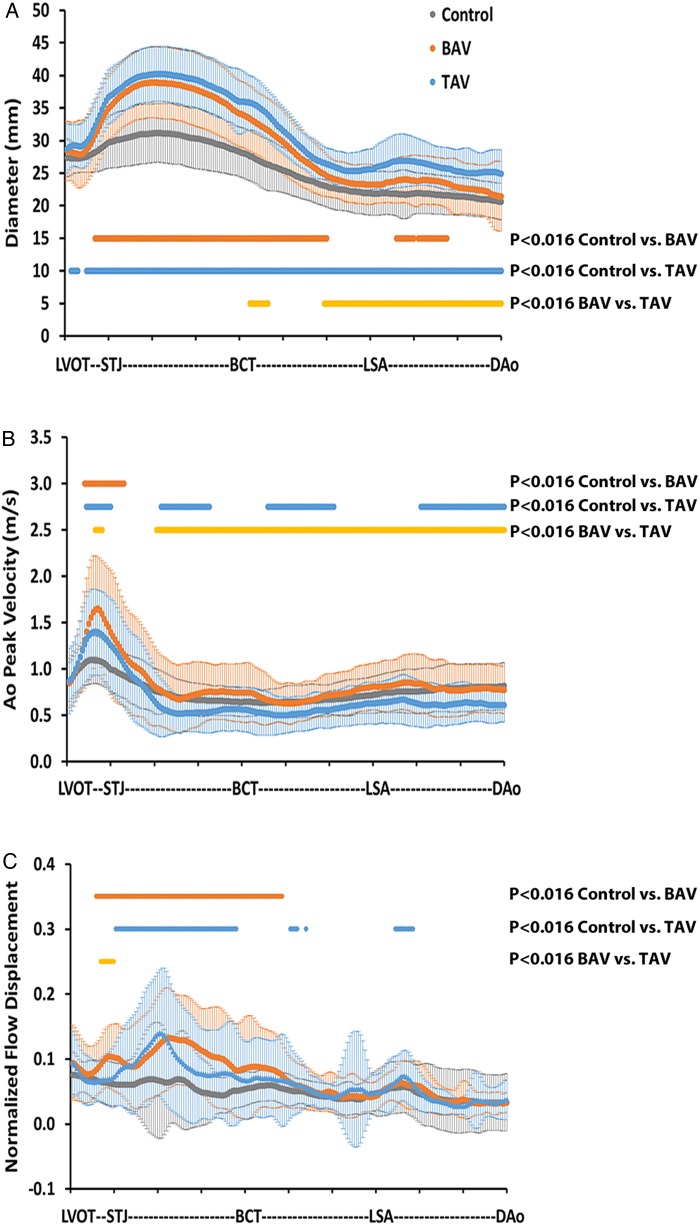
Methods and results: One hundred and sixty-five subjects, 65 controls, 50 patients with bicuspid aortic valve (BAV), and 50 patients with a dilated aorta, and a tricuspid aortic valve (TAV) underwent 4D flow MRI. Following 3D segmentation of the aorta, a vessel centreline was calculated and used to extract aorta diameter, peak systolic velocity, and normalized systolic flow displacement. Validation of 4D flow MRI-based morphometric measurements compared with manual diameter measurements from standard contrast-enhanced MR angiography in 20 controls showed good agreement (mean difference = 0.4 mm, limits of agreement = ±1.31 mm) except at the sinus of valsalva. BAV showed significant differences in average peak velocity (PV; P < 0.016) compared with TAV and controls between the left ventricle outflow tract to sino-tubular junction (BAV: 1.3 ± 0.3 m/s; TAV: 1.2 ± 0.2 m/s; controls: 1.0 ± 0.1 m/s) and the ascending aorta for average normalized flow displacement (BAV: 0.11 ± 0.02; TAV: 0.09 ± 0.02; controls: 0.06 ± 0.01, P < 0.016) despite similar average aortic dimensions for BAV (37 ± 1 mm) and TAV (39 ± 1 mm). Multivariate linear regression showed a significant correlation of maximal aortic diameter to age, PV, and normalized flow displacement (R(2) = 0.413, P < 0.001).
Conclusion: A single acquisition of 4D flow MRI characterized local morphological and haemodynamic differences between groups along the aorta. BAV showed altered haemodynamics when compared with TAV in spite of having similar aorta dimensions. Maximal aorta diameter was associated with age, PV, and normalized flow displacement.
Keywords: Aortic diseases; Haemodynamics; Magnetic resonance imaging.
Published on behalf of the European Society of Cardiology. All rights reserved. © The Author 2015. For permissions please email: journals.permissions@oup.com.
Figures
References
-
- Verma S, Siu SC. Aortic dilatation in patients with bicuspid aortic valve. N Engl J Med 2014;370:1920–9. - PubMed
-
- Erbel R, Aboyans V, Boileau C, Bossone E, Bartolomeo RD, Eggbrech H et al. ESC Guidelines on the diagnosis and treatment of aortic diseases. Eur Heart J 2014;35:2873–926. - PubMed
-
- Vahanian A, Alfieri O, Andreotti F, Antunes MJ, Barón-Esquivias G, Baumgartner H et al. Guidelines on the management of valvular heart disease. Eur Heart J 2012;33:2451–96. - PubMed
Publication types
MeSH terms
Grants and funding
LinkOut - more resources
Full Text Sources
Other Literature Sources
Medical
