


Nuclear autonomy in multinucleate fungi
- PMID: 26379197
- PMCID: PMC4688108
- DOI: 10.1016/j.mib.2015.08.009
Nuclear autonomy in multinucleate fungi
Abstract
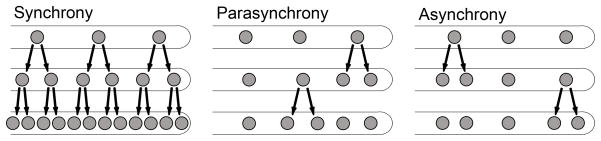
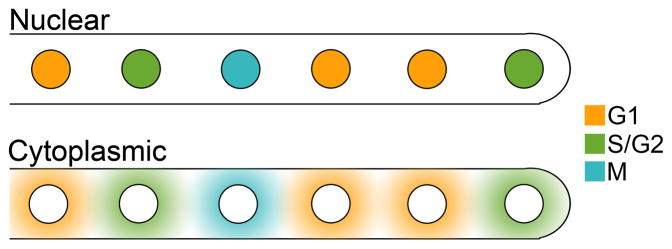
Within many fungal syncytia, nuclei behave independently despite sharing a common cytoplasm. Creation of independent nuclear zones of control in one cell is paradoxical considering random protein synthesis sites, predicted rapid diffusion rates, and well-mixed cytosol. In studying the surprising fungal nuclear autonomy, new principles of cellular organization are emerging. We discuss the current understanding of nuclear autonomy, focusing on asynchronous cell cycle progression where most work has been directed. Mechanisms underlying nuclear autonomy are diverse including mRNA localization, ploidy variability, and nuclear spacing control. With the challenges fungal syncytia face due to cytoplasmic size and shape, they serve as powerful models for uncovering new subcellular organization modes, variability sources among isogenic uninucleate cells, and the evolution of multicellularity.
Copyright © 2015 Elsevier Ltd. All rights reserved.
Figures
References
-
- Johnson RT, Rao PN. Nucleo-cytoplasmic interactions in the achievement of nuclear synchrony in DNA synthesis and mitosis in multinucleate cells. Biol Rev Camb Philos Soc. 1971;46:97–155. - PubMed
-
- Howard FL. Nuclear Division in Plasmodia of Physarum. Ann Bot. 1932;46:461–477.
-
- Nygaard OF, Güttes S, Rusch HP. Nucleic acid metabolism in a slime mold with synchronous mitosis. Biochim Biophys Acta. 1960;38:298–306. - PubMed
-
- Sudbery PE, Grant WD. The control of mitosis in Physarum polycephalum: the effect of delaying mitosis and evidence for the operation of the control mechanism in the absence of growth. J Cell Sci. 1976;22:59–65. - PubMed
Publication types
MeSH terms
Grants and funding
LinkOut - more resources
Full Text Sources
Other Literature Sources
Medical
