. 2015 Aug 25:6:1185.
doi: 10.3389/fpsyg.2015.01185. eCollection 2015.

Temporal prediction errors modulate task-switching performance

Affiliations

Temporal prediction errors modulate task-switching performance

Roberto Limongi et al. Front Psychol. .

Abstract

We have previously shown that temporal prediction errors (PEs, the differences between the expected and the actual stimulus' onset times) modulate the effective connectivity between the anterior cingulate cortex and the right anterior insular cortex (rAI), causing the activity of the rAI to decrease. The activity of the rAI is associated with efficient performance under uncertainty (e.g., changing a prepared behavior when a change demand is not expected), which leads to hypothesize that temporal PEs might disrupt behavior-change performance under uncertainty. This hypothesis has not been tested at a behavioral level. In this work, we evaluated this hypothesis within the context of task switching and concurrent temporal predictions. Our participants performed temporal predictions while observing one moving ball striking a stationary ball which bounced off with a variable temporal gap. Simultaneously, they performed a simple color comparison task. In some trials, a change signal made the participants change their behaviors. Performance accuracy decreased as a function of both the temporal PE and the delay. Explaining these results without appealing to ad hoc concepts such as "executive control" is a challenge for cognitive neuroscience. We provide a predictive coding explanation. We hypothesize that exteroceptive and proprioceptive minimization of PEs would converge in a fronto-basal ganglia network which would include the rAI. Both temporal gaps (or uncertainty) and temporal PEs would drive and modulate this network respectively. Whereas the temporal gaps would drive the activity of the rAI, the temporal PEs would modulate the endogenous excitatory connections of the fronto-striatal network. We conclude that in the context of perceptual uncertainty, the system is not able to minimize perceptual PE, causing the ongoing behavior to finalize and, in consequence, disrupting task switching.

Keywords: cognitive neuroscience; insular cortex; prediction errors; predictive coding; response inhibition.


Figures
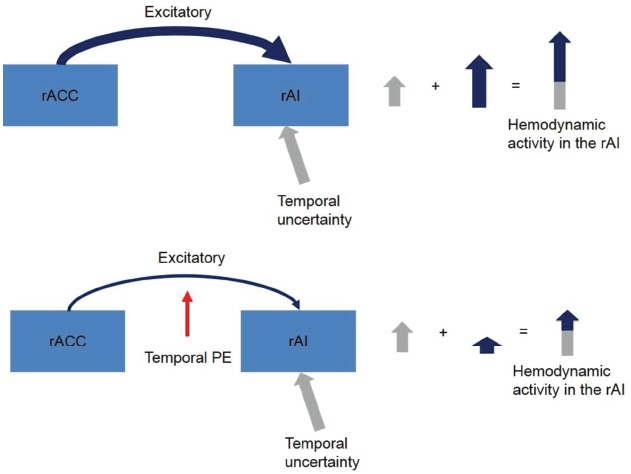
FIGURE 1
FIGURE 1
Driving and modulatory effects of temporal uncertainty and temporal PEs in the rACC-rAI coupling as reported by Limongi et al. (2013). When participants accurately predict an event’s onset time, the activity of the rAI increases. Additional insular activation is provided by afferent excitatory projections from the rACC. This extra excitatory effect is dampened by temporal PEs which suggests that when participants fail to accurately predict an event’s onset time the performance of an unexpected secondary-task demand decreases. Notice that in DCM endogenous connections are assumed excitatory.
FIGURE 2
FIGURE 2
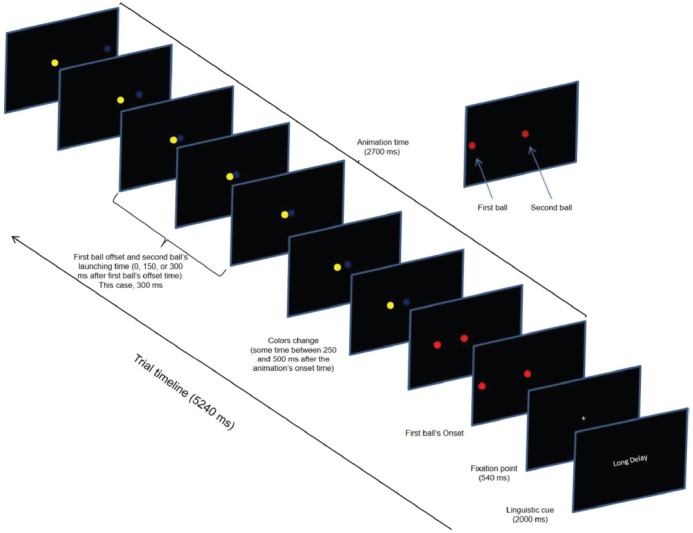
Timeline of a single experimental trial depicting the long delay temporal gap during the change condition of the task.
FIGURE 3
FIGURE 3
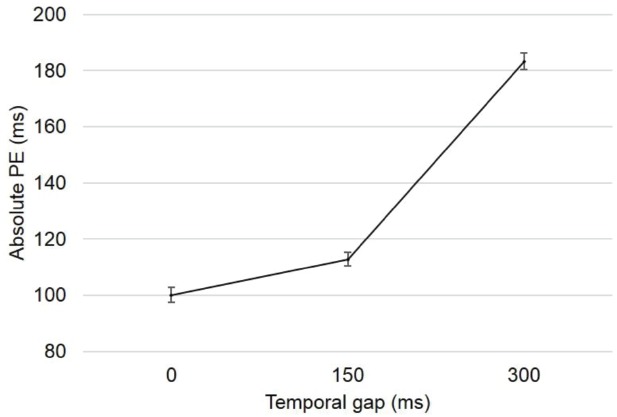
Absolute PEs as a function of the temporal gaps.
FIGURE 4
FIGURE 4
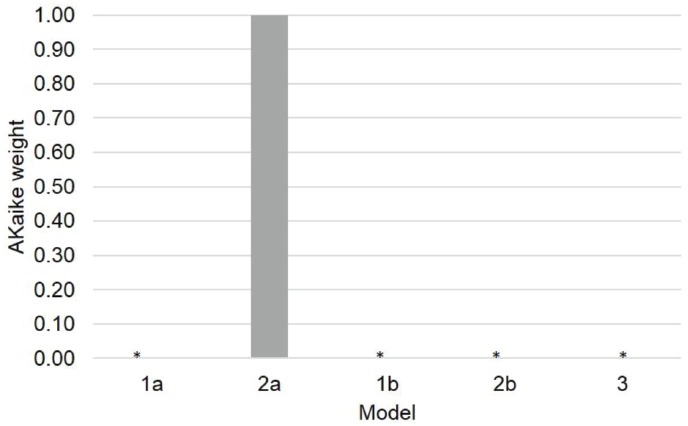
Akaike weights of the hypothesized models. The Akaike weights show the support that each model receives from the data relative to all of the other models within a specific model space.*Akaike weight approaches 0.
FIGURE 5
FIGURE 5
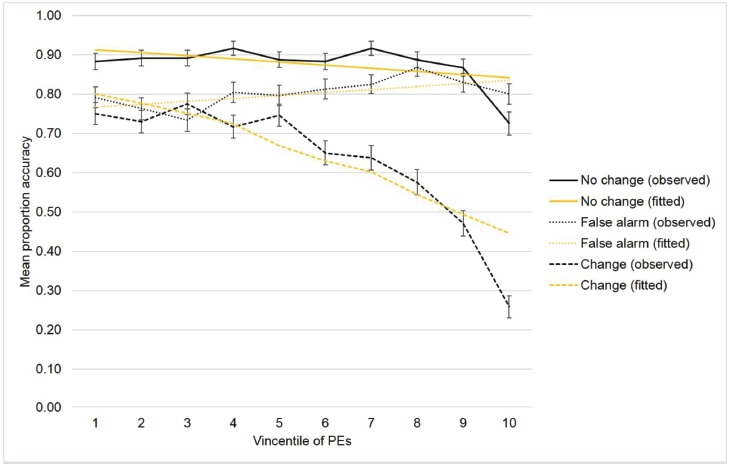
Observed and fitted performance accuracy as a function of the PEs across the three task conditions. PEs are represented in terms of Vincentiles.
FIGURE 6
FIGURE 6
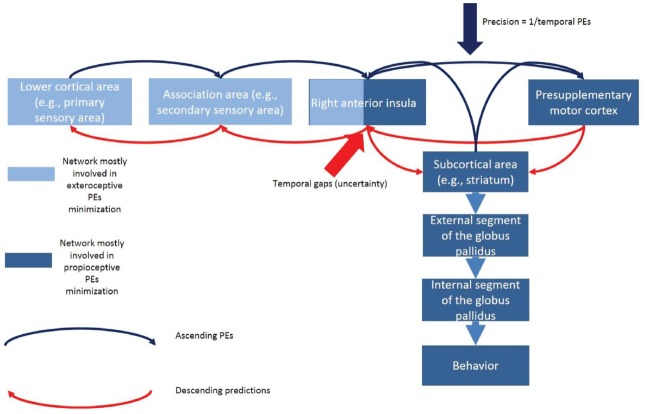
Hypothetical model of the exteroceptive and proprioceptive PEs minimization in the context of task switching during temporal predictions. The rAI links a circuit mostly engaged in minimization of exteroceptive PEs (associated with temporal predictions) with a circuit mostly engaged in the minimization of the proprioceptive PEs (associated with the control of action). Temporal uncertainty would drive the activity of the exteroceptive circuit whereas temporal PEs would modulate the effective connectivity of the fronto-basal ganglia network (the proprioceptive circuit). We hypothesize that whereas the activity of the rAI would facilitate temporal estimation, temporal PEs would negatively modulate the behavior-change performance. The net effect would be the execution of the anticipatorily prepared (but innacurate) behavior which would release proprioceptive-related free energy that could not be minimized via the exteroceptive circuit.

References

    1. Adams R. A., Perrinet L. U., Friston K. J. (2012). Smooth pursuit and visual occlusion: active inference and oculomotor control in schizophrenia. PLoS ONE 7:e47502. 10.1371/journal.pone.0047502 - DOI - PMC - PubMed
    1. Adams R. A., Shipp S., Friston K. J. (2013). Predictions not commands: active inference in the motor system. Brain Struc. Funct. 218, 611–643. 10.1007/s00429-012-0475-5 - DOI - PMC - PubMed
    1. Alexander W. H., Brown J. W. (2010). Computational models of performance monitoring and cognitive control. Top. Cogn. Sci. 2, 658–677. 10.1111/j.1756-8765.2010.01085.x - DOI - PMC - PubMed
    1. Alexander W. H., Brown J. W. (2011). Medial prefrontal cortex as an action-outcome predictor. Nat. Neurosci. 14, 1338–1344. 10.1038/nn.2921 - DOI - PMC - PubMed
    1. Anderson D. R. (2008). Model Based Inference in Life Sciences: A Primer on Evidence. New York: Springer.

LinkOut - more resources