. 2015:2015:154762.
doi: 10.1155/2015/154762. Epub 2015 Aug 25.

Inhibition of Ceramide De Novo Synthesis Ameliorates Diet Induced Skeletal Muscles Insulin Resistance

Affiliations

Inhibition of Ceramide De Novo Synthesis Ameliorates Diet Induced Skeletal Muscles Insulin Resistance

Krzysztof Kurek et al. J Diabetes Res. 2015.

Abstract

Nowadays wrong nutritional habits and lack of physical activity give a rich soil for the development of insulin resistance and obesity. Many researches indicate lipids, especially the one from the sphingolipids class, as the group of molecules heavily implicated in the progress of insulin resistance in skeletal muscle. Recently, scientists have focused their scrutiny on myriocin, a potent chemical compound that inhibits ceramide (i.e., central hub of sphingolipids signaling pathway) de novo synthesis. In the present research we evaluated the effects of myriocin application on type 2 diabetes mellitus in three different types of skeletal muscles: (1) slow-oxidative (red gastrocnemius), (2) oxidative-glycolytic (soleus), and (3) glycolytic (white gastrocnemius). For these reasons the animals were randomly divided into four groups: "control" (C), "myriocin" (M), "high fat diet" (HFD), "high fat diet" (HFD), and "high fat diet + myriocin" (HFD + M). Our in vivo study demonstrated that ceramide synthesis inhibition reduces intramuscular ceramide, its precursor sphinganine, and its derivatives sphingosine and sphingosine-1-phosphate concentrations. Moreover, FFA and TG contents were also decreased after myriocin treatment. Thus, myriocin presents potential therapeutic perspectives with respect to the treatment of insulin resistance and its serious consequences in obese patients.


Figures
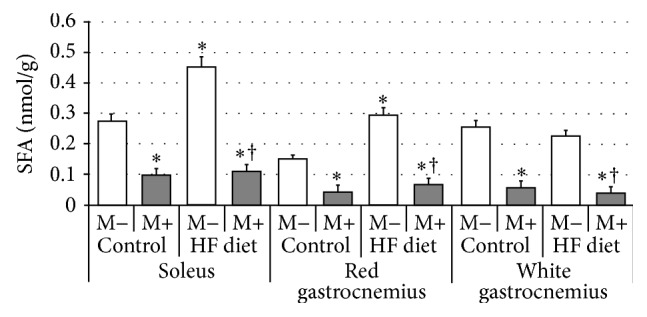
Figure 1
Figure 1
Effect of high-fat diet (HFD) feeding (5 weeks) and/or myriocin application (7 days) on sphinganine (SFA) content in skeletal muscles (n (per group) = 8). M+: rats administered with myriocin. M−: untreated group. Results are expressed as means ± SD. p < 0.05 compared with control group. p < 0.05 compared with HF diet group.
Figure 2
Figure 2
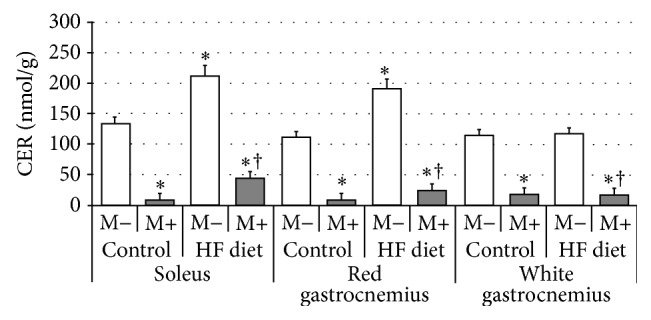
Effect of high-fat diet (HFD) feeding (5 weeks) and/or myriocin application (7 days) on ceramide (CER) content in skeletal muscles (n (per group) = 8). M+: rats administered with myriocin. M−: untreated group. Results are expressed as means ± SD. p < 0.05 compared with control group. p < 0.05 compared with HF diet group.
Figure 3
Figure 3
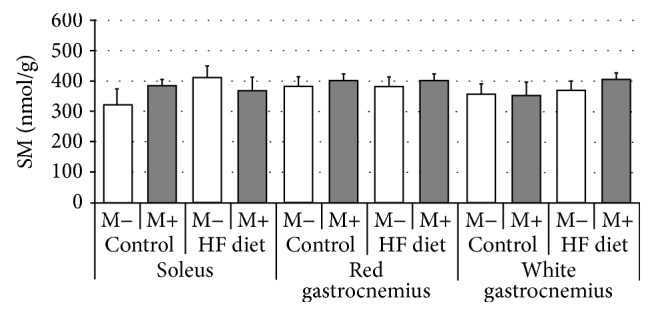
Effect of high-fat diet (HFD) feeding (5 weeks) and/or myriocin application (7 days) on sphingomyelin (SM) content in skeletal muscles (n (per group) = 8). M+: rats administered with myriocin. M−: untreated group. Results are expressed as means ± SD.
Figure 4
Figure 4
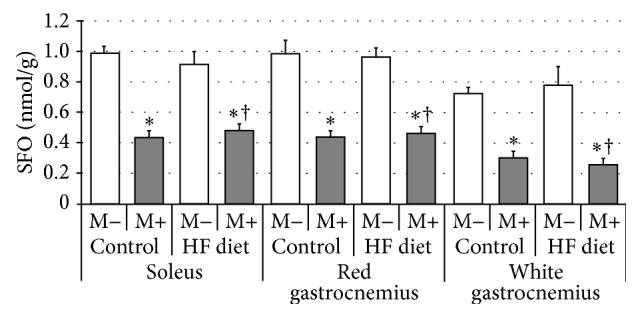
Effect of high-fat diet (HFD) feeding (5 weeks) and/or myriocin application (7 days) on sphingosine (SFO) content in skeletal muscles (n (per group) = 8). M+: rats administered with myriocin. M−: untreated group. Results are expressed as means ± SD. p < 0.05 compared with control group. p < 0.05 compared with HF diet group.
Figure 5
Figure 5
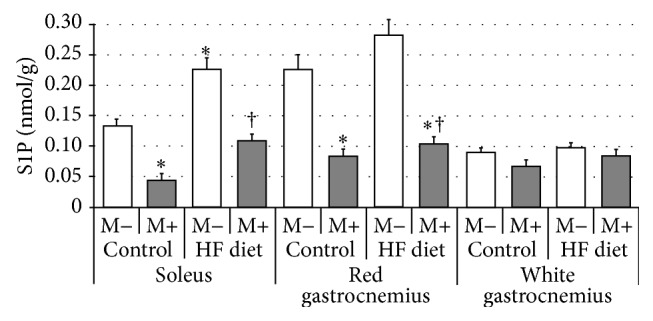
Effect of high-fat diet (HFD) feeding (5 weeks) and/or myriocin application (7 days) on sphingosine-1-phosphate (S1P) content in skeletal muscles (n (per group) = 8). M+: rats administered with myriocin. M−: untreated group. Results are expressed as means ± SD. p < 0.05 compared with control group. p < 0.05 compared with HF diet group.
Figure 6
Figure 6
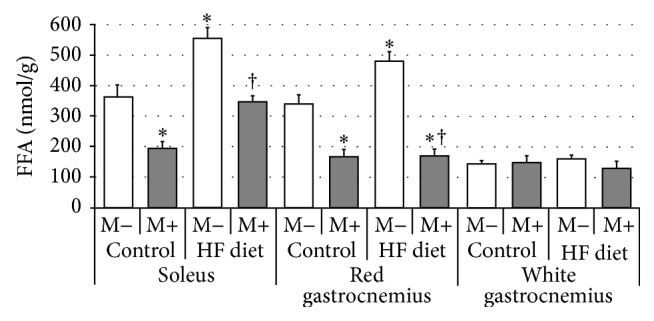
Effect of high-fat diet (HFD) feeding (5 weeks) and/or myriocin application (7 days) on free fatty acids (FFA) content in skeletal muscles (n (per group) = 8). M+: rats administered with myriocin. M−: untreated group. Results are expressed as means ± SD. p < 0.05 compared with control group. p < 0.05 compared with HF diet group.
Figure 7
Figure 7
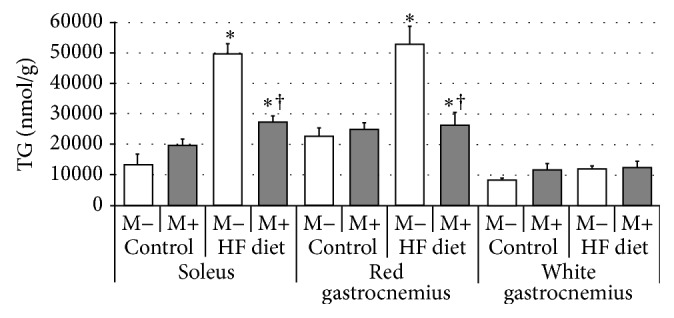
Effect of high-fat diet (HFD) feeding (5 weeks) and/or myriocin application (7 days) on triacylglycerols (TG) content in skeletal muscles (n (per group) = 8). M+: rats administered with myriocin. M−: untreated group. Results are expressed as means ± SD. p < 0.05 compared with control group. p < 0.05 compared with HF diet group.

References

    1. Kiens B. Skeletal muscle lipid metabolism in exercise and insulin resistance. Physiological Reviews. 2006;86(1):205–243. doi: 10.1152/physrev.00023.2004. - DOI - PubMed
    1. Zhang L., Keung W., Samokhvalov V., Wang W., Lopaschuk G. D. Role of fatty acid uptake and fatty acid β-oxidation in mediating insulin resistance in heart and skeletal muscle. Biochimica et Biophysica Acta. 2010;1801(1):1–22. doi: 10.1016/j.bbalip.2009.09.014. - DOI - PubMed
    1. Denis McGarry J. Dysregulation of fatty acid metabolism in the etiology of type 2 diabetes. Diabetes. 2002;51(1):7–18. doi: 10.2337/diabetes.51.1.7. - DOI - PubMed
    1. Petersen K. F., Dufour S., Savage D. B., et al. The role of skeletal muscle insulin resistance in the pathogenesis of the metabolic syndrome. Proceedings of the National Academy of Sciences of the United States of America. 2007;104(31):12587–12594. doi: 10.1073/pnas.0705408104. - DOI - PMC - PubMed
    1. Bonen A., Parolin M. L., Steinberg G. R., et al. Triacylglycerol accumulation in human obesity and type 2 diabetes is associated with increased rates of skeletal muscle fatty acid transport and increased sarcolemmal FAT/CD36. The FASEB Journal. 2004;18(10):1144–1146. doi: 10.1096/fj.03-1065fje. - DOI - PubMed

Publication types

MeSH terms