


Training Medical Specialists to Communicate Better with Patients with Medically Unexplained Physical Symptoms (MUPS). A Randomized, Controlled Trial
- PMID: 26381400
- PMCID: PMC4575077
- DOI: 10.1371/journal.pone.0138342
Training Medical Specialists to Communicate Better with Patients with Medically Unexplained Physical Symptoms (MUPS). A Randomized, Controlled Trial
Abstract
Background: Patients with medically unexplained physical symptoms (MUPS) are prevalent 25-50% in general and specialist care. Medical specialists and residents often find patients without underlying pathology difficult to deal with, whereas patients sometimes don't feel understood. We developed an evidence-based communication training, aimed to improve specialists' interviewing, information-giving and planning skills in MUPS consultations, and tested its effectiveness.
Methods: The intervention group in this multi-center randomized controlled trial received a 14-hour training program to which experiential learning and feedback were essential. Using techniques from Cognitive Behavioral Therapy, they were stimulated to seek interrelating factors (symptoms, cognitions, emotions, behavior, and social environment) that reinforced a patient's symptoms. They were taught to explain MUPS understandably, reassure patients effectively and avoid unnecessary diagnostic testing. Before and after the intervention training, specialists videotaped a total of six consultations with different MUPS patients. These were evaluated to assess doctors' MUPS-focused communicating skills using an adapted version of the Four Habit Coding Scheme on five-point Likert scales. Participants evaluated the training by self-report on three-point Likert scales. Doctors in the control group received training after completion of the study.
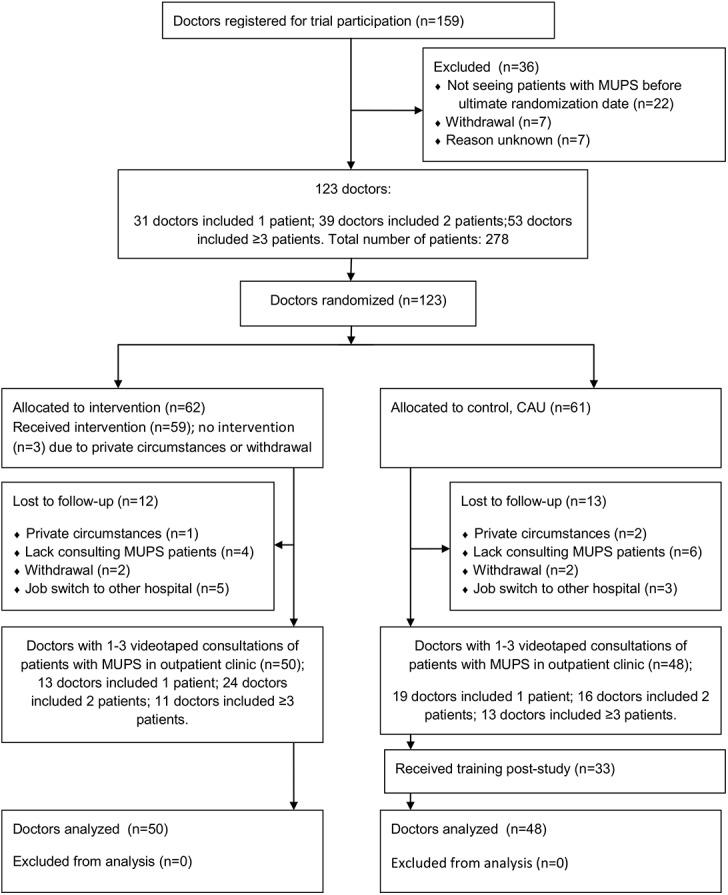
Results: 123 doctors (40% specialists, 60% residents) and 478 MUPS patients from 11 specialties were included; 98 doctors completed the study (80%) and 449 videotaped consultations were assessed. Trained doctors interviewed patients more effectively than untrained ones (p < 0.001), summarized information in a more patient-centered way (p = 0.001), and better explained MUPS and the role of perpetuating factors (p < 0.05). No effects on planning skills were found. On a 3-point scale the training was evaluated with 2.79.
Conclusion: MUPS-focused communication training increases the interviewing and information-giving skills of medical specialists. We recommend that the training is incorporated in postgraduate education for medical specialists and residents who frequently encounter patients with MUPS.
Trial registration: Dutch Trial Registration NTR2612.
Conflict of interest statement
Figures
References
-
- Olde Hartman TC, Borghuis M, Lucassen PL, Van de Laar FA, Speckens AE, Van Weel C. Medically unexplained symptoms, somatisation disorder and hypochondriasis: course and prognosis. A systematic review. J Psychosom Res. 2009;May;66(5):363–77. Epub 2008 Dec 16. PubMed Central PMCID: [PubMed—indexed for MEDLINE] 10.1016/j.jpsychores.2008.09.018 - DOI - PubMed
Publication types
MeSH terms
Associated data
LinkOut - more resources
Full Text Sources
Other Literature Sources
Medical
