. 2015 Sep 17:15:378.
doi: 10.1186/s12879-015-1110-x.

Emergence and evolution of internationally disseminated cephalosporin-resistant Neisseria gonorrhoeae clones from 1995 to 2005 in Japan

Affiliations

Emergence and evolution of internationally disseminated cephalosporin-resistant Neisseria gonorrhoeae clones from 1995 to 2005 in Japan

Ken Shimuta et al. BMC Infect Dis. .

Abstract

Background: Neisseria gonorrhoeae strains with resistance to extended-spectrum cephalosporins (ESCs), last options for first-line monotherapy of gonorrhoea, likely emerged and initially disseminated in Japan, followed by international transmission. In recent years, multi-locus sequence typing (MLST) ST1901 and N. gonorrhoeae multiantigen sequence typing (NG-MAST) ST1407 isolates with the mosaic penicillin-binding protein (PBP) 2 XXXIV have accounted for most ESC resistance globally. Our aim was to elucidate the initial emergence and transmission of ESC-resistant strains by detailed examination of N. gonorrhoeae isolates from 1995 to 2005 in Kanagawa, Japan.

Methods: N. gonorrhoeae isolates were examined phenotypically (n = 690) and genetically (n = 372) by agar dilution method (cefixime, ceftriaxone and ciprofloxacin), penA gene sequencing, MLST and NG-MAST.

Results: Already in 1995, one cefixime-resistant (CFM-R) isolate was found, which is the first CFM-R isolate described globally. After 1996, the prevalence of CFM-R and CFM-decreased susceptibility (CFM-DS) isolates significantly increased, with the peak resistance level in 2002 (57.1% CFM-R). In 1997-2002, the CFM-R MLST ST7363 strain type with the mosaic PBP 2 X was predominant among CFM-R/DS isolates. The first CFM-R/DS MLST ST1901 clone(s), which became the predominant CFM-R/DS strain type(s) already in 2003-2005, possessed the mosaic PBP 2 X, which was possibly originally transferred from the MLST ST7363 strains, and subsequently acquired the mosaic PBP 2 XXXIV. The first MLST ST1901 and NG-MAST ST1407 isolate was identified in Kanagawa already in 2003.

Conclusions: The two main internationally spread cefixime-resistant gonococcal clones, MLST ST7363 and ST1901 (NG-MAST ST1407 most frequent internationally) that also have shown their capacity to develop high-level ceftriaxone resistance (superbugs H041 and F89), likely emerged, evolved and started to disseminate in the metropolitan area, including Kanagawa, in Japan, which was followed by global transmission.


Figures
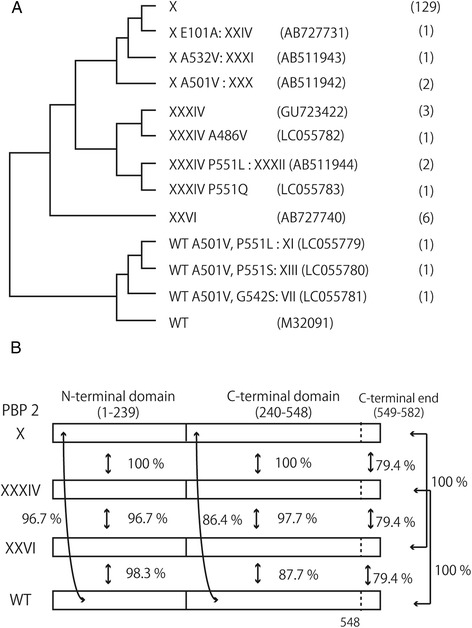
Fig. 1
Fig. 1
Neisseria gonorrhoeae penicillin-binding protein 2 (PBP 2) amino acid sequences in strains with resistance or decreased susceptible to cefixime. a The dendrogram analysis of amino acid sequences included 12 PBP 2 sequences from N. gonorrhoeae with resistance and decreased susceptibility to cefixime and a wild-type (WT) PBP 2 sequence (M32091). Lower half contains the wild-type PBP 2 sequence and amino acid alterations in the non-mosaic PBP2 XI, XIII and VII, which possessed two amino acid substitutions compared to WT. Upper half displays the mosaic PBP 2 X, XXXI and XXXIV and their single amino acid variants that were found in this study. The numbers of isolates in this study are shown in parentheses. b Amino acid sequence similarities of mosaic PBP 2 (X, XXXIV and XXVI) and WT are shown. The boundary of N- and C-terminal domain is from the crystal structure of PBP 2 derived from the penicillin-resistant strain FA19 [33]. The N-terminal domain (1–239) of the mosaic PBP 2 sequences are similar to WT (over 96.7 %), but the C-terminal domains of mosaic PBP 2 show lower similarity: 86.4 % for PBP 2 X and PBP 2 XXXIV and 87.7 % for XXVI compared to WT. PBP 2 X is identical to PBP 2 XXXIV, except for the C-terminal end (549–582, where seven amino acids differ). The C-terminal end of PBP 2 XXXIV is identical with that of WT, whereas that of PBP 2 X is identical to PBP 2 XXVI, although the C-terminal domain of PBP 2 XXVI differs from the mosaic PBP 2 X and XXXIV (97.7 % identity). For detailed amino acid sequences of these and other PBP 2’s, see Ohnishi et al. [7]
Fig. 2
Fig. 2
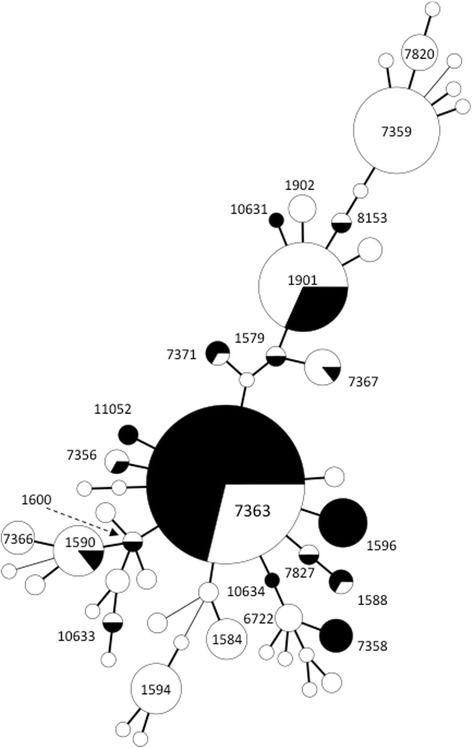
Molecular epidemiological relatedness of Neisseria gonorrhoeae isolates from 1998 to 2005 in the Kanagawa area, Japan. Minimal spanning tree of 48 MLST STs shows genetic distance of STs derived from 370 isolates. Circle sizes denote the number of isolates sharing the same ST. Black indicates N. gonorrhoeae isolates with resistance or decreased susceptibility to cefixime
Fig. 3
Fig. 3
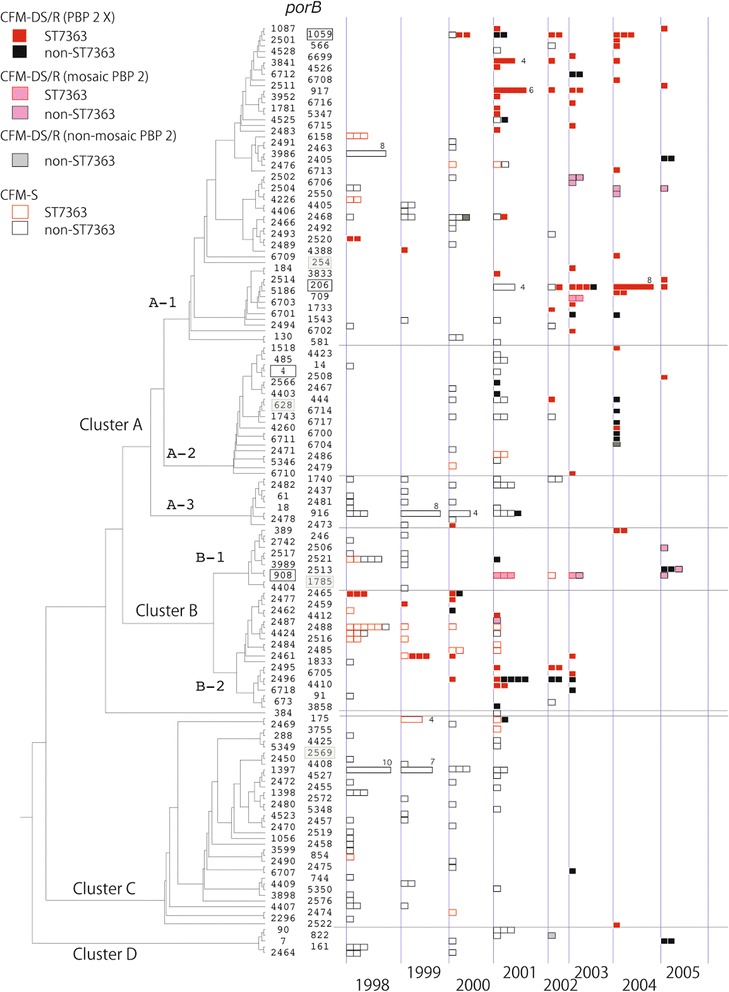
Comparison of the porB gene sequences in Neisseria gonorrhoeae isolates obtained from 1998 to 2005 in the Kanagawa area, Japan. Dendrogram was constructed using 163 partial porB sequences (490 bp) by UPGMA. One -hundred -fifty-nine porB sequences were from N. gonorrhoeae isolates examined in this study, including four of the major porB alleles in the Kyoto/Osaka strains isolated during 2010–2012 [24], (depicted in the shaded frame). The two remaining of the major porB alleles in the Kyoto/Osaka strains (porB1785 and porB2569) [24] and porB254 and porB628, from strains with cefixime resistance in Sweden (2002) and the USA (2003) [27], were also included with the porB type framed. Each box illustrates an individual strain. When more than four isolates with the identical porB type were cultured in the same year, the number of isolates is shown. Red and black boxes indicate MLST ST7363 strains and non-ST7363, respectively. Filled boxes indicate CFM-R/DS strains. Red and black filled rectangles, ST7363 and non-ST7363 strains with PBP 2 X, pink and gray are mosaic PBP 2 other than PBP 2 X and non-mosaic PBP 2

References

    1. World Health Organization (WHO). Global incidence and prevalence of selected curable sexually transmitted infections - 2008. Geneva, Switzerland; 2012. Available at: http://www.who.int/reproductivehealth/publications/rtis/2008_STI_estimat... (Accessed: May 30, 2015).
    1. Tapsall JW, Ndowa F, Lewis DA, Unemo M. Meeting the public health challenge of multidrug- and extensively drug-resistant Neisseria gonorrhoeae. Expert Rev Anti Infect Ther. 2009;7:821–34. doi: 10.1586/eri.09.63. - DOI - PubMed
    1. Unemo M, Nicholas RA. Emergence of multidrug-resistant, extensively drug-resistant and untreatable gonorrhea. Future Microbiol. 2012;7:1401–22. doi: 10.2217/fmb.12.117. - DOI - PMC - PubMed
    1. Unemo M, Shafer WM. Antimicrobial resistance in Neisseria gonorrhoeae in the 21st Century: past, evolution, and future. Clin Microbiol Rev. 2014;27:587–613. doi: 10.1128/CMR.00010-14. - DOI - PMC - PubMed
    1. Lewis DA. The gonococcus fights back: is this time a knock out? Sex Transm Infect. 2010;86:415–21. doi: 10.1136/sti.2010.042648. - DOI - PubMed

Publication types

MeSH terms