


Effects of endurance, circuit, and relaxing training on cardiovascular risk factors in hypertensive elderly patients
- PMID: 26381921
- PMCID: PMC5005840
- DOI: 10.1007/s11357-015-9835-4
Effects of endurance, circuit, and relaxing training on cardiovascular risk factors in hypertensive elderly patients
Abstract
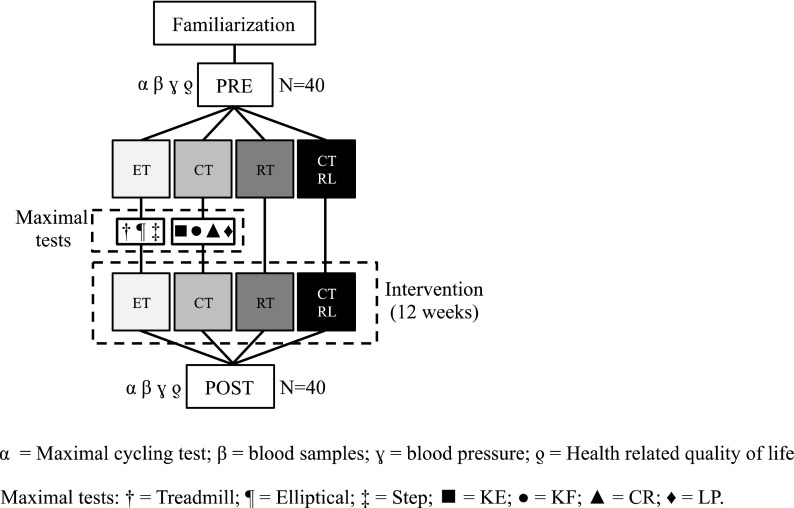
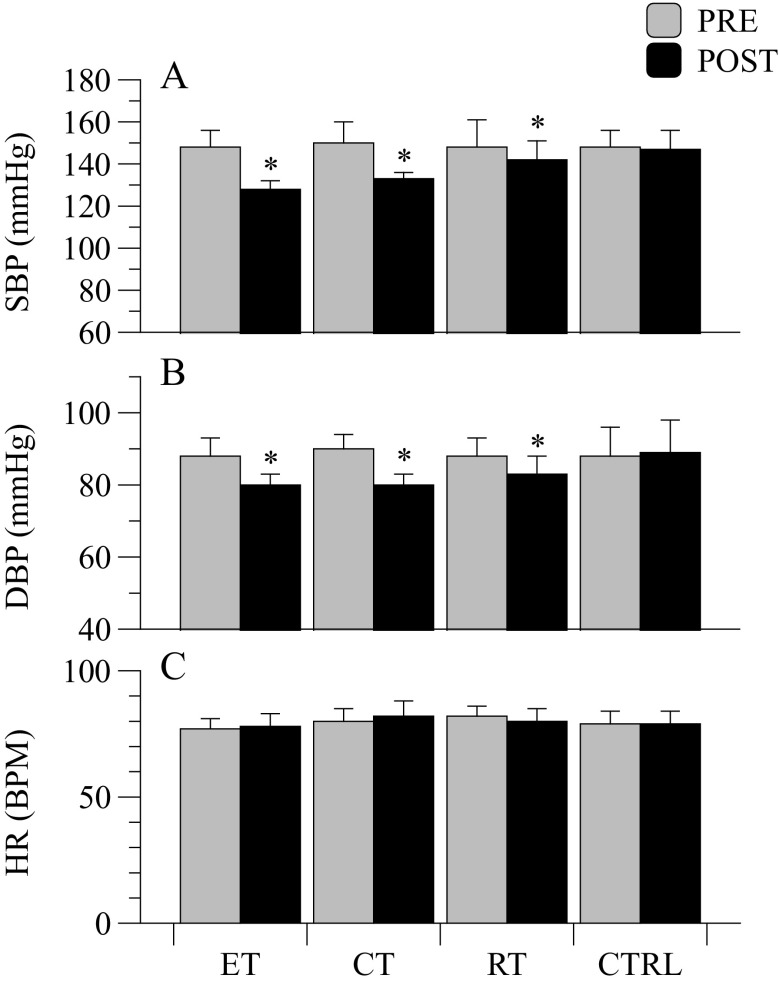
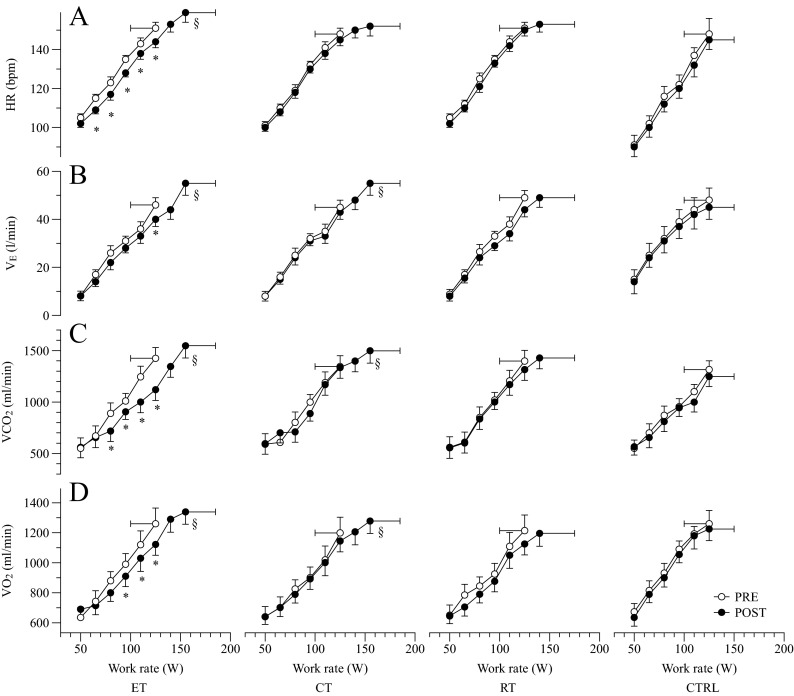
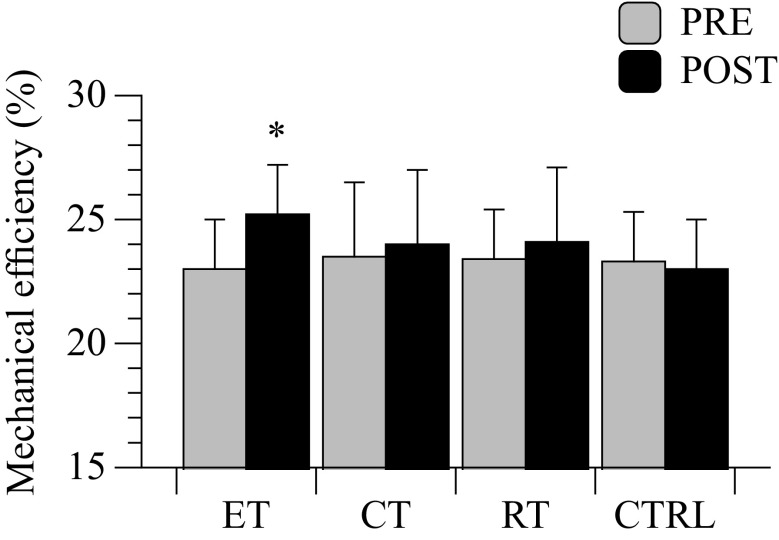
Recommendations for prevention of cardiovascular diseases (CVDs) risk factors among older adults highlighted the importance of exercise-based interventions, including endurance training (ET). However, the evidence of efficacy of other interventions based on short-bouts of exercise (circuit training, CT), and the practice of breath-control and meditation (relaxing training, RT) is growing. The aim of this study was to elucidate if CT or RT are equally effective in CVD risk factors reduction compared to ET. To this purpose, in 40 elderly participants, with clinically diagnosed grade 1 hypertension, resting blood pressure, blood glucose, and cholesterol levels, peak oxygen uptake ([Formula: see text]), mechanical efficiency and quality of life were evaluated before and after 12 weeks of ET, CT, and RT treatments. Resting blood pressure reduced significantly in all groups by ∼11 %. In ET, blood cholesterol levels (-18 %), [Formula: see text] (+8 %), mechanical efficiency (+9 %), and quality of life scores (+36 %) ameliorated. In CT blood glucose levels (-11 %), [Formula: see text] (+7 %) and quality of life scores (+35 %) were bettered. Conversely, in RT, the lower blood pressure went along only with an improvement in the mental component of quality of life (+42 %). ET and CT were both appropriate interventions to reduce CVDs risk factors, because blood pressure reduction was accompanied by decreases in blood glucose and cholesterol levels, increases in [Formula: see text], mechanical efficiency, and quality of life. Although RT influenced only blood pressure and quality of life, this approach would be an attractive alternative for old individuals unable or reluctant to carry out ET or CT.
Keywords: Aging; Blood pressure; Cardiovascular disease; Circuit training; Endurance training; Relaxing training.
Figures
References
-
- Aronow WS, Fleg JL, Pepine CJ, Artinian NT, Bakris G, Brown AS, Ferdinand KC, Forciea MA, Frishman WH, Jaigobin C, Kostis JB, Mancia G, Oparil S, Ortiz E, Reisin E, Rich MW, Schocken DD, Weber MA, Wesley DJ, Harrington RA, Force AT. ACCF/AHA 2011 expert consensus document on hypertension in the elderly: a report of the American College of Cardiology Foundation Task Force on Clinical Expert Consensus Documents. Circulation. 2011;123(21):2434–2506. doi: 10.1161/CIR.0b013e31821daaf6. - DOI - PubMed
-
- Astrand P-O. Textbook of work physiology: physiological bases of exercise. Champaign: Human Kinetics; 2003.
-
- Blanco-Rivero J, Roque FR, Sastre E, Caracuel L, Couto GK, Avendano MS, Paula SM, Rossoni LV, Salaices M, Balfagon G. Aerobic exercise training increases neuronal nitric oxide release and bioavailability and decreases noradrenaline release in mesenteric artery from spontaneously hypertensive rats. J Hypertens. 2013;31(5):916–926. doi: 10.1097/HJH.0b013e32835f749c. - DOI - PubMed
Publication types
MeSH terms
LinkOut - more resources
Full Text Sources
Other Literature Sources
Medical