


Preoperative biliary drainage in perihilar cholangiocarcinoma: identifying patients who require percutaneous drainage after failed endoscopic drainage
- PMID: 26382308
- PMCID: PMC4745253
- DOI: 10.1055/s-0034-1392559
Preoperative biliary drainage in perihilar cholangiocarcinoma: identifying patients who require percutaneous drainage after failed endoscopic drainage
Abstract
Background and study aims: Preoperative biliary drainage is often initiated with endoscopic retrograde cholangiopancreatography (ERCP) in patients with potentially resectable perihilar cholangiocarcinoma (PHC), but additional percutaneous transhepatic catheter (PTC) drainage is frequently required. This study aimed to develop and validate a prediction model to identify patients with a high risk of inadequate ERCP drainage.
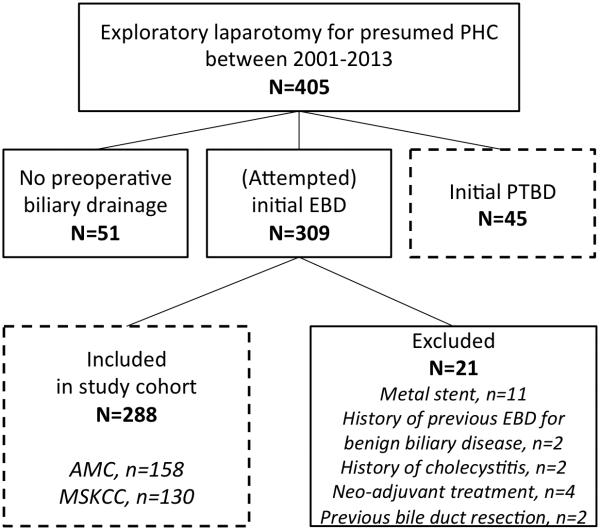
Patients and methods: Patients with potentially resectable PHC and (attempted) preoperative ERCP drainage were included from two specialty center cohorts between 2001 and 2013. Indications for additional PTC drainage were failure to place an endoscopic stent, failure to relieve jaundice, cholangitis, or insufficient drainage of the future liver remnant. A prediction model was derived from the European cohort and externally validated in the USA cohort.
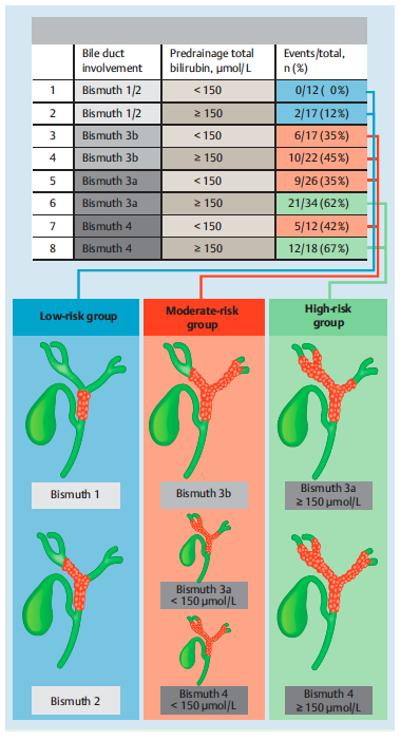
Results: Of the 288 patients, 108 (38%) required additional preoperative PTC drainage after inadequate ERCP drainage. Independent risk factors for additional PTC drainage were proximal biliary obstruction on preoperative imaging (Bismuth 3 or 4) and predrainage total bilirubin level. The prediction model identified three subgroups: patients with low risk (7%), moderate risk (40%), and high risk (62%). The high-risk group consisted of patients with a total bilirubin level above 150 µmol/L and Bismuth 3a or 4 tumors, who typically require preoperative drainage of the angulated left bile ducts. The prediction model had good discrimination (area under the curve 0.74) and adequate calibration in the external validation cohort.
Conclusions: Selected patients with potentially resectable PHC have a high risk (62%) of inadequate preoperative ERCP drainage requiring additional PTC drainage. These patients might do better with initial PTC drainage instead of ERCP.
© Georg Thieme Verlag KG Stuttgart · New York.
Figures
Comment in
-
Commentaire du travail de Wiggers JK et al., pp. 1124.Endoscopy. 2015 Dec;47(12):1197. Endoscopy. 2015. PMID: 26966737 French. No abstract available.
References
-
- Valle J, Wasan H, Palmer DH, et al. Cisplatin plus gemcitabine versus gemcitabine for biliary tract cancer. N Engl J Med. 2010;362:1273–1281. - PubMed
-
- Ebata T, Kosuge T, Hirano S, et al. Proposal to modify the International Union Against Cancer staging system for perihilar cholangiocarcinomas. Br J Surg. 2014;101:79–88. - PubMed
-
- Matsuo K, Rocha FG, Ito K, et al. The Blumgart preoperative staging system for hilar cholangiocarcinoma: analysis of resectability and outcomes in 380 patients. J Am Coll Surg. 2012;215:343–355. - PubMed
-
- Nuzzo G, Giuliante F, Ardito F, et al. Improvement in perioperative and long-term outcome after surgical treatment of hilar cholangiocarcinoma: results of an Italian multicenter analysis of 440 patients. Arch Surg. 2012;147:26–34. - PubMed
-
- Nagino M, Ebata T, Yokoyama Y, et al. Evolution of surgical treatment for perihilar cholangiocarcinoma: a single-center 34-year review of 574 consecutive resections. Ann Surg. 2013;258:129–140. - PubMed
Publication types
MeSH terms
Grants and funding
LinkOut - more resources
Full Text Sources
Other Literature Sources
Medical
