


Alterations of biomarker profiles after neoadjuvant chemotherapy in breast cancer: tumor heterogeneity should be taken into consideration
- PMID: 26384297
- PMCID: PMC4742218
- DOI: 10.18632/oncotarget.5050
Alterations of biomarker profiles after neoadjuvant chemotherapy in breast cancer: tumor heterogeneity should be taken into consideration
Abstract
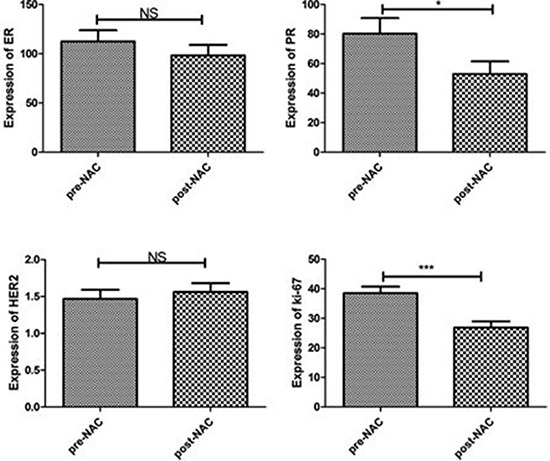
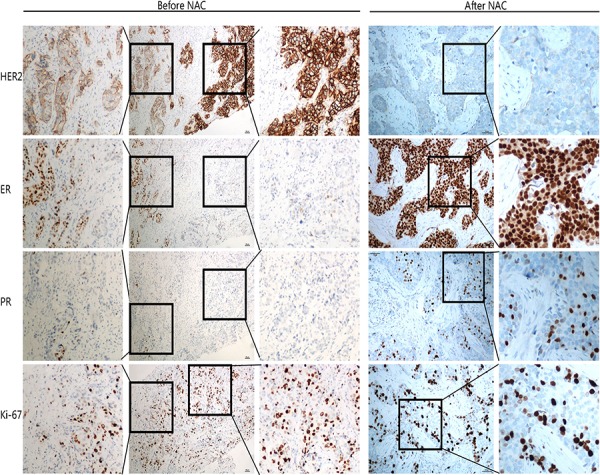
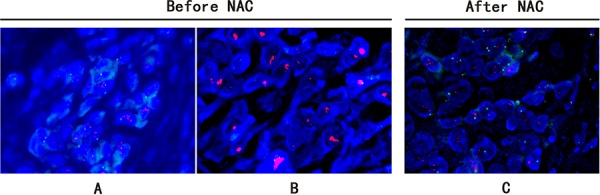
Tumor biomarkers including estrogen receptor (ER), progesterone receptor (PR), human epidermal growth factor receptor 2 (HER2) and Ki-67 are routinely tested in breast cancer patients and their status guides clinical management and predicts prognosis. A few retrospective studies have suggested that neoadjuvant chemotherapy (NAC) in breast cancer may change the status of biomarker expression, which in turn will affect further management of these patients. In this study we take advantage of a relatively large cohort and aim to study the effect of NAC on biomarker expression and explore the impact of tumor size and lymph node involvement on biomarker status changes. We collected 107 patients with invasive breast cancer who received at least three cycles of NAC. We retrospectively performed and scored the immunohistochemistry (IHC) of ER, PR, HER2 and Ki-67 using both the diagnostic core biopsies before NAC and excisional specimens following NAC. HER2 gene status was assessed by fluorescence in situ hybridization for cases with IHC result of 2+. We demonstrated that there was a significant decrease in expression of PR (P = 0.013) and Ki-67 (P = 0.000) in post-NAC specimens compared to pre-NAC core biopsies. In addition, cases with large tumor size (≥ 2 cm) and cases with lymph node metastasis were more frequently to have biomarker changes. Finally we studied cases with HER2 status changes after NAC treatments in detail and emphasized the nature of tumor heterogeneity.
Keywords: biomarkers; breast cancer; heterogeneity; neoadjuvant chemotherapy.
Conflict of interest statement
The authors declare no conflict of interest.
Figures
References
-
- Colleoni M, Goldhirsch A. Neoadjuvant chemotherapy for breast cancer: any progress? Lancet Oncol. 2014;15:131–132. - PubMed
-
- Read RL, Flitcroft K, Snook KL, Boyle FM, Spillane AJ. Utility of neoadjuvant chemotherapy in the treatment of operable breast cancer. ANZ J Surg. 2015;85:315–320. - PubMed
-
- Ko ES, Han BK, Kim RB, Ko EY, Shin JH, Hahn SY, Nam SJ, Lee JE, Lee SK, Im YH, Park YH. Analysis of factors that influence the accuracy of magnetic resonance imaging for predicting response after neoadjuvant chemotherapy in locally advanced breast cancer. Ann Surg Oncol. 2013;20:2562–2568. - PubMed
-
- Leone JP, Leone J, Vallejo CT, Perez JE, Romero AO, Machiavelli MR, Romero Acuna L, Dominguez ME, Langui M, Fasce HM, Leone BA, Ortiz E, Iturbe J, et al. Sixteen years follow-up results of a randomized phase II trial of neoadjuvant fluorouracil, doxorubicin, and cyclophosphamide (FAC) compared with cyclophosphamide, methotrexate, and 5-fluorouracil (CMF) in stage III breast cancer: GOCS experience. Breast Cancer Res Treat. 2014;143:313–323. - PubMed
Publication types
MeSH terms
Substances
LinkOut - more resources
Full Text Sources
Other Literature Sources
Medical
Research Materials
Miscellaneous
