. 2015 Sep 18:15:227.
doi: 10.1186/s12870-015-0596-0.

Transcriptome analysis of 20 taxonomically related benzylisoquinoline alkaloid-producing plants

Affiliations

Transcriptome analysis of 20 taxonomically related benzylisoquinoline alkaloid-producing plants

Jillian M Hagel et al. BMC Plant Biol. .

Abstract

Background: Benzylisoquinoline alkaloids (BIAs) represent a diverse class of plant specialized metabolites sharing a common biosynthetic origin beginning with tyrosine. Many BIAs have potent pharmacological activities, and plants accumulating them boast long histories of use in traditional medicine and cultural practices. The decades-long focus on a select number of plant species as model systems has allowed near or full elucidation of major BIA pathways, including those of morphine, sanguinarine and berberine. However, this focus has created a dearth of knowledge surrounding non-model species, which also are known to accumulate a wide-range of BIAs but whose biosynthesis is thus far entirely unexplored. Further, these non-model species represent a rich source of catalyst diversity valuable to plant biochemists and emerging synthetic biology efforts.

Results: In order to access the genetic diversity of non-model plants accumulating BIAs, we selected 20 species representing 4 families within the Ranunculales. RNA extracted from each species was processed for analysis by both 1) Roche GS-FLX Titanium and 2) Illumina GA/HiSeq platforms, generating a total of 40 deep-sequencing transcriptome libraries. De novo assembly, annotation and subsequent full-length coding sequence (CDS) predictions indicated greater success for most species using the Illumina-based platform. Assembled data for each transcriptome were deposited into an established web-based BLAST portal ( www.phytometasyn.ca) to allow public access. Homology-based mining of libraries using BIA-biosynthetic enzymes as queries yielded ~850 gene candidates potentially involved in alkaloid biosynthesis. Expression analysis of these candidates was performed using inter-library FPKM normalization methods. These expression data provide a basis for the rational selection of gene candidates, and suggest possible metabolic bottlenecks within BIA metabolism. Phylogenetic analysis was performed for each of 15 different enzyme/protein groupings, highlighting many novel genes with potential involvement in the formation of one or more alkaloid types, including morphinan, aporphine, and phthalideisoquinoline alkaloids. Transcriptome resources were used to design and execute a case study of candidate N-methyltransferases (NMTs) from Glaucium flavum, which revealed predicted and novel enzyme activities.

Conclusions: This study establishes an essential resource for the isolation and discovery of 1) functional homologues and 2) entirely novel catalysts within BIA metabolism. Functional analysis of G. flavum NMTs demonstrated the utility of this resource and underscored the importance of empirical determination of proposed enzymatic function. Publically accessible, fully annotated, BLAST-accessible transcriptomes were not previously available for most species included in this report, despite the rich repertoire of bioactive alkaloids found in these plants and their importance to traditional medicine. The results presented herein provide essential sequence information and inform experimental design for the continued elucidation of BIA metabolism.


Figures
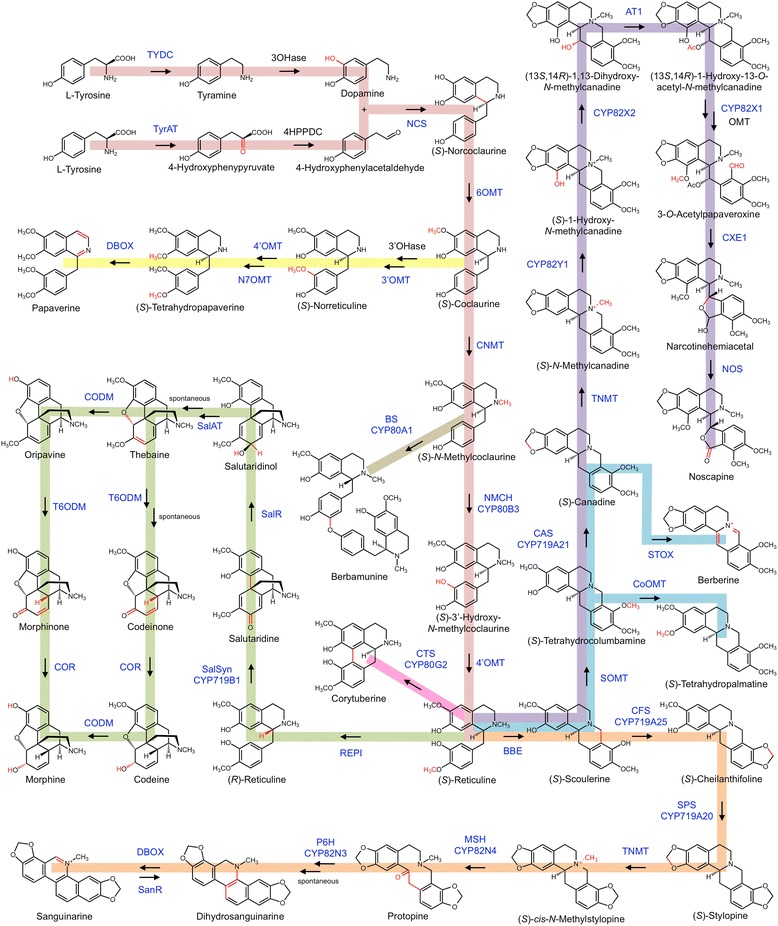
Fig. 1
Fig. 1
Major routes of BIA biosynthesis leading to (S)-reticuline (light pink), papaverine (yellow), morphine (green), sanguinarine (orange), berberine (blue) and noscapine (purple). C-O and C-C coupling reactions are shown for berbamunine (olive) and corytuberine (dark pink), respectively. Red within each alkaloid highlights enzyme-catalyzed structural changes. Solid and dotted arrows represent reactions catalyzed by single and multiple enzymes, respectively. Enzymes abbreviated in blue text have been characterized at the molecular level, whereas those in black text have not been cloned. Abbreviations: 3'-OHase, 3'-hydroxylase; 3'OMT, 3'-O-methyltransferase; 3OHase, 3-hydroxylase; 4HPPDC, 4-hydroxyphenylpyruvate decarboxylase; 4'OMT, 3'-hydroxy-N-methylcoclaurine 4'-O-methyltransferase; 6OMT, norcoclaurine 6-O-methyltransferase; AT1, 1,13-dihydroxy-N-methylcanadine 13-O-acetyltransferase; BBE, berberine bridge enzyme; BS, berbamunine synthase; CAS, canadine synthase; CFS, cheilanthifoline synthase; CNMT, coclaurine N-methyltransferase; CODM, codeine O-demethylase; CoOMT, columbamine O-methyltransferase; COR, codeinone reductase; CTS, corytuberine synthase; CYP82X1, 1-hydroxy-13-O-acetyl-N-methylcanadine 8-hydroxylase; CYP82X2, 1-hydroxy-N-methylcanadine 13-hydroxylase; CYP82Y1, N-methylcanadine 1-hydroxylase; CDBOX, dihydrobenzophenanthridine oxidase; CXE1, 3-O-acetylpapaveroxine carboxylesterase; MSH, N-methylstylopine hydroxylase; N7OMT, norreticuline 7-O-methyltransferase; NCS, norcoclaurine synthase; NMCanH, N-methylcanadine 1-hydroxylase; NMCH, N-methylcoclaurine 3'-hydroxylase; NOS, noscapine synthase; P6H, protopine 6-hydroxylase; REPI, reticuline epimerase; SalAT, salutaridinol 7-O-acetyltransferase; SalR, salutaridine reductase; SalSyn, salutaridine synthase; SanR, sanguinarine reductase; SOMT, scoulerine 9-O-methyltransferase; SPS, stylopine synthase; STOX, (S)-tetrahydroprotoberberine oxidase; T6ODM, thebaine 6-O-demethylase; TNMT, tetrahydroprotoberberine N-methyltransferase; TYDC, tyrosine decarboxylase; TyrAT, tyrosine aminotransferase
Fig. 2
Fig. 2
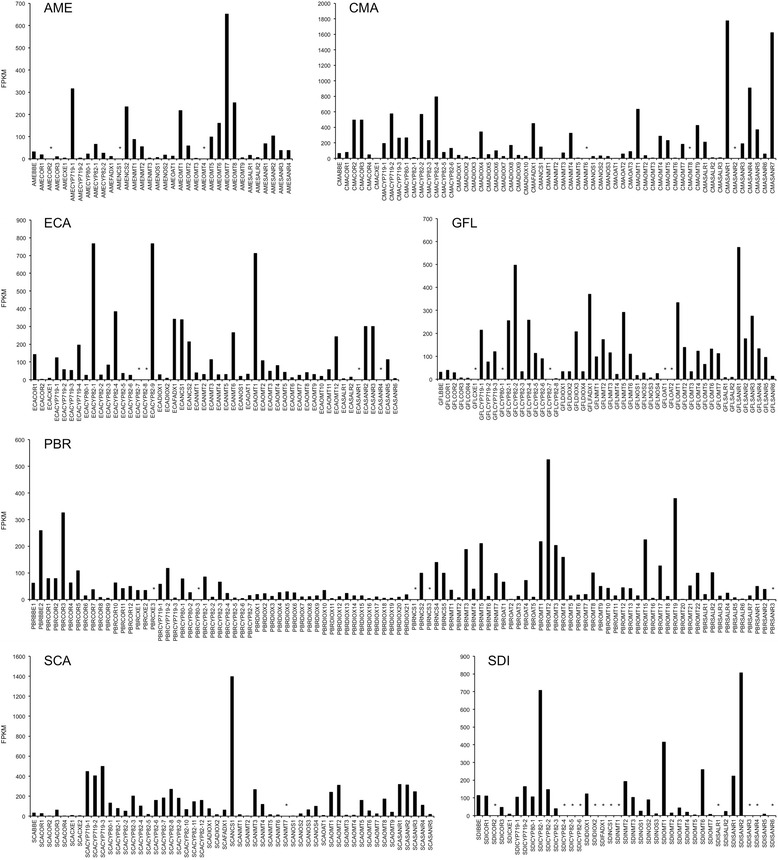
Normalized expression analysis for gene candidates potentially involved in BIA biosynthesis in Papaveraceae (tribe: Papaveroideae) species. Each candidate is labeled with respective species abbreviations (e.g. AME, Argemone mexicana) and the type of enzyme potentially encoded by the gene (e.g. BBE, berberine bridge enzyme). Candidates present exclusively in Roche-based transcriptomes could not be assigned an FPKM value, and are marked with asterisk. Refer to Table 1 for species abbreviations. Enzyme/protein family abbreviations: BBE, berberine bridge enzyme; COR, codeinone reductase; CXE, carboxylesterase; CYP, cytochrome P450 monooxygenase; DIOX, dioxygenase; FAD, FAD-dependent oxidase; NCS, norcoclaurine synthase; NMT, N-methyltransferase; NOS, noscapine synthase; OAT, O-acetyltransferase; OMT, O-methyltransferase; SALR, salutaridine reductase; SANR, sanguinarine reductase
Fig. 3
Fig. 3
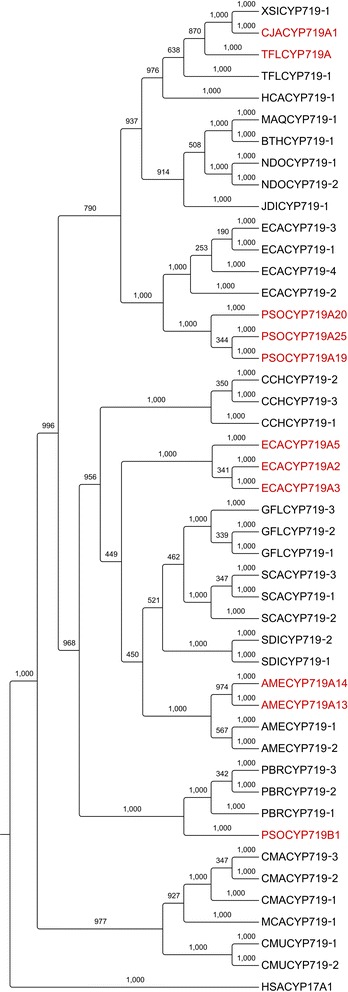
Phylogenetic analysis of CYP719 gene candidates from twenty BIA-accumulating plant species. Red text denotes characterized genes or enzymes used as tBLASTn queries for transcriptome mining. Black text denotes uncharacterized gene candidates identified through mining (>40 % identity to queries). Bootstrap values for each clade were based on 1000 iterations. Each candidate is labeled with respective species abbreviation (e.g. AME, Argemone mexicana; see Table 1) and candidate number (e.g. CYP719-1). Each query is labeled according to species (additional species: CJA, Coptis japonica; PSO, Papaver somniferum) with CYP719 subfamily and gene number indicated (e.g. CYP719B1, salutaridine synthase; see Fig. 1). Outgroup is CYP17A1 from Homo sapiens (HSA). Amino acid sequences for candidates, queries, and outgroups are found in Additional file 6
Fig. 4
Fig. 4
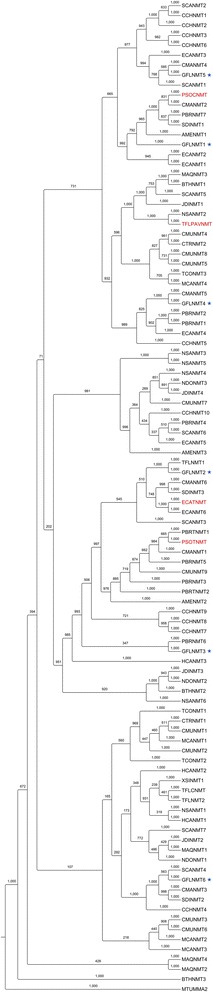
Phylogenetic analysis of N-methyltransferase (NMT) gene candidates from twenty BIA-accumulating plant species. Red text denotes characterized genes or enzymes used as tBLASTn queries for transcriptome mining. Black text denotes uncharacterized gene candidates identified through mining (>40 % identity to queries). Bootstrap values for each clade were based on 1000 iterations. Each candidate is labeled with respective species abbreviation (e.g. AME, Argemone mexicana; see Table 1) and candidate number (e.g. NMT1). Each query is labeled according to species (additional species: PSO, Papaver somniferum) and specific NMT function (CNMT, coclaurine N-methyltransferase; PAVNMT, pavine N-methyltransferase; TNMT, tetrahydroprotoberberine N-methyltransferase; see Fig. 1). Outgroup is mycolic acid synthase from Mycobacterium tuberculosis (MTUMMA2). NMT candidates from Glaucium flavum tested for catalytic activity are indicated with asterisks. Amino acid sequences for candidates, queries, and outgroups are found in Additional file 6

References

    1. Beaudoin GAW, Facchini PJ. Isolation and characterization of a cDNA encoding (S)-cis-N-methylstylopine 14-hydroxylase from opium poppy, a key enzyme in sanguinarine biosynthesis. Biochem Biophys Res Commum. 2013;431:597–603. - PubMed
    1. Blaskó G, Gula DJ, Shamma M. The phthalideisoquinoline alkaloids. J Nat Prod. 1982;45:105–122. doi: 10.1021/np50020a001. - DOI
    1. Chen Y, McCarthy D, Robinson M, Smyth GK. edgeR: differential expression analysis of digital gene expression data. Bioconductor User’s Guide. 2014;1–78. - PMC - PubMed
    1. Chevreux B, Pfisterer T, Drescher B, Driesel AJ, Müller WE, Wetter T, Suhai S. Using the miraEST assembler for reliable and automated mRNA transcript assembly and SNP detection in sequenced ESTs. Genome Resource. 2004;14:1147–1159. doi: 10.1101/gr.1917404. - DOI - PMC - PubMed
    1. D’Auria JC. Acyltransferases in plants: a good time to be BAHD. Curr Opin Plant Biol. 2006;9:331–340. doi: 10.1016/j.pbi.2006.03.016. - DOI - PubMed

Publication types