


Trajectories of estradiol and follicle-stimulating hormone over the menopause transition and early markers of atherosclerosis after menopause
- PMID: 26385249
- PMCID: PMC4816655
- DOI: 10.1177/2047487315607044
Trajectories of estradiol and follicle-stimulating hormone over the menopause transition and early markers of atherosclerosis after menopause
Abstract
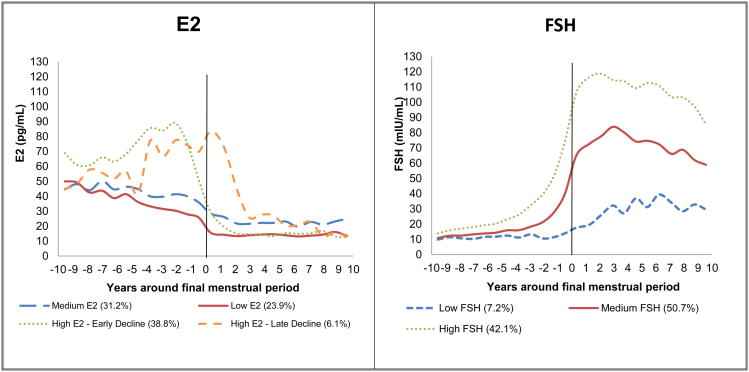
Aim: The purpose of this study was to assess associations between distinct patterns of circulating estradiol (E2) and follicle-stimulating hormone (FSH) over the menopause transition (MT) and subclinical measures of atherosclerosis after menopause.
Methods and results: Four temporal patterns of E2 decline (Low: low before and after final menstrual period (FMP); Medium: medium before and high after FMP; High-early decline: high prior to FMP and early decline thereafter; High-late decline: high prior to FMP and late decline thereafter) and three of FSH rise (Low, Medium, High) over 9.6 years across FMP were identified and linked to carotid intima-media-thickness (IMT), adventitial diameter (AD), and presence of carotid plaque (cPlaque) measured after menopause at the 12th annual visit (visit 12). Participants were 856 women (age at visit 12 = 59.5 ± 2.7 years) from the Study of Women's Health Across the Nation (SWAN), who never reported a stroke or a heart attack. In models adjusted for visit 12 or baseline cardiovascular disease (CVD) risk factors, odds of having any cPlaque were ∼43% lower among women with the High-early decline E2 trajectory compared to women with the Low E2 trajectory. In contrast, women with the Medium E2 trajectory had significantly higher IMT than those with the Low E2 trajectory adjusting for visit 12 CVD risk factors. Interestingly, adjusting for baseline CVD risk factors attenuated this association. The Low FSH group had lower IMT than the Medium and High FSH groups (p ≤ 0.05) in all models.
Conclusion: During MT, women are subjected to hormonal alterations that could potentially increase their risk of developing CVD after menopause.
Keywords: Estradiol; atherosclerosis; epidemiology; intima-media thickness; menopause; women.
© The European Society of Cardiology 2015.
Figures
References
-
- Mozaffarian D, Benjamin EJ, Go AS, Arnett DK, Blaha MJ, Cushman M, de Ferranti S, Després JP, Fullerton HJ, Howard VJ, Huffman MD, Judd SE, Kissela BM, Lackland DT, Lichtman JH, Lisabeth LD, Liu S, Mackey RH, Matchar DB, McGuire DK, Mohler ER, 3rd, Moy CS, Muntner P, Mussolino ME, Nasir K, Neumar RW, Nichol G, Palaniappan L, Pandey DK, Reeves MJ, Rodriguez CJ, Sorlie PD, Stein J, Towfighi A, Turan TN, Virani SS, Willey JZ, Woo D, Yeh RW, Turner MB American Heart Association Statistics Committee and Stroke Statistics Subcommittee. Circulation. 2015;27(131):e29–322. - PubMed
-
- Gorodeski GI. Impact of the menopause on the epidemiology and risk factors of coronary artery heart disease in women. Exp Gerontol. 1994;29:357–375. - PubMed
-
- Psaty BM, Heckbert SR, Atkins D, Lemaitre R, Koepsell TD, Wahl PW, Siscovick DS, Wagner EH. The risk of myocardial infarction associated with the combined use of estrogens and progestins in postmenopausal women. Arch Intern Med. 1994;154:1333–1339. - PubMed
-
- Grodstein F, Stampfer MJ, Manson JE, Colditz GA, Willett WC, Rosner B, Speizer FE, Hennekens CH. Postmenopausal estrogen and progestin use and the risk of cardiovascular disease. N Engl J Med. 1996;335:453–461. - PubMed
Publication types
MeSH terms
Substances
Grants and funding
- U01AG012535/AG/NIA NIH HHS/United States
- U01 AG012554/AG/NIA NIH HHS/United States
- U01AG012546/AG/NIA NIH HHS/United States
- U01AG012495/AG/NIA NIH HHS/United States
- U01AG012531/AG/NIA NIH HHS/United States
- U01AG012505/AG/NIA NIH HHS/United States
- U01AG012539/AG/NIA NIH HHS/United States
- U01 AG012535/AG/NIA NIH HHS/United States
- U01 AG012553/AG/NIA NIH HHS/United States
- U01 NR004061/NR/NINR NIH HHS/United States
- U01 AG012539/AG/NIA NIH HHS/United States
- U01AG012554/AG/NIA NIH HHS/United States
- U01 AG012546/AG/NIA NIH HHS/United States
- U01 AG012495/AG/NIA NIH HHS/United States
- U01 AG012505/AG/NIA NIH HHS/United States
- U01 AG012531/AG/NIA NIH HHS/United States
- U01NR004061/NR/NINR NIH HHS/United States
- U01AG012553/AG/NIA NIH HHS/United States
LinkOut - more resources
Full Text Sources
Other Literature Sources
Medical
