


Allelic loss of 9p21.3 is a prognostic factor in 1p/19q codeleted anaplastic gliomas
- PMID: 26385879
- PMCID: PMC4617162
- DOI: 10.1212/WNL.0000000000002014
Allelic loss of 9p21.3 is a prognostic factor in 1p/19q codeleted anaplastic gliomas
Abstract
Objectives: We aimed to study the potential clinical relevance of 9p allelic loss, with or without copy number variation, in 1p/19q codeleted anaplastic oligodendroglial tumors (AOTs).
Methods: This study enrolled 216 patients with 1p/19q codeleted AOT. The prognostic value of 9p allelic loss was investigated using a French nation-wide prospective registry, POLA (prise en charge des tumeurs oligodendrogliales anaplasiques) and high-density single nucleotide polymorphism arrays. We validated our results using the Repository of Molecular Brain Neoplasia Data (REMBRANDT) dataset.
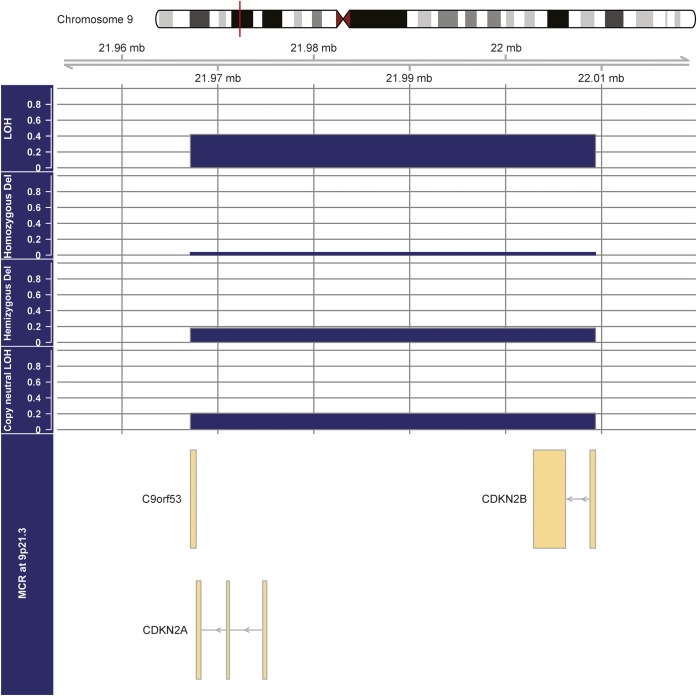
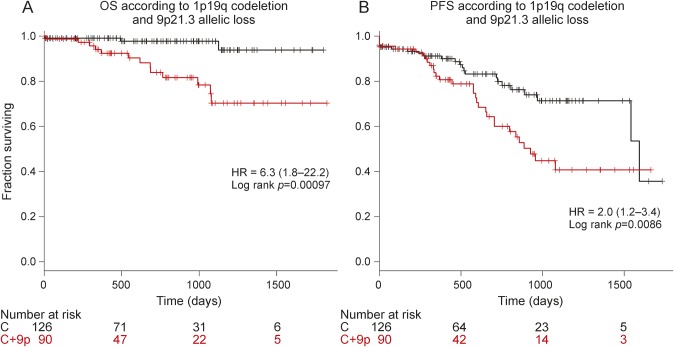
Results: The minimal common region of allelic loss in chromosome arm 9p was 9p21.3. Allelic loss of 9p21.3, detected in 41.7% of tumors, was associated with shorter progression-free and overall survival rates in univariate (p = 0.008 and p < 0.001, respectively) and multivariate analyses (p = 0.009 and p = 0.009, respectively). This finding was validated in the REMBRANDT dataset in univariate and multivariate analysis (p = 0.01 and p = 0.01, respectively).
Conclusion: Our study highlights a novel potential prognostic biomarker in 1p/19q codeleted AOT. Further prospective studies are warranted to investigate our finding.
© 2015 American Academy of Neurology.
Figures
References
-
- Van den Bent MJ, Bromberg JEC. Anaplastic oligodendroglial tumors. Handb Clin Neurol 2012;105:467–484. - PubMed
-
- Van den Bent MJ, Brandes AA, Taphoorn MJB, et al. Adjuvant procarbazine, lomustine, and vincristine chemotherapy in newly diagnosed anaplastic oligodendroglioma: long-term follow-up of EORTC brain tumor group study 26951. J Clin Oncol 2013;31:344–350. - PubMed
Publication types
MeSH terms
LinkOut - more resources
Full Text Sources
Medical
Research Materials
