


Challenges in the reproducibility of clinical studies with resting state fMRI: An example in early Parkinson's disease
- PMID: 26386348
- PMCID: PMC4655939
- DOI: 10.1016/j.neuroimage.2015.09.021
Challenges in the reproducibility of clinical studies with resting state fMRI: An example in early Parkinson's disease
Abstract
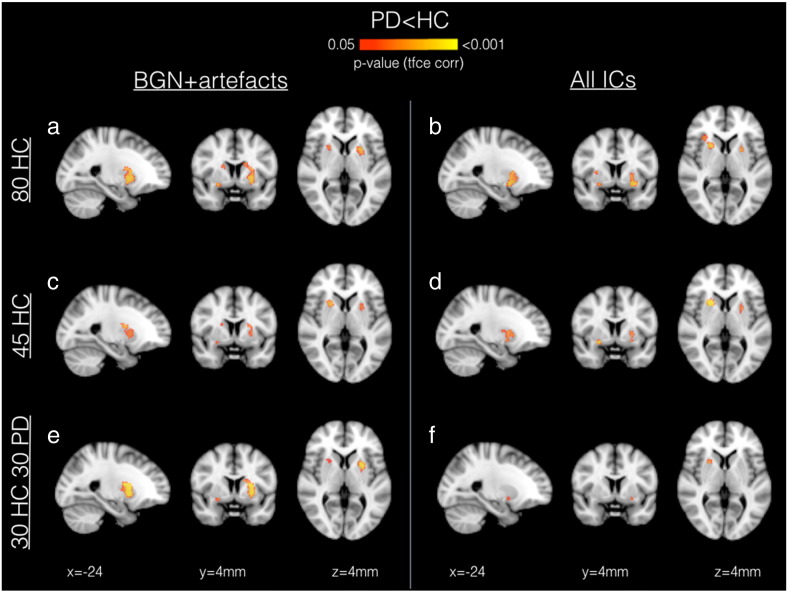
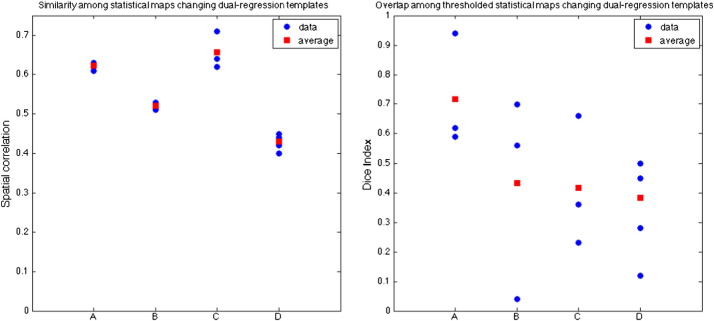
Resting state fMRI (rfMRI) is gaining in popularity, being easy to acquire and with promising clinical applications. However, rfMRI studies, especially those involving clinical groups, still lack reproducibility, largely due to the different analysis settings. This is particularly important for the development of imaging biomarkers. The aim of this work was to evaluate the reproducibility of our recent study regarding the functional connectivity of the basal ganglia network in early Parkinson's disease (PD) (Szewczyk-Krolikowski et al., 2014). In particular, we systematically analysed the influence of two rfMRI analysis steps on the results: the individual cleaning (artefact removal) of fMRI data and the choice of the set of independent components (template) used for dual regression. Our experience suggests that the use of a cleaning approach based on single-subject independent component analysis, which removes non neural-related sources of inter-individual variability, can help to increase the reproducibility of clinical findings. A template generated using an independent set of healthy controls is recommended for studies where the aim is to detect differences from a "healthy" brain, rather than an "average" template, derived from an equal number of patients and controls. While, exploratory analyses (e.g. testing multiple resting state networks) should be used to formulate new hypotheses, careful validation is necessary before promising findings can be translated into useful biomarkers.
Keywords: Artefact removal; Basal ganglia network; Dual regression; Functional connectivity; Parkinson's disease; Resting state functional magnetic resonance imaging (rfMRI).
Copyright © 2015 The Authors. Published by Elsevier Inc. All rights reserved.
Figures
References
-
- Barkhof F., Haller S., Rombouts S.A. Resting-state functional MR imaging: a new window to the brain. Radiology. 2014;272:29–49. - PubMed
-
- Beckmann C.F., Smith S.M. Probabilistic independent component analysis for functional magnetic resonance imaging. IEEE Trans. Med. Imaging. 2004;23:137–152. - PubMed
-
- Duan F., Zhao T., He Y., Shu N. Test-retest reliability of diffusion measures in cerebral white matter: a multiband diffusion MRI study. J. Magn. Reson. Imaging. 2015;42(4):1106–1116. - PubMed
Publication types
MeSH terms
Grants and funding
LinkOut - more resources
Full Text Sources
Other Literature Sources
Medical
