


Effect of beta-blocker therapy on heart rate response in patients with hypertension and newly diagnosed untreated obstructive sleep apnea syndrome
- PMID: 26386925
- PMCID: PMC4656106
- DOI: 10.1016/j.ijcard.2015.08.139
Effect of beta-blocker therapy on heart rate response in patients with hypertension and newly diagnosed untreated obstructive sleep apnea syndrome
Abstract
Background: Beta1-receptor antagonists (BBs) are commonly administered in the treatment of cardiovascular disease (CVD). The reported benefits of BB use in CVD patients with concomitant obstructive sleep apnea (OSA) may be limited by their impact on apnea-induced bradycardias. Therefore the aim of the study was to test the influence of BBs on periapneic heart rate (HR) fluctuations in hypertensive patients with newly-detected and untreated OSA.
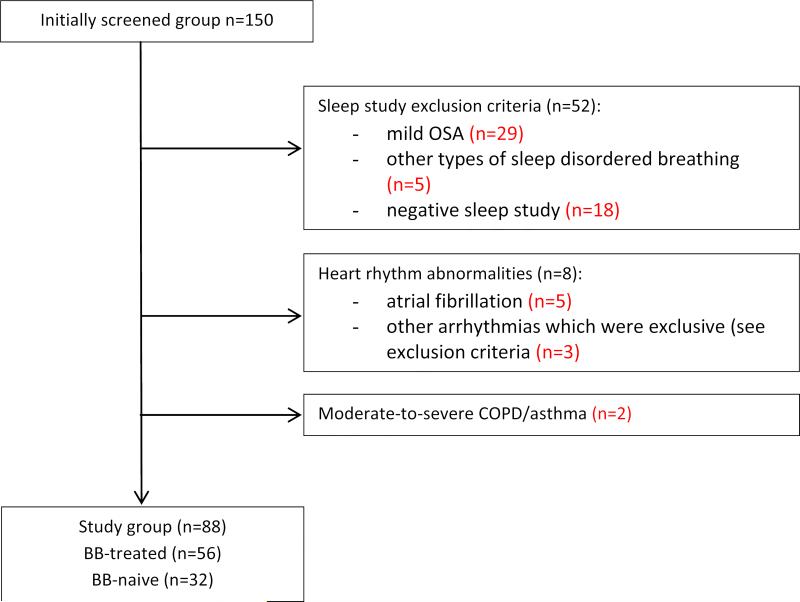
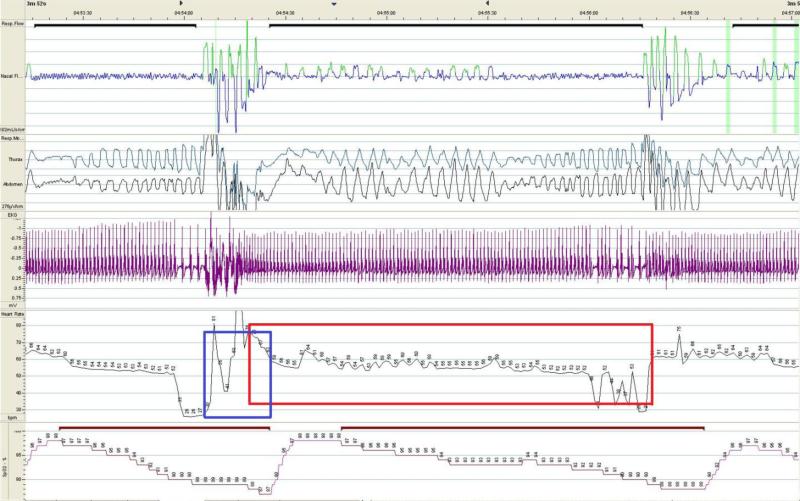
Methods: We studied 88 hypertensive patients (56 on BBs and 32 BB naive) with newly-diagnosed moderate-to-severe OSA who were free of major pulmonary comorbidities and did not require antiarrhythmic therapy. ECGs recorded during sleep were investigated for heart rate (HR) responses to apneas allowing to compare extreme HR accelerations and decelerations between the groups.
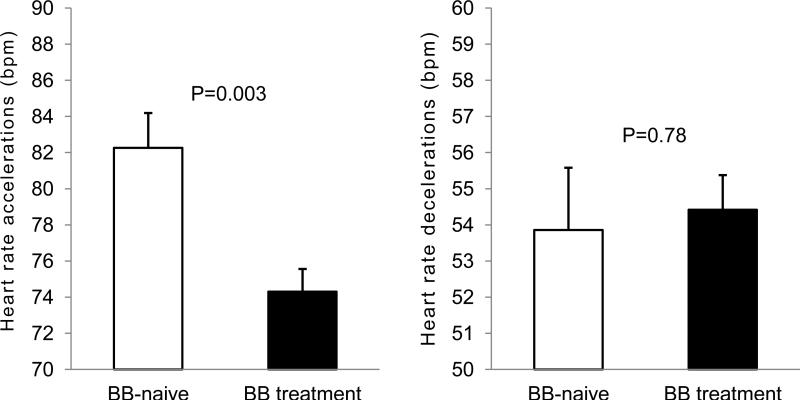
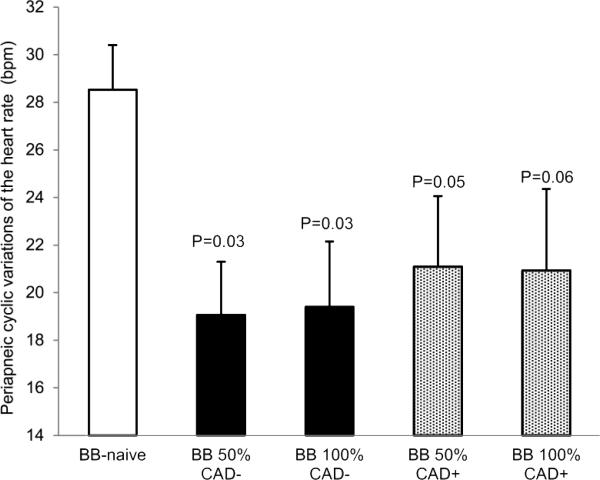
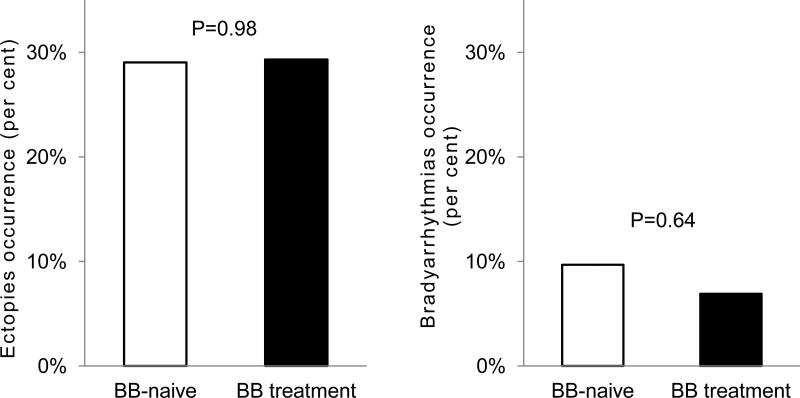
Results: Average sleep-time HR was comparable in BB-naive (BB-) and BB-treated (BB+) patients. Direct comparisons showed that HR decelerations were also similar in the two subgroups (53.8±9.6 vs. 54.4±7.8 bpm; P=0.78, for BB- and BB+, respectively) however, BBs blunted the OSA-induced HR accelerations (82.3±12.2 vs. 74.3±10.0; P=0.003). After adjusting for baseline HR and magnitude of desaturations, HR decelerations were more evident in BB-naive group whereas tachycardic responses remained blunted in the BB+ group. The incidence of ectopies and conduction abnormalities were comparable across two groups.
Conclusions: Beta-blockers do not potentiate apnea-induced HR decelerations, attenuate apnea-induced increases in heart rate and do not influence incidence of ectopies and conduction abnormalities in patients with hypertension and moderate-to-severe, untreated OSA.
Keywords: Beta-blockers; Bradycardia; Heart rate control; Obstructive sleep apnea; Tachycardia.
Copyright © 2015 Elsevier Ireland Ltd. All rights reserved.
Figures
References
-
- Weber MA, Bakris GL, Dahlöf B, Pitt B, Velazquez E, Gupte J, Lefkowitz M, Hester A, Shi V, Weir M, Kjeldsen S, Massie B, Nesbitt S, Ofili E, Jamerson K. Baseline characteristics in the Avoiding Cardiovascular events through Combination therapy in Patients Living with Systolic Hypertension (ACCOMPLISH) trial: a hypertensive population at high cardiovascular risk. Blood Press. 2007;16:13–19. - PubMed
-
- ONTARGET Investigators. Yusuf S, Teo KK, Pogue J, Dyal L, Copland I, Schumacher H, Dagenais G, Sleight P, Anderson C. Telmisartan, ramipril, or both in patients at high risk for vascular events. N Engl J Med. 2008;358:1547–1559. - PubMed
-
- Kraiczi H, Hedner J, Peker Y, Grote L. Comparison of atenolol, amlodipine, enalapril, hydrochlorothiazide, and losartan for antihypertensive treatment in patients with obstructive sleep apnea. Am J RespirCrit Care Med. 2000;161:1423–1428. - PubMed
-
- Salo TM, Kantola I, Voipio-Pulkki LM, Pelttari L, Viikari JS. The effect of four different antihypertensive medications on cardiovascular regulation in hypertensive sleep apneic patients--assessment by spectral analysis of heart rate and blood pressure variability. Eur J Clin Pharmacol. 1999;55:191–198. - PubMed
Publication types
MeSH terms
Substances
Grants and funding
LinkOut - more resources
Full Text Sources
Other Literature Sources
Medical
