


The impact of addiction medications on treatment outcomes for persons with co-occurring PTSD and opioid use disorders
- PMID: 26388539
- PMCID: PMC4866634
- DOI: 10.1111/ajad.12292
The impact of addiction medications on treatment outcomes for persons with co-occurring PTSD and opioid use disorders
Abstract
Background and objectives: Previous research has been inconclusive about whether adding psychosocial treatment to medication assisted treatment (MAT) improves outcomes for patients with co-occurring psychiatric and opioid use disorders. This study evaluated the impact of MAT and psychosocial therapies on treatment outcomes for patients with co-occurring opioid use disorders and PTSD.
Methods: Patients meeting criteria for PTSD and substance use disorders were randomly assigned to one of three treatment conditions: Standard Care (SC) alone, Integrated Cognitive Behavioral Therapy (ICBT) plus SC, or Individual Addiction Counseling (IAC) plus SC. Substance use and psychiatric symptoms were assessed at baseline and 6 months. Only patients with opioid use disorders were included in the present analyses (n = 126). Two-way ANOVAS and logistic regression analyses were used to examine associations between treatment conditions and MAT, for substance use and psychiatric outcomes.
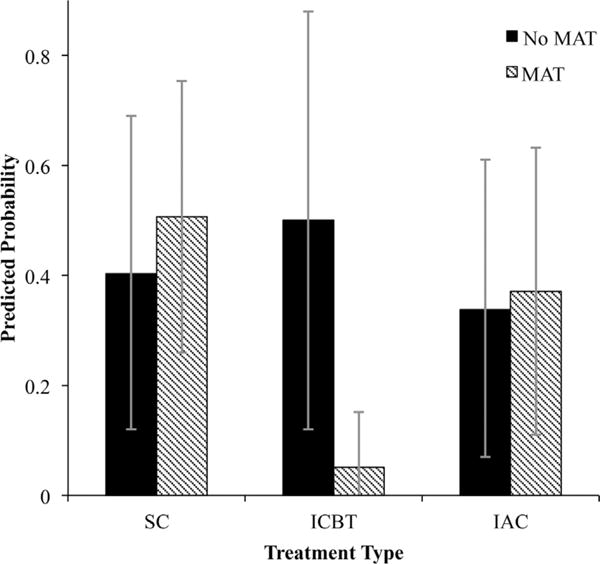
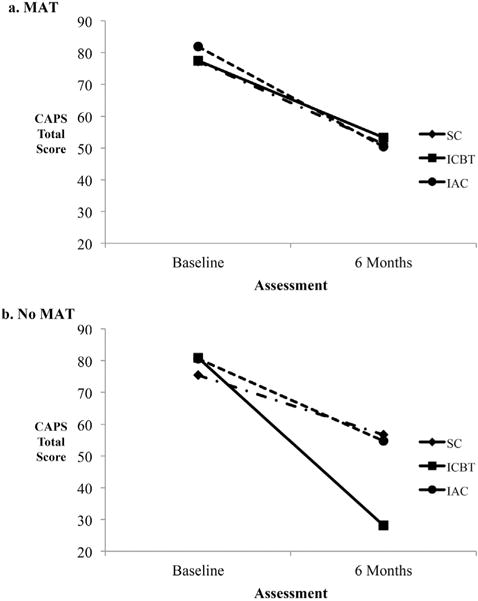
Results: MAT patients receiving ICBT had significantly decreased odds of a positive urine drug screen, compared to non-MAT patients receiving SC alone (OR = .07, 95% CI = .01, .81, p = .03). For PTSD symptoms, a significant MAT by psychosocial treatment condition interaction demonstrated that MAT patients had comparable declines in PTSD symptoms regardless of psychosocial treatment type (F(2, 88) = 4.74, p = .011). Non-MAT patients in ICBT had significantly larger reductions in PTSD.
Conclusions and scientific significance: For patients with co-occurring opioid use disorders and PTSD, MAT plus ICBT is associated with more significant improvement in substance use. For non-MAT patients, ICBT is most beneficial for PTSD symptoms.
Keywords: co-occurring disorders; integrated treatment; medication-assisted treatment; opioid dependence; posttraumatic stress disorder.
© American Academy of Addiction Psychiatry.
Conflict of interest statement
Declaration of Interest
The authors report no conflicts of interest. The authors alone are responsible for the content and writing of this paper.
Figures
References
-
- Substance Abuse and Mental Health Services Administration (SAMHSA) Results from the 2012 National Survey on Drug Use and Health: Summary of National Findings. Rockville, MD: Substance Abuse and Mental Health Administration (SAMHSA); 2013.
-
- Volkow ND, Frieden TR, Hyde PS, et al. Medication-assisted therapies-Tackling the opioid-overdose epidemic. N E J Med. 2014;370:2063–2066. - PubMed
-
- Substance Abuse and Mental Health Services Administration. About one-third of substance abuse treatment admissions had a psychiatric problem. Rockville, MD: 2014.
-
- Mills KL, Teesson M, Ross J, et al. The costs and outcomes of treatment for opioid dependence associated with posttraumatic stress disorder. Psychiatr Serv. 2005;56:940–945. - PubMed
Publication types
MeSH terms
Substances
Grants and funding
LinkOut - more resources
Full Text Sources
Other Literature Sources
Medical
Miscellaneous
