. 2015 Sep 3:7:133.
doi: 10.3389/fnagi.2015.00133. eCollection 2015.

Social robots in advanced dementia

Affiliations

Social robots in advanced dementia

Meritxell Valentí Soler et al. Front Aging Neurosci. .

Abstract

Aims: Pilot studies applying a humanoid robot (NAO), a pet robot (PARO) and a real animal (DOG) in therapy sessions of patients with dementia in a nursing home and a day care center.

Methods: In the nursing home, patients were assigned by living units, based on dementia severity, to one of the three parallel therapeutic arms to compare: CONTROL, PARO and NAO (Phase 1) and CONTROL, PARO, and DOG (Phase 2). In the day care center, all patients received therapy with NAO (Phase 1) and PARO (Phase 2). Therapy sessions were held 2 days per week during 3 months. Evaluation, at baseline and follow-up, was carried out by blind raters using: the Global Deterioration Scale (GDS), the Severe Mini Mental State Examination (sMMSE), the Mini Mental State Examination (MMSE), the Neuropsychiatric Inventory (NPI), the Apathy Scale for Institutionalized Patients with Dementia Nursing Home version (APADEM-NH), the Apathy Inventory (AI) and the Quality of Life Scale (QUALID). Statistical analysis included descriptive statistics and non-parametric tests performed by a blinded investigator.

Results: In the nursing home, 101 patients (Phase 1) and 110 patients (Phase 2) were included. There were no significant differences at baseline. The relevant changes at follow-up were: (Phase 1) patients in the robot groups showed an improvement in apathy; patients in NAO group showed a decline in cognition as measured by the MMSE scores, but not the sMMSE; the robot groups showed no significant changes between them; (Phase 2) QUALID scores increased in the PARO group. In the day care center, 20 patients (Phase 1) and 17 patients (Phase 2) were included. The main findings were: (Phase 1) improvement in the NPI irritability and the NPI total score; (Phase 2) no differences were observed at follow-up.

Keywords: Alzheimer disease; animal assisted therapy; apathy; dementia; human-robot interaction; robotics; technology; therapy.


Figures
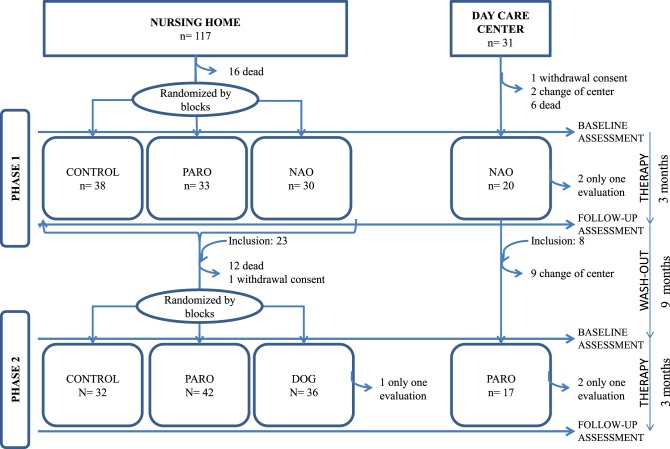
Figure 1
Figure 1
All patients whose families/guardians gave consent and who fit inclusion/exclusion criteria were included. Therapy sessions: each group worked only with a tool (conventional, PARO, NAO, or DOG) in the nursing home; in the day care center all participants worked with NAO in the first phase, and PARO in the second. Assessments were realized before and after the study sessions. The wash-out period allowed the entry of new participants. Randomization was carried out before the study sessions only in the nursing home.
Figure 2
Figure 2
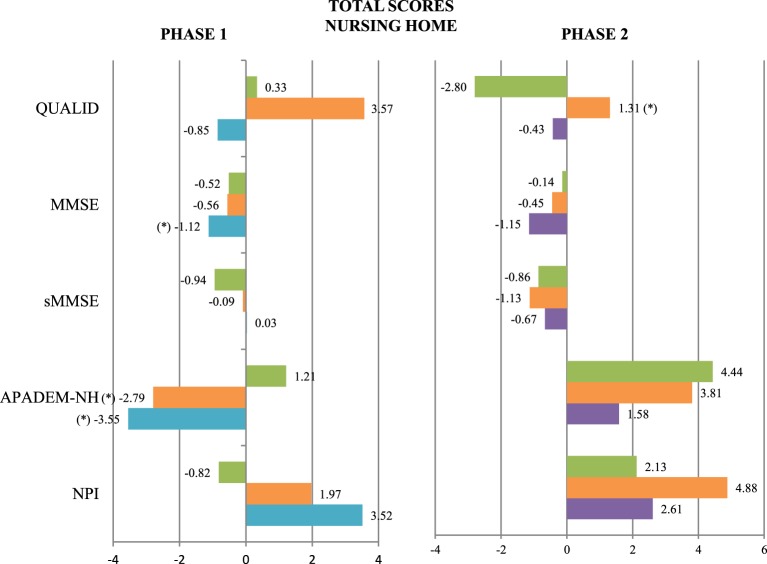
Mean change at follow-up evaluation in the QUALID, MMSE, sMMSE, APADEM-NH, and NPI scores in the three patients groups of Phase 1 and Phase 2. CONTROL (green), PARO (orange), NAO (blue), and DOG (purple) (*): Statistically significant differences between the groups at follow-up were observed. P not corrected < 0.05. The scales are represented on the vertical axis and the mean change in the units of measure of each scale is represented on the horizontal axis.
Figure 3
Figure 3
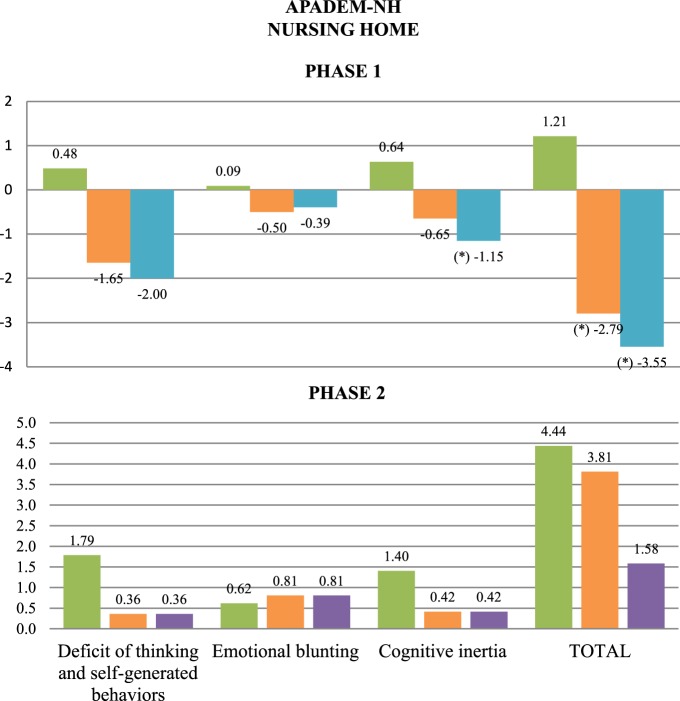
Mean change at follow-up in APADEM-NH scores, by item and total, for the three patients groups of Phase 1 and Phase 2. CONTROL (green), PARO (orange), NAO (blue), and DOG (purple) (*): Statistically significant differences between the groups at follow-up were observed. P not corrected < 0.05. The scales are represented on the horizontal axis and the mean change in the units of measure of each scale is represented on the vertical axis.
Figure 4
Figure 4
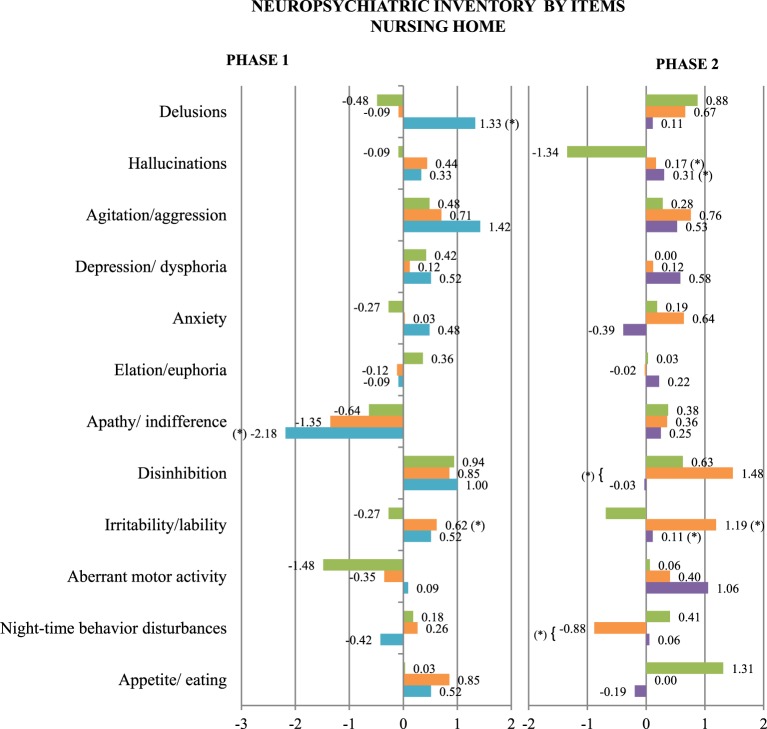
Mean change at follow-up in NPI scores, by item, for the three patients groups of Phase 1 and Phase 2. CONTROL (green), PARO (orange), NAO (blue), and DOG (purple) (*): Statistically significant differences between the groups at follow-up were observed. P not corrected < 0.05. The scales are represented on the vertical axis and the mean change in the units of measure of each scale is represented on the horizontal axis.
Figure 5
Figure 5
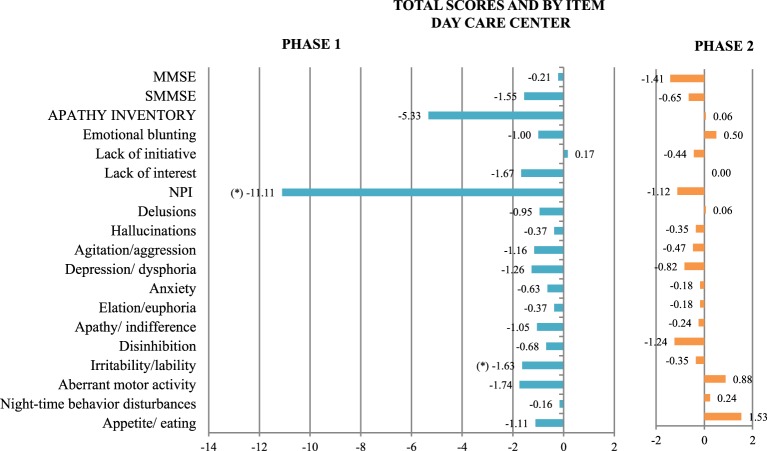
Mean change at follow-up in scores on all the scales used, both totals and by item, in the day care center group of Phase 1, with NAO (blue), and Phase 2, with PARO (orange). (*) Statistically significant differences between the groups at follow-up were observed. P not corrected < 0.05. The scales are represented on the vertical axis and the mean change in the units of measure of each scale is represented on the horizontal axis.

References

    1. Agüera-Ortiz L., Gil-Ruiz N., Cruz-Orduña I., Ramos-García I., Osorio R. S., Valentí-Soler M., et al. (2015). A novel rating scale for the measurement of apathy in institutionalized persons with dementia: the APADEM-NH. Am. J. Geriatr. Psychiatry 23, 149–159. 10.1016/j.jagp.2013.01.079 - DOI - PubMed
    1. Bemelmans R., Gelderblom G. J., Jonker P., de Witte L. (2012). Socially assistive robots in elderly care: a systematic review into effects and effectiveness. J. Am. Med. Dir. Assoc. 13, 14–120.e1. 10.1016/j.jamda.2010.10.002 - DOI - PubMed
    1. Bernabei V., De Ronchi D., La Ferla T., Moretti F., Tonelli L., Ferrari B., et al. (2013). Animal-assisted interventions for elderly patients affected by dementia or psychiatric disorders: a review. J. Psychiatr. Res. 47, 762–773. 10.1016/j.jpsychires.2012.12.014 - DOI - PubMed
    1. Boada M., Tárraga L., Modinos G., López O. L., Cummings J. L. (2005). Neuropsychiatric inventory-nursing home version (NPI-NH): Spanish validation. Neurol. Barc. Spain 20, 665–673. - PubMed
    1. Brodaty H., Burns K. (2012). Nonpharmacological management of apathy in dementia: a systematic review. Am. J. Geriatr. Psychiatry 20, 549–564. 10.1097/JGP.0b013e31822be242 - DOI - PubMed

LinkOut - more resources