


Modulation of Renin-Angiotensin System May Slow Conversion from Mild Cognitive Impairment to Alzheimer's Disease
- PMID: 26389987
- PMCID: PMC4743657
- DOI: 10.1111/jgs.13627
Modulation of Renin-Angiotensin System May Slow Conversion from Mild Cognitive Impairment to Alzheimer's Disease
Abstract
Objectives: To assess the effect of modulation of the renin-angiotensin system (RAS) on conversion to Alzheimer's disease (AD) and cognitive decline in people with mild cognitive impairment (MCI) and the effect of the permeability of the blood-brain barrier (BBB) and race on the potential relationship between the RAS and AD.
Design: Analysis of data from AD centers funded by the National Alzheimer's Coordinating Center, National Institute on Aging.
Setting: Alzheimer's Disease Centers.
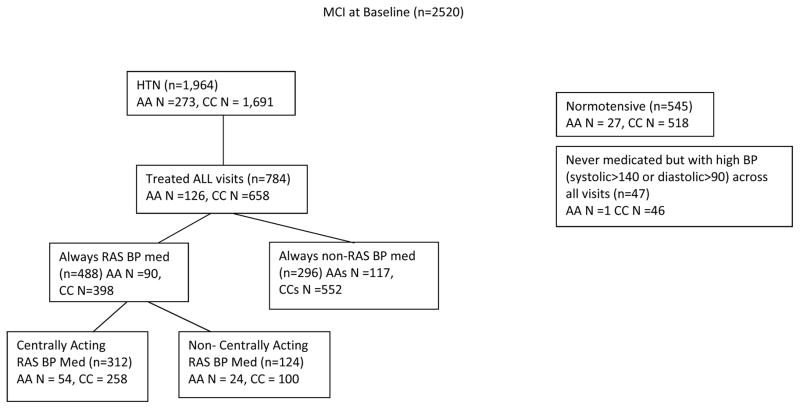
Participants: Individuals receiving antihypertensive medications who had MCI at baseline and had cognitive assessments on at least two follow-up visits (N = 784; mean age 75 l 48/% male).
Measurements: Conversion to AD and cognitive and functional decline.
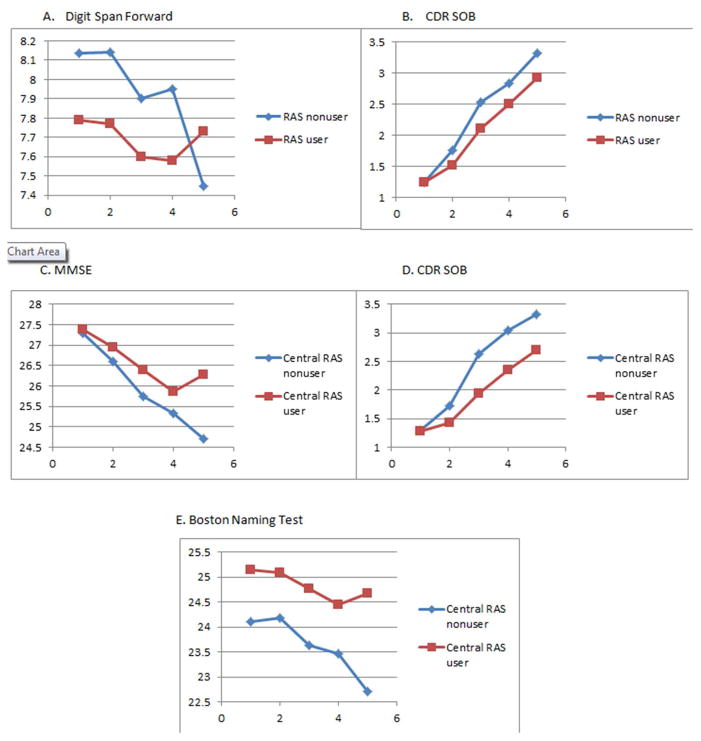
Results: Four hundred eighty-eight participants were receiving RAS-acting antihypertensive medications. RAS-acting medication users were less likely to convert to AD (33% vs 40%; P = .04) and had slower decline on the Clinical Dementia Rating Sum of Boxes (CDR-SOB, P = .005) and Digit Span Forward (P = .02) than nonusers. BBB-crossing RAS-acting medications were associated with slower cognitive decline on the CDR-SOB, (P = .009), the Mini-Mental State Examination (MMSE), (P = .001), and the Boston Naming test (P = .002). RAS-acting medications were associated with cognitive benefits more in African Americans than in Caucasians (MMSE, P = .05; category fluency, P = .04; Digit Span Backward, P = .03).
Conclusion: RAS-acting medication users were less likely to convert to AD. BBB permeability may produce additional cognitive benefit, and African Americans may benefit more from RAS modulation than Caucasians. Results highlight the need for trials investigating RAS modulation during prodromal disease stages.
Keywords: Alzheimer's disease; blood pressure; cognition; hypertension; mild cognitive impairment; renin angiotensin system.
© 2015, Copyright the Authors Journal compilation © 2015, The American Geriatrics Society.
Figures
References
-
- Kivipelto M, Helkala EL, Hanninen T, et al. Midlife vascular risk factors and late-life mild cognitive impairment: A population-based study. Neurology. 2001 Jun 26;56(12):1683–1689. - PubMed
-
- Ohrui T, Tomita N, Sato-Nakagawa T, et al. Effects of brain-penetrating ACE inhibitors on Alzheimer disease progression. Neurology. 2004 Oct 12;63(7):1324–1325. - PubMed
-
- Savaskan E, Hock C, Olivieri G, et al. Cortical alterations of angiotensin converting enzyme, angiotensin II and AT1 receptor in Alzheimer’s dementia. Neurobiology of aging. 2001 Jul-Aug;22(4):541–546. - PubMed
Publication types
MeSH terms
Substances
Grants and funding
LinkOut - more resources
Full Text Sources
Other Literature Sources
Medical
