


A small scale honey dehydrator
- PMID: 26396418
- PMCID: PMC4573101
- DOI: 10.1007/s13197-015-1760-0
A small scale honey dehydrator
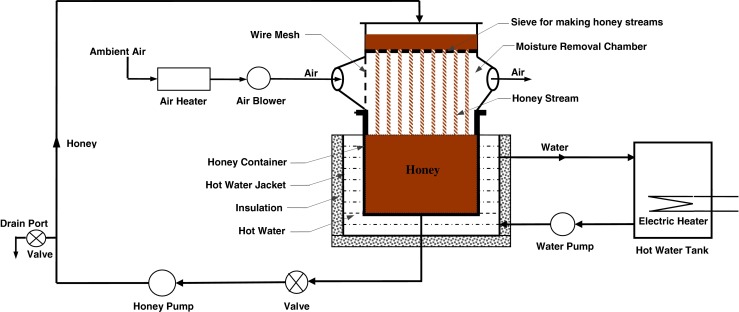
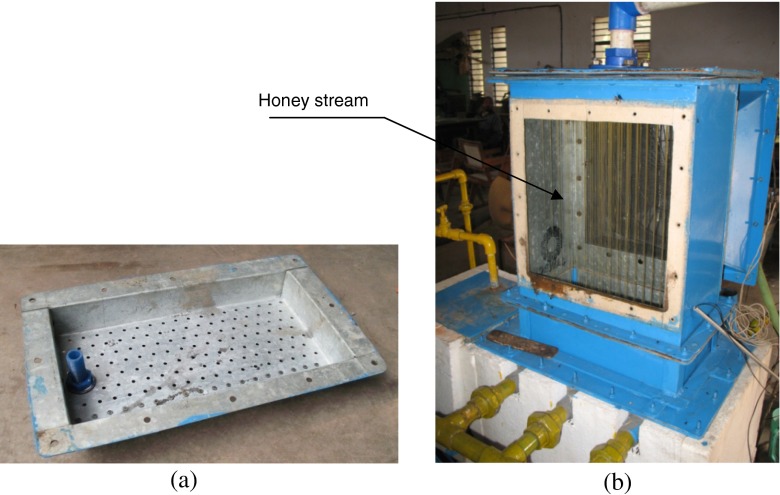
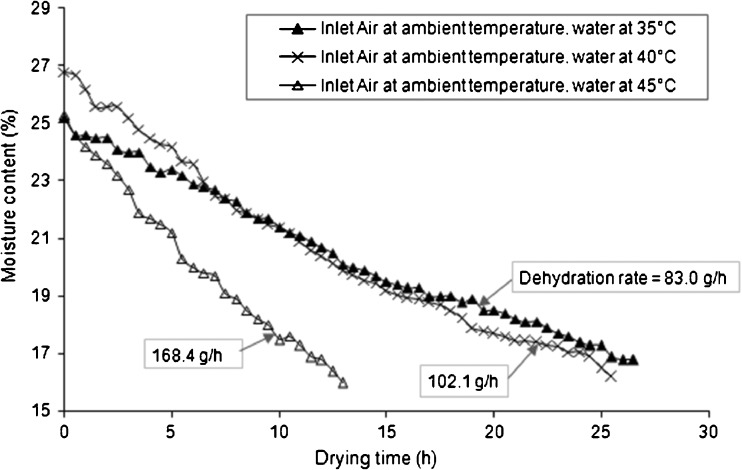
Abstract
A small scale honey dehydrator has been designed, developed, and tested to reduce moisture content of honey below 17 %. Experiments have been conducted for honey dehydration by using drying air at ambient temperature, 30 and 40 °C and water at 35, 40 and 45 °C. In this dehydrator, hot water has been circulated in a water jacket around the honey container to heat honey. The heated honey has been pumped through a sieve to form honey streams through which drying air passes for moisture removal. The honey streams help in increasing the exposed surface area of honey in contact with drying air, thus resulting in faster dehydration of honey. The maximum drying rate per square meter area of honey exposed to drying air was found to be 197.0 g/h-m(2) corresponding to the drying air and water temperature of 40 and 45 °C respectively whereas it was found to be minimum (74.8 g/h-m(2)) corresponding to the drying air at ambient temperature (8-17 °C) and water at 35 °C. The energy cost of honey moisture content reduction from 25.2 to 16.4 % was Rs. 6.20 to Rs. 17.36 (US $ 0.10 to US $ 0.28 (One US $ = 62.00 Indian Rupee on February, 2014) per kilogram of honey.
Keywords: Dehydration rate; Drying; Energy consumption; Honey; Moisture content.
Figures


References
-
- Abramovic H, Jamnik M, Burkan L, Kac M. Water activity and water content in Slovenian honeys. Food Control. 2008;19(11):1086–1090. doi: 10.1016/j.foodcont.2007.11.008. - DOI
-
- Beckh G, Wessel P, Lullmann C. A contribution to yeasts and their metabolisms products as natural components of honey - Part 2: Moisture content and water activity as quality parameters. Dtsch Lebensm-Rundsch. 2004;100(1):14–17.
-
- Chakraverty A. Post harvest technology of cereals Post Harvest Technology of Cereals. New Delhi: Pulses and Oilseeds. Oxford and IBH Publishing Co. Pvt. Ltd.; 1988.
-
- Chirife J., Zamora MC, Motto A. The correlation between water activity and % moisture in honey: Fundamental aspects and application to Argentine honeys. J Food Eng. 2006;72(3):287–292. doi: 10.1016/j.jfoodeng.2004.12.009. - DOI
LinkOut - more resources
Full Text Sources
Other Literature Sources