


Major Factors Affecting Incidence of Childhood Thyroid Cancer in Belarus after the Chernobyl Accident: Do Nitrates in Drinking Water Play a Role?
- PMID: 26397978
- PMCID: PMC4580601
- DOI: 10.1371/journal.pone.0137226
Major Factors Affecting Incidence of Childhood Thyroid Cancer in Belarus after the Chernobyl Accident: Do Nitrates in Drinking Water Play a Role?
Abstract
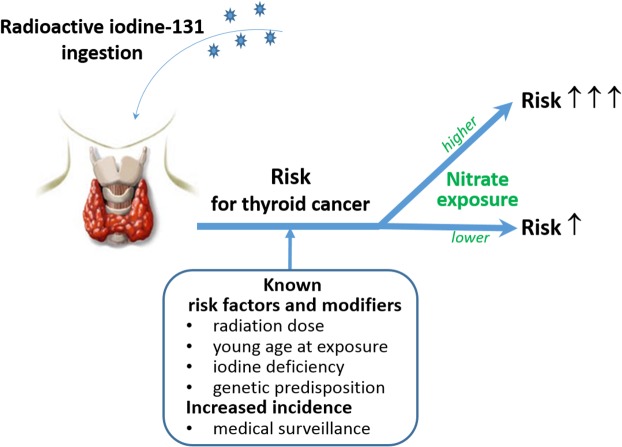
One of the major health consequences of the Chernobyl Nuclear Power Plant accident in 1986 was a dramatic increase in incidence of thyroid cancer among those who were aged less than 18 years at the time of the accident. This increase has been directly linked in several analytic epidemiological studies to iodine-131 (131I) thyroid doses received from the accident. However, there remains limited understanding of factors that modify the 131I-related risk. Focusing on post-Chernobyl pediatric thyroid cancer in Belarus, we reviewed evidence of the effects of radiation, thyroid screening, and iodine deficiency on regional differences in incidence rates of thyroid cancer. We also reviewed current evidence on content of nitrate in groundwater and thyroid cancer risk drawing attention to high levels of nitrates in open well water in several contaminated regions of Belarus, i.e. Gomel and Brest, related to the usage of nitrogen fertilizers. In this hypothesis generating study, based on ecological data and biological plausibility, we suggest that nitrate pollution may modify the radiation-related risk of thyroid cancer contributing to regional differences in rates of pediatric thyroid cancer in Belarus. Analytic epidemiological studies designed to evaluate joint effect of nitrate content in groundwater and radiation present a promising avenue of research and may provide useful insights into etiology of thyroid cancer.
Conflict of interest statement
Figures
References
-
- Ivanov VK, Kashcheev VV, Chekin SY, Maksioutov MA, Tumanov KA, Vlasov OK, et al. Radiation-epidemiological studies of thyroid cancer incidence in Russia after the Chernobyl accident (estimation of radiation risks, 1991–2008 follow-up period). Radiat Prot Dosimetry. 2012;151(3):489–99. 10.1093/rpd/ncs019 . - DOI - PubMed
Publication types
MeSH terms
Substances
LinkOut - more resources
Full Text Sources
Other Literature Sources
Medical
