Motor, linguistic, personal and social aspects of children with Down syndrome
- PMID: 26398516
- PMCID: PMC4560504
- DOI: 10.1590/1678-775720150102
Motor, linguistic, personal and social aspects of children with Down syndrome
Abstract
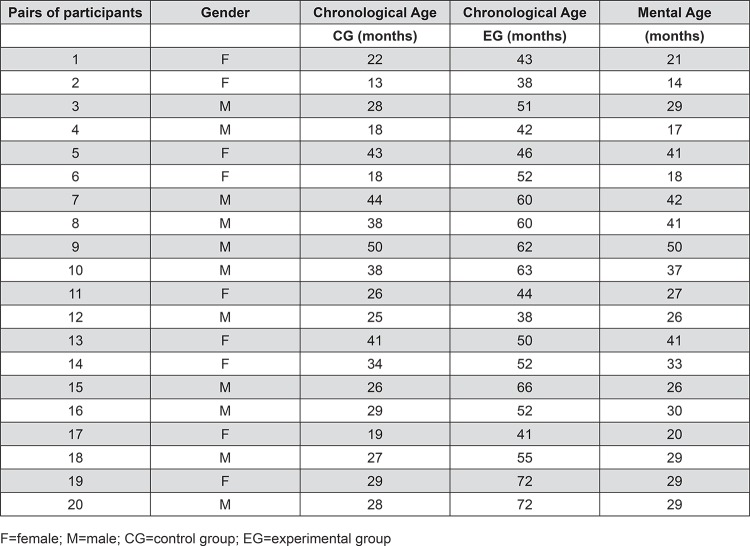
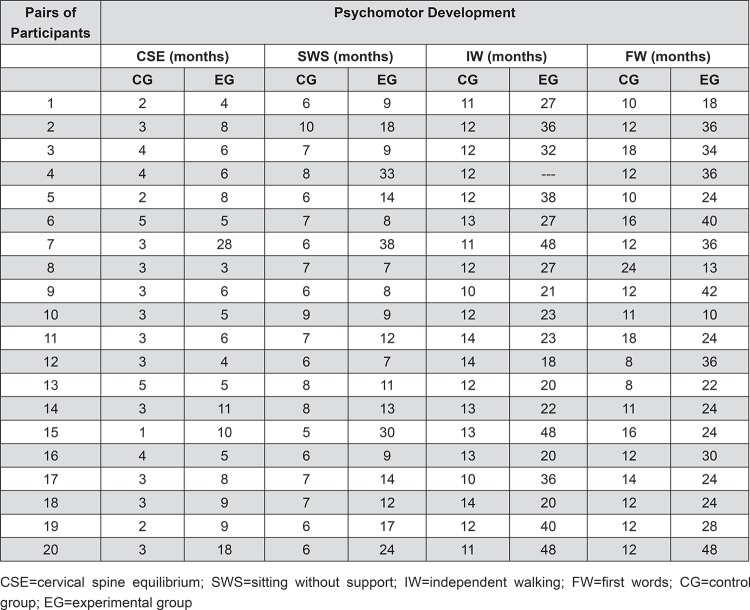
A global developmental delay is expected from Down syndrome, affecting motor, cognitive, linguistic and personal-social skills. However, not always these delays are proportional; different conditions occur due to several intrinsic and extrinsic variables that must be controlled to form groups of greater homogeneity.Objective To enhance personal-social, fine motor-adaptive, gross motor and linguistic skills among children with Down syndrome and compare them with typically developing children, matched for gender, socioeconomic status and mental age, while controlling some variables that interfere with the global development.Methods The ethical aspects were fulfilled (Case No. 040/2009). The following inclusion criteria were considered: participants without a history of prematurity, very low birth weight, congenital hypothyroidism, significant hearing and vision problems, and signs of Autism Spectrum Disorder. After the inclusion criteria were considered, 40 children participated in the study, of which 20 had Down syndrome (experimental group - EG), these being of both genders and with chronological ages ranging from 38 to 63 months, and the other 20 being typically developing children (control group - CG), matching the EG in terms of gender, socioeconomic status and mental age, with this age ranging from 13 to 50 months. The evaluation consisted in applying the Denver Developmental Screening Test II, a test that assesses areas such as personal-social, fine motor-adaptive, linguistic and gross motor development. The results were subjected to statistical analysis using Student's t-test.Results A statistically significant difference was verified between the groups for the language and fine motor-adaptive areas.Conclusion Children with Down syndrome showed lower performance in language and fine motor skills when compared with typically developing children. There was no statistically significant difference in gross motor and personal-social areas. It is worth mentioning the importance of controlling the variables to deal with more homogeneous groups.
Figures
References
-
- Anjos CC, Neto FG, Fontes VL. Comparative study of motor development of children with Down syndrome in relation to Denver II Scale. Fisioter Bras. 2008;9(6):387–391.
-
- Brazilian Economic Classification Criteria. São Paulo: Brazilian Association of Research Companies (ABEP); 2011.
-
- Campbell C, Landry O, Russo N, Flores H, Jacques S, Burack JA. Cognitive flexibility among Individuals with Down syndrome: assessing the influence of verbal and nonverbal abilities. Am J Intellect Dev Disabil. 2013;118(3):193–200. - PubMed
-
- Carney DP, Henry LA, Messer DJ, Danielsson H, Brown JH, Rönnberg J. Using developmental trajectories to examine verbal and visuospatial short-term memory development in children and adolescents with Williams and Down syndromes. Res Dev Disabil. 2013;(34):3421–3432. - PubMed
Publication types
MeSH terms
LinkOut - more resources
Full Text Sources
Other Literature Sources
Medical