


Interpregnancy interval and perinatal outcomes across Latin America from 1990 to 2009: a large multi-country study
- PMID: 26399217
- PMCID: PMC4949506
- DOI: 10.1111/1471-0528.13625
Interpregnancy interval and perinatal outcomes across Latin America from 1990 to 2009: a large multi-country study
Erratum in
-
Corrigendum.BJOG. 2016 Aug;123(9):1568. doi: 10.1111/1471-0528.14191. BJOG. 2016. PMID: 27440609 Free PMC article. No abstract available.
Abstract
Objective: To determine the relationship of interpregnancy interval with maternal and offspring outcomes.
Design: Retrospective study with data from the Perinatal Information System database of the Latin American Centre for Perinatology and Human Development, Uruguay.
Setting: Latin America, 1990-2009.
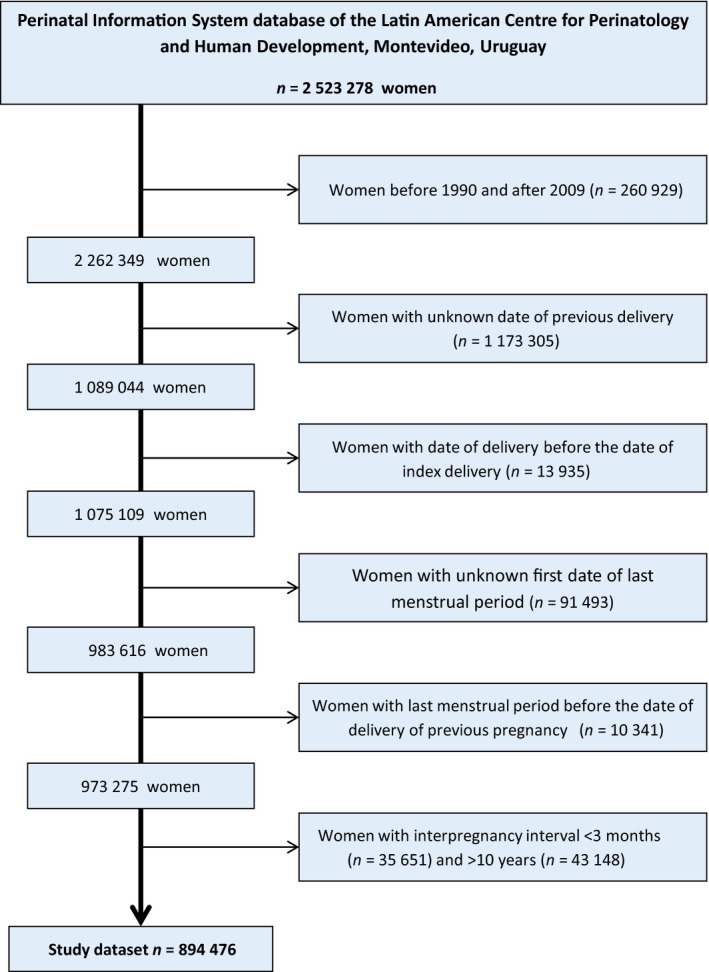
Population: A cohort of 894 476 women delivering singleton infants.
Methods: During 1990-2009 the Perinatal Information System database of the Latin American Centre for Perinatology identified 894 476 women with defined interpregnancy intervals: i.e. the time elapsed between the date of the previous delivery and the first day of the last normal menstrual period for the index pregnancy. Using the interval 12-23 months as the reference category, multiple logistic regression estimated adjusted odds ratios (aORs) with 95% confidence intervals (95% CIs) of the association between various interval lengths and maternal and offspring outcomes.
Main outcome measures: Maternal death, pre-eclampsia, eclampsia, puerperal infection, fetal death, neonatal death, preterm birth, and low birthweight.
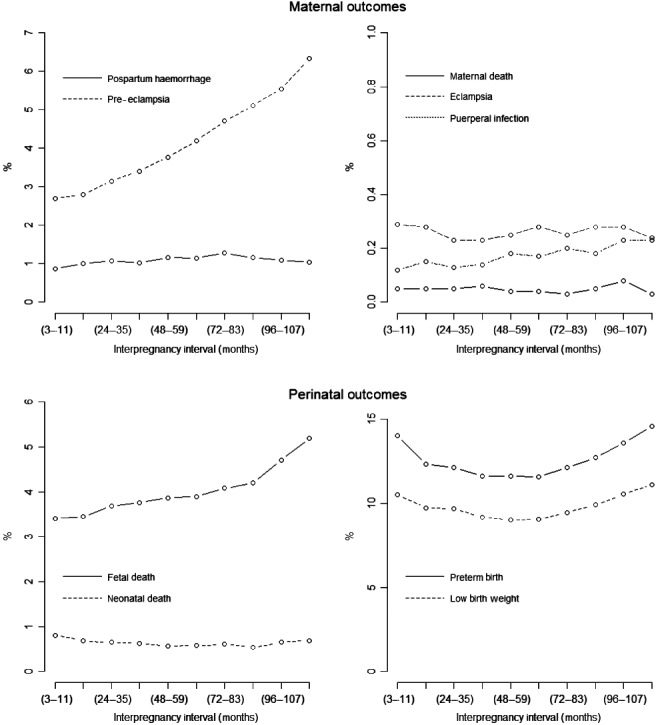
Results: In the reference interval there was 0.05% maternal death, 1.00% postpartum haemorrhage, 2.80% pre-eclampsia, 0.15% eclampsia, 0.28% puerperal infection, 3.45% fetal death, 0.68% neonatal death, 12.33% preterm birth, and 9.73% low birthweight. Longer intervals had increased odds of pre-eclampsia (>72 months), fetal death (>108-119 months), and low birthweight (96-107 months). Short intervals of <12 months had increased odds of pre-eclampsia (aOR 0.80; 95% CI 0.76-0.85), neonatal death (aOR 1.18; 95% CI 1.08-1.28), and preterm birth (aOR 1.16; 95% CI 1.11-1.21). Statistically, the interval had no relationship with maternal death, eclampsia, and puerperal infection.
Conclusions: A short interpregnancy interval of <12 months is associated with pre-eclampsia, neonatal mortality, and preterm birth, but not with other maternal or offspring outcomes. Longer intervals of >72 months are associated with pre-eclampsia, fetal death, and low birthweight, but not with other maternal or offspring outcomes.
Tweetable abstract: A short interpregnancy interval of <12 months is associated with neonatal mortality and preterm birth.
Keywords: Fetal death; interpregnancy intervals; maternal death; perinatal; pre-eclampsia.
© 2015 The Authors. BJOG An International Journal of Obstetrics and Gynaecology published by John Wiley & Sons Ltd on behalf of Royal College of Obstetricians and Gynaecologists.
Figures
References
-
- Billari FC, Kohler HP. Patterns of low and lowest‐low fertility in Europe. Popul Stud (Camb) 2004;58:161–76. - PubMed
-
- Andersson G. Childbearing trends in Sweden 1961–1997. Eur J Popul 1999;15:1–24. - PubMed
-
- Conde‐Agudelo A, Rosas‐Bermudez A, Kafury‐Goeta AC. Birth spacing and risk of adverse perinatal outcomes: a meta‐analysis. JAMA 2006;295:1809–23. - PubMed
-
- Conde‐Agudelo A, Rosas‐Bermudez A, Kafury‐Goeta AC. Effects of birth spacing on maternal health: a systematic review. Am J Obstet Gynecol 2007;196:297–308. - PubMed
Publication types
MeSH terms
Grants and funding
LinkOut - more resources
Full Text Sources
Other Literature Sources
Medical
