. 2015 Sep 24:4:120.
doi: 10.1186/s13643-015-0109-0.

Diagnostic accuracy of fine needle aspiration biopsy for detection of malignancy in pediatric thyroid nodules: protocol for a systematic review and meta-analysis

Affiliations

Diagnostic accuracy of fine needle aspiration biopsy for detection of malignancy in pediatric thyroid nodules: protocol for a systematic review and meta-analysis

Sarah W Lai et al. Syst Rev. .

Abstract

Background: Fine needle aspiration biopsy (FNAB) is an accurate test commonly used to determine whether thyroid nodules are malignant in adults. However, less is known about its diagnostic accuracy for this purpose in children, where conduct of FNAB is less frequent, more technically challenging, and pre-test probabilities of malignancy are often higher. The purpose of this systematic review is to evaluate the diagnostic accuracy of FNAB for the detection of malignancy in pediatric thyroid nodules.

Methods: We will search electronic bibliographic databases (MEDLINE, EMBASE, the Cochrane Library, and Evidence-Based Medicine) from their date of inception, reference lists of included articles, proceedings from relevant conferences, and the table of contents of the Journal of Pediatric Surgery (January 2007-present). Two reviewers will independently screen titles and abstracts and identify diagnostic accuracy studies involving FNAB of the thyroid in children. We will include studies comparing FNAB to a reference standard of surgical histopathology or clinical follow-up for detection of malignancy in pediatric thyroid nodules. Two investigators will independently extract data and assess risk of bias using the Quality of Diagnostic Accuracy Studies-II tool. Pooled estimates of sensitivity, specificity, and positive and negative likelihood ratios will be calculated using bivariate random-effects and hierarchical summary receiver operating characteristic models. In the presence of between-study heterogeneity, we will conduct stratified meta-analyses and meta-regression to determine whether diagnostic accuracy estimates vary by country of origin, use of ultrasound guidance during FNAB, qualifications of the individuals performing/interpreting FNAB, adherence to the Bethesda criteria for cytology classification, length of clinical follow-up, timing of data collection, patient selection methods, and presence of verification bias.

Discussion: This meta-analysis will determine the diagnostic accuracy of FNAB for detection of malignancy in pediatric thyroid nodules and explore whether heterogeneity observed across studies may be explained by variations in patient population, FNAB technique or interpretation, and/or study-level risks of bias. This will be the first study to determine the accuracy of Bethesda cytological classification levels of FNAB (benign, atypical, follicular, suspicious, malignant). We expect that our results will help in guiding clinical decision-making in children with thyroid nodules.

Systematic review registration: PROSPERO No. CRD42014007140.


Figures
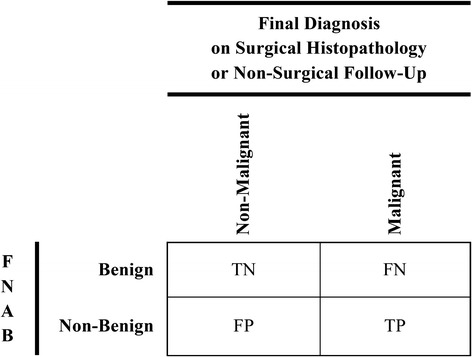
Fig. 1
Fig. 1
Two-by-two table examining the primary outcome. Definitions of true and false positives and negatives comparing fine needle aspiration biopsy (FNAB) to the final diagnosis based on surgical histopathology or non-surgical clinical follow-up. Positive and negative results of index test (FNAB) separated into non-benign and benign. Positive and negative results of reference test (surgical histopathology or non-surgical clinical follow-up) separated into malignant and non-malignant. TN true negative, FN false negative, FP false positive, TP true positive, FNAB fine needle aspiration biopsy
Fig. 2
Fig. 2
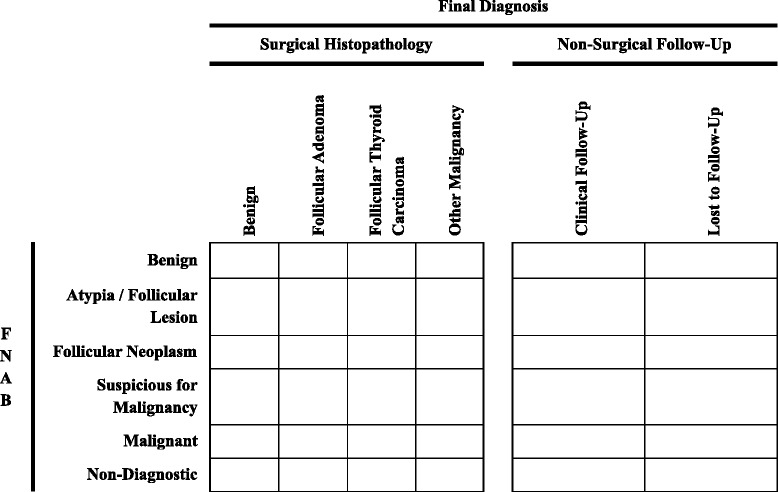
Six-by-six table examining the secondary outcome in studies that report data using the Bethesda criteria. FNAB fine needle aspiration biopsy
Fig. 3
Fig. 3
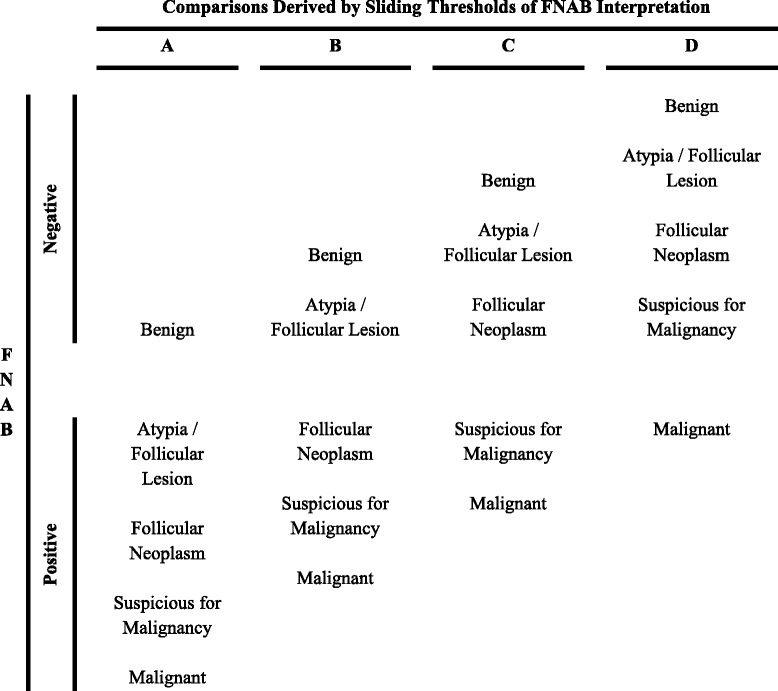
Sliding thresholds. Sliding thresholds used for fine needle aspiration biopsy (FNAB) interpretation as test negative or positive. Four separate comparisons (A, B, C, D) evaluate the test accuracy of each FNAB diagnostic category to predict thyroid nodule malignancy. FNAB fine needle aspiration biopsy
Fig. 4
Fig. 4
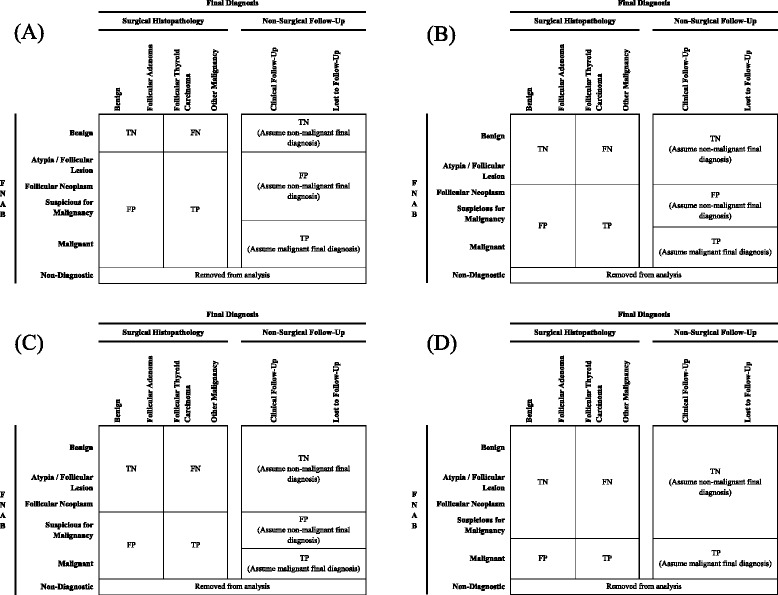
Definitions of true and false positives and negatives. Definitions of true and false positives and negatives after condensing six-by-six tables into two-by-two contingency tables for comparisons (ad). In a, positive and negative results of index test (fine needle aspiration biopsy [FNAB]) separated into non-benign and benign. In b, positive results of FNAB including follicular neoplasm, suspicious for malignancy and malignant, and negative results of FNAB including benign and atypia/follicular lesion. In c, positive results of FNAB including suspicious for malignancy and malignant, and negative results of FNAB including benign, atypia/follicular lesion and follicular neoplasm. In d, positive results of FNAB including malignant only, and negative results of FNAB including benign, atypia/follicular lesion, follicular neoplasm and suspicious for malignancy. In all comparisons, positive and negative results of gold standard reference test (surgical histopathology) separated into malignant and non-malignant. Positive and negative results of surrogate reference test (clinical follow-up) and losses to follow-up separated into final diagnoses based on FNAB results. Non-diagnostic biopsies were removed from analysis as final diagnosis of malignant or non-malignant disease unclear in patients lost to follow-up. TN true negative, FN false negative, FP false positive, TP true positive, FNAB fine needle aspiration biopsy

References

    1. Altincik A, Demir K, Abaci A, Bober E, Buyugebiz A. Fine-needle aspiration biopsy in the diagnosis and follow-up of thyroid nodules in childhood. JCRPE. 2010;2:78–80. doi: 10.4274/jcrpe.v2i2.78. - DOI - PMC - PubMed
    1. Buryk MA, Monaco SE, Witchel SF, Mehta DK, Gurtunca N, Nikiforov YE, et al. Preoperative cytology with molecular analysis to help guide surgery for pediatric thyroid nodules. Int J Pediatr Otorhinolaryngol. 2013;77:1697–700. doi: 10.1016/j.ijporl.2013.07.029. - DOI - PubMed
    1. Kaur J, Srinivasan R, Arora SK, Rajwanshi A, Saikia UN, Dutta P, et al. Fine-needle aspiration in the evaluation of thyroid lesions in children. Diagn Cytopathol. 2012;40(S1):E33–7. doi: 10.1002/dc.21568. - DOI - PubMed
    1. Hoperia V, Larin A, Jensen K, Bauer A, Vasko V. Thyroid fine needle aspiration biopsies in children: study of cytological-histological correlation and immunostaining with thyroid peroxidase monoclonal antibodies. Int J Pediatr Endocrinol. 2010; doi:10.1155/2010/690108. - PMC - PubMed
    1. Mirshemirani A, Roshanzamir F, Tabari AK, Ghorobi J, Salehpoor S, Gorji FA. Thyroid nodules in childhood: a single institute experience. Iran J Pediatr. 2010;20:91–6. - PMC - PubMed

Publication types