


Noninvasive Ventilation for Preterm Twin Neonates with Respiratory Distress Syndrome: A Randomized Controlled Trial
- PMID: 26399752
- PMCID: PMC4585863
- DOI: 10.1038/srep14483
Noninvasive Ventilation for Preterm Twin Neonates with Respiratory Distress Syndrome: A Randomized Controlled Trial
Abstract
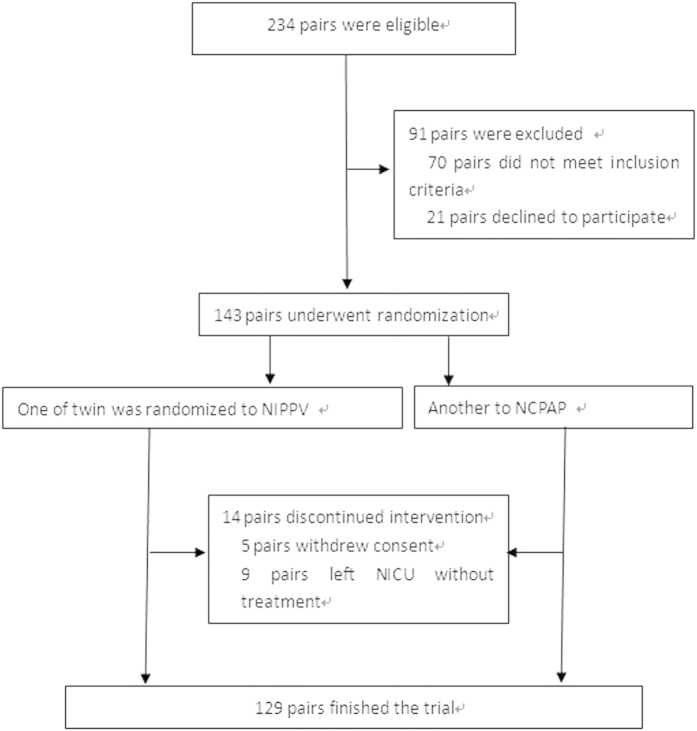
Noninvasive ventilation has been proven to be effective strategies for reducing the need for endotracheal ventilation in preterm infant with respiratory distress syndrome (RDS), however the best option needs to be further determined. A single center, paired design, randomized, controlled trial was conducted between Jan 2011 and July 2014. Preterm twins with RDS were included. One of a pair was randomized to NIPPV, while another to NCPAP. Surfactant was administrated as rescue treatment. The primary outcome was the need for endotracheal ventilation. The secondary outcomes were the complications. 143 pairs were randomized and 129 pairs finished the trial. The rates of endotracheal ventilation did not differ significantly between NIPPV and NCPAP groups (11.9% vs 19.6%, P = 0.080). This difference was not observed in the subgroup of infants who received surfactant therapy (11.1% vs 19.7%, P = 0.087). No secondary outcomes also differed significantly between the two groups. NIPPV did not result in a significantly lower incidence of intubation as compared with NCPAP in preterm twins with RDS.
References
-
- Schmidt B. et al. Impact of bronchopulmonary dysplasia, brain injury, and severe retinopathy on the outcome of extremely low-birthweight infants at 18 months: results from the Trial of Indomethacin Prophylaxis in Preterms. JAMA. 289, 1124–1129 (2010). - PubMed
-
- Stroustrup A. & Trasande L. Epidemiological characteristics and resource use in neonates with bronchopulmonary dysplasia: 1993–2006. Pediatrics. 126, 291–297 (2010). - PubMed
-
- Long C., Jie L., Nan W. & Yuan S. Post-Newborn: A New Concept of Period in Early Life. Frontier and Future Development of Information Technology in Medicine and Education. LNEE. 269, 1343–1350 (2014).
Publication types
MeSH terms
LinkOut - more resources
Full Text Sources
Other Literature Sources
Medical
