Review
. 2016 Jan;13(1):34-46.
doi: 10.1007/s13311-015-0391-5.

Efficacy of Intravenous Immunoglobulin in Neurological Diseases

Affiliations
Review

Efficacy of Intravenous Immunoglobulin in Neurological Diseases

Jan D Lünemann et al. Neurotherapeutics. 2016 Jan.

Abstract

Owing to its anti-inflammatory efficacy in various autoimmune disease conditions, intravenous immunoglobulin (IVIG)-pooled IgG obtained from the plasma of several thousands individuals-has been used for nearly three decades and is proving to be efficient in a growing number of neurological diseases. IVIG therapy has been firmly established for the treatment of Guillain-Barré syndrome, chronic inflammatory demyelinating polyneuropathy, and multifocal motor neuropathy, either as first-line therapy or adjunctive treatment. IVIG is also recommended as rescue therapy in patients with worsening myasthenia gravis and is beneficial as a second-line therapy for dermatomyositis and stiff-person syndrome. Subcutaneous rather than intravenous administration of IgG is gaining momentum because of its effectiveness in patients with primary immunodeficiency and the ease with which it can be administered independently from hospital-based infusions. The demand for IVIG therapy is growing, resulting in rising costs and supply shortages. Strategies to replace IVIG with recombinant products have been developed based on proposed mechanisms that confer the anti-inflammatory activity of IVIG, but their efficacy has not been tested in clinical trials. This review covers new developments in the immunobiology and clinical applications of IVIG in neurological diseases.

Keywords: Immunotherapy; Intravenous immunoglobulin; Neurology.


Figures
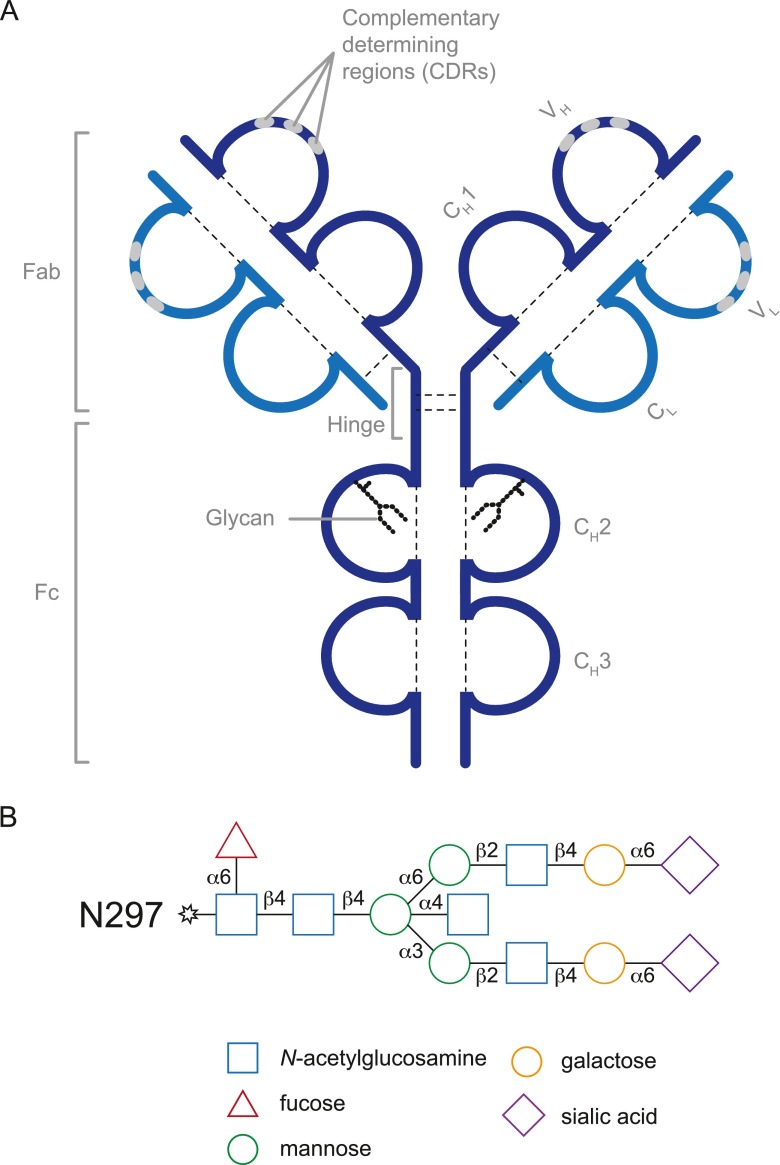
Fig. 1
Fig. 1
Structure of IgG and its Fc-linked glycans. (A) Schematic depiction of a prototypic IgG1 antibody composed of 2 heavy and light chains and 2 glycans. Structural and functional components are indicated in gray. Fab = fragment antigen binding; Fc = fragment crystallizable; CH = constant domain heavy chain; CL = constant domain light chain; VH = variable domain heavy chain; VL = variable domain light chain. (B) Composition of a fully processed N297-glycan (galactosylated, sialylated, and containing a bisecting N-acetylglucosamine)
Fig. 2
Fig. 2
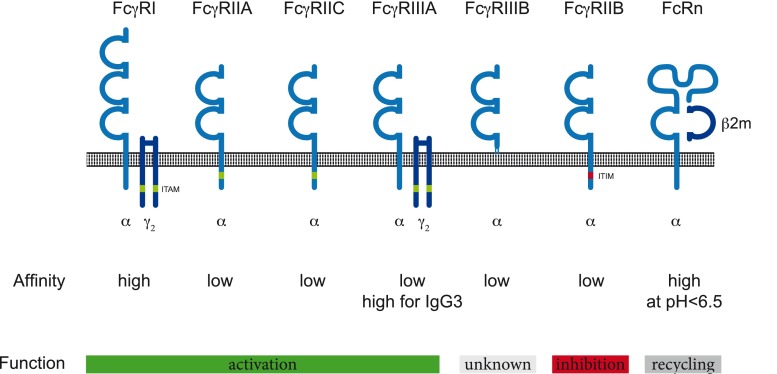
The human FcγR family. Schematic depiction of human FcγRs α-chains and the major signaling adaptor molecule for FcγRI and FcγRIIIA, the common gamma chain dimer (γ2). Immune tyrosine-based activation (ITAM, green) or inhibition (ITIM, red) sequences are indicated. FcRn is a heterodimeric major histocompatibility chain-I like molecule associated with β2 microglobulin (β2m). The receptor’s affinity for IgG and their function in upon receptor cross-linking are indicated

References

    1. Imbach P, Barandun S, d'Apuzzo V, et al. High-dose intravenous gammaglobulin for idiopathic thrombocytopenic purpura in childhood. Lancet. 1981;1:1228–1231. doi: 10.1016/S0140-6736(81)92400-4. - DOI - PubMed
    1. Fehr J, Hofmann V, Kappeler U. Transient reversal of thrombocytopenia in idiopathic thrombocytopenic purpura by high-dose intravenous gamma globulin. N Engl J Med. 1982;306:1254–1258. doi: 10.1056/NEJM198205273062102. - DOI - PubMed
    1. Gelfand EW. Intravenous immune globulin in autoimmune and inflammatory diseases. N Engl J Med. 2012;367:2015–2025. doi: 10.1056/NEJMra1009433. - DOI - PubMed
    1. Lunemann JD, Nimmerjahn F, Dalakas MC. Intravenous immunoglobulin in neurology--mode of action and clinical efficacy. Nat Rev Neurol. 2015;11:80–89. doi: 10.1038/nrneurol.2014.253. - DOI - PubMed
    1. Boruchov AM, Heller G, Veri MC, Bonvini E, Ravetch JV, Young JW. Activating and inhibitory IgG Fc receptors on human DCs mediate opposing functions. J Clin Invest. 2005;115:2914–2923. doi: 10.1172/JCI24772. - DOI - PMC - PubMed

Publication types

MeSH terms

Substances