. 2015 Sep 22;5(11):2513-22.
doi: 10.1534/g3.115.020115.

Genomic Instability of the Sex-Determining Locus in Atlantic Salmon (Salmo salar)

Affiliations

Genomic Instability of the Sex-Determining Locus in Atlantic Salmon (Salmo salar)

Krzysztof P Lubieniecki et al. G3 (Bethesda). .

Abstract

Atlantic salmon and rainbow trout, like other members of the subfamily Salmoninae, are gonochoristic with male heterogamety. The finding that sex-linked genetic markers varied between species suggested that the sex-determining gene differs among salmonid species, or that there is one sex-determining gene that has the capacity to move around the genome. The discovery of sdY, the sex-determining gene in rainbow trout, and its presence in many male salmonids gave support to the latter. Additional evidence for a salmonid-specific, sex-determining jumping gene came from the mapping of the sex-determining locus to three different chromosomes in Tasmanian male Atlantic salmon lineages. To characterize the sex-determining region, we isolated three sdY containing BACs from an Atlantic salmon male library. Sequencing of these BACs yielded two contigs, one of which contained the sdY gene. Sequence analysis of the borders of male-specific and female/male common regions revealed highly repetitive sequences associated with mobile elements, which may allow an sdY cassette to jump around the genome. FISH analysis using a BAC or a plasmid containing the sdY gene showed that the sdY gene did indeed localize to the chromosomes where SEX had been mapped in different Tasmanian Atlantic salmon families. Moreover, the plasmid sdY gene probe hybridized primarily to one of the sex chromosomes as would be expected of a male-specific gene. Our results suggest that a common salmonid sex-determining gene (sdY) can move between three specific loci on chromosomes 2, 3, and 6, giving the impression that there are multiple SEX loci both within and between salmonid species.

Keywords: Atlantic salmon; genetics of sex; jumping gene; sdY; sex-determining locus.


Figures

Figure 1
Figure 1
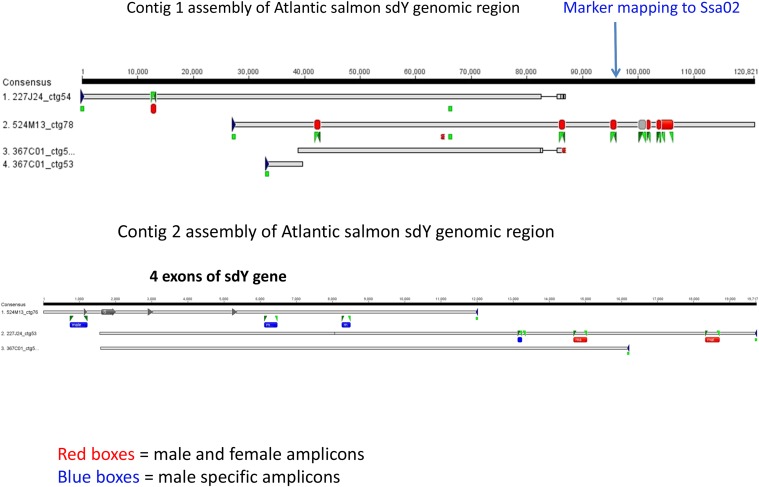
Schema of the assembly of the contig 1 and contig 2 with indication of the male-specific (blue boxes) and male and female common (red boxes) genomic regions. BAC end sequences are denoted by green boxes at the end of sequences. The green triangles illustrate the positions of primers (Table S1) used in PCR. The exons of sdY are shown as boxes ending in arrows in Contig 2. The position of the microsatellite marker that mapped to linkage group 1 (Ssa02) in European Atlantic salmon is shown by the blue arrow in Contig 1.
Figure 2
Figure 2
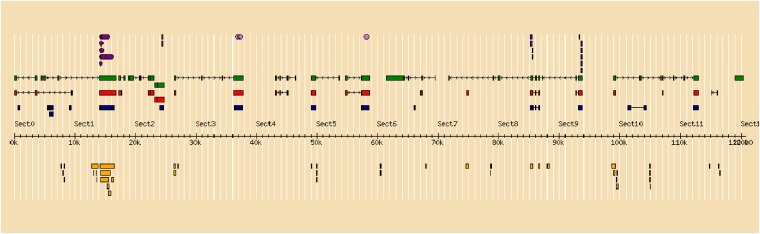
Annotation of contig 1. The sequence of Contig 1 has been submitted to GenBank (KP898411). The sequence was annotated using the Genomics Research on Atlantic Salmon Project (GRASP) annotation pipeline (see http://trutta.mbb.sfu.ca/bacannotations/GRASPbac.html and select Information for a schematic of the work flow). The full annotation data can be seen by going to http://trutta.mbb.sfu.ca/bacannotations/GRASPbac.html and choosing SOSDY_contig291 from the Atlantic salmon BAC list. Purple indicates conserved domain; green indicates a predicted protein by GeneScan from unmasked sequence using BLASTp against the UniRef database; red indicates a predicted protein by GeneScan from masked sequence using BLASTp against the UniRef database; blue shows the results of BLASTx comparisons against the nonredundant NCBI protein database; and yellow shows Atlantic salmon ESTs identified in the sequence using BLAT.
Figure 3
Figure 3
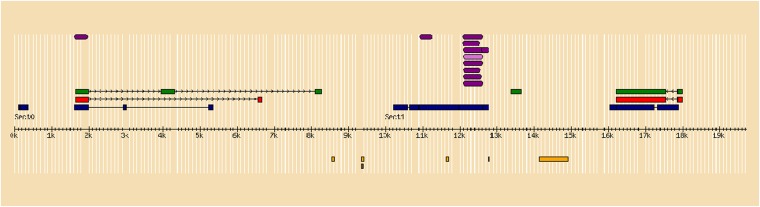
Annotation of contig 2. The sequence of Contig 2 has been submitted to GenBank (KP898412). The sequence was annotated using the Genomics Research on Atlantic Salmon Project (GRASP) annotation pipeline (see http://trutta.mbb.sfu.ca/bacannotations/GRASPbac.html and select Information for a schematic of the work flow). The full annotation data can be seen by going to http://trutta.mbb.sfu.ca/bacannotations/GRASPbac.html and choosing SOSDY_contig292 from the Atlantic salmon BAC list. Purple indicates conserved domain; green indicates a predicted protein by GeneScan from unmasked sequence using BLASTp against the UniRef database; red indicates a predicted protein by GeneScan from masked sequence using BLASTp against the UniRef database; blue shows the results of BLASTx comparisons against the nonredundant NCBI protein database; and yellow shows Atlantic salmon ESTs identified in the sequence using BLAT.
Figure 4
Figure 4
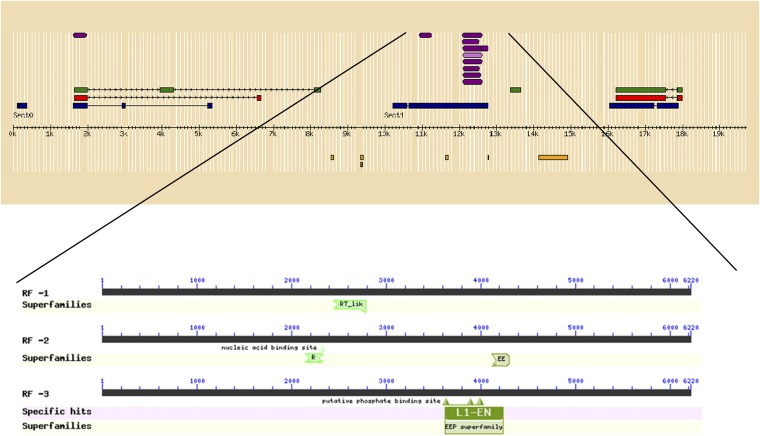
Conserved domains in genomic region of Contig 2 between male-specific DNA amplification and amplification of DNA from both male and female Atlantic salmon. See legends for Figure 2 and Figure 3 for explanation of colors and annotation pipeline.
Figure 5
Figure 5
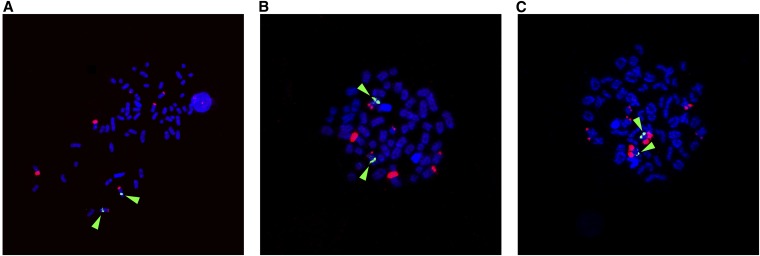
sdY chromosomal locations of European Atlantic salmon revealed by FISH using BAC probe, S0524M13, containing sdY sequences as part of insert. S0524M13 red fluorescence. Green arrows show S0033O17 (Ssa03 marker), S0332O19 (Ssa06 marker) and S0227A12 (Ssa02 marker) in A, B and C, respectively.
Figure 6
Figure 6
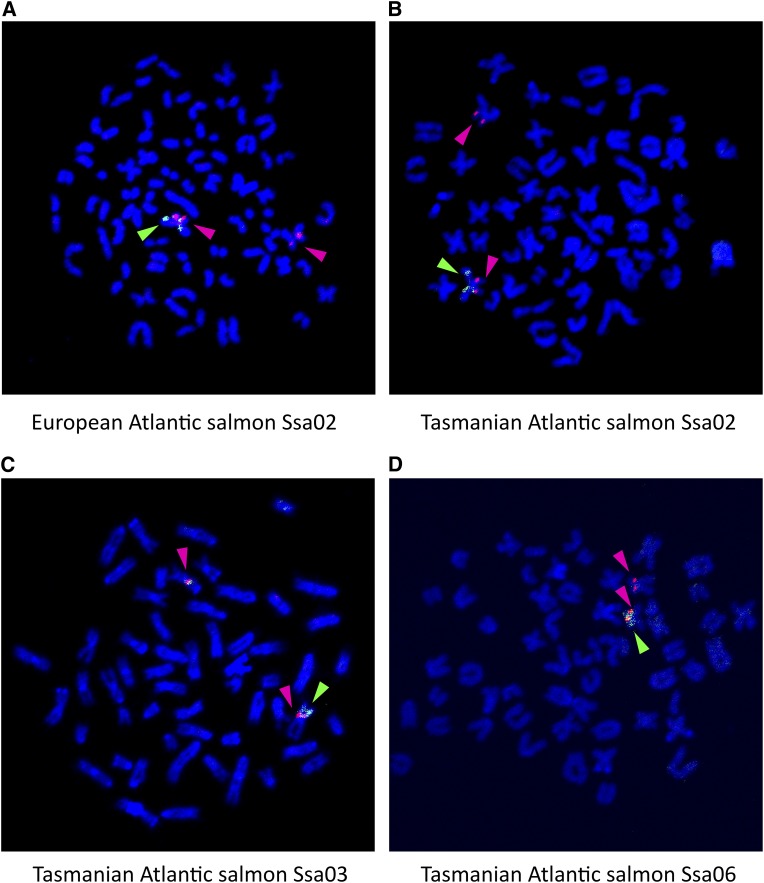
sdY chromosomal locations in male European (A) and Tasmanian (B, C, and D) Atlantic salmon revealed by FISH using a plasmid probe containing the sdY gene sequence. Green arrow: sdY-containing plasmid; red arrow: S0227A12 (Ssa02 marker), S0227A12 (Ssa02 marker), S0033O17 (Ssa03 marker), and S0332O19 (Ssa06 marker) in (A), (B), (C), and (D), respectively.

References

    1. Artieri C. G., Mitchell L. A., Ng S. H. S., Parisotto S. E., Danzmann R. G., et al. , 2006. Identification of the sex-determining locus of Atlantic salmon Salmo salar on chromosome 2. Cytogenet. Genome Res. 112: 152–159. - PubMed
    1. Bachtrog D., Mank J. E., Peichel C. L., Kirkpatrick M., Otto S. P., et al. , 2014. Sex determination: Why so many ways of doing it? PLoS Biol. 12: e1001899. - PMC - PubMed
    1. Brenna-Hansen S., Li J., Kent M. P., Boulding E. G., Dominik S., et al. , 2012. Chromosomal differences between European and North American Atlantic salmon discovered by linkage mapping and supported by fluorescence in situ hybridization analysis. BMC Genomics 13: 432. - PMC - PubMed
    1. Brunelli J. P., K. J. Wertzler, K. Sundin, and G. H. Thorgaard, 2008. Y-specific sequences and polymorphisms in rainbow trout and Chinook salmon. Genome 51: 739–748. - PubMed
    1. Cavileer T. D., Hunter S. S., Olsen J., Wenburg J., Nagler J. J., 2015. A sex-determining gene (sdY) assay shows discordance between phenotypic and genotypic sex in wild populations of Chinook salmon. Trans. Am. Fish. Soc. 144: 423–430.

Publication types

LinkOut - more resources