


Effect of constituents from samaras of Austroplenckia populnea (Celastraceae) on human cancer cells
- PMID: 26401377
- PMCID: PMC4566755
- DOI: 10.5455/jice.20141006105747
Effect of constituents from samaras of Austroplenckia populnea (Celastraceae) on human cancer cells
Abstract
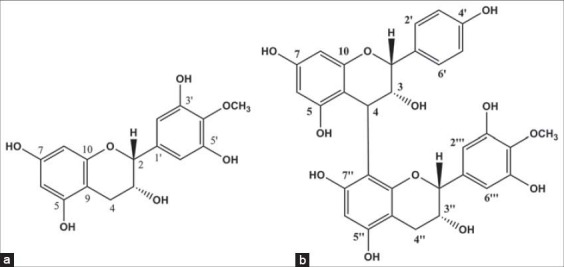
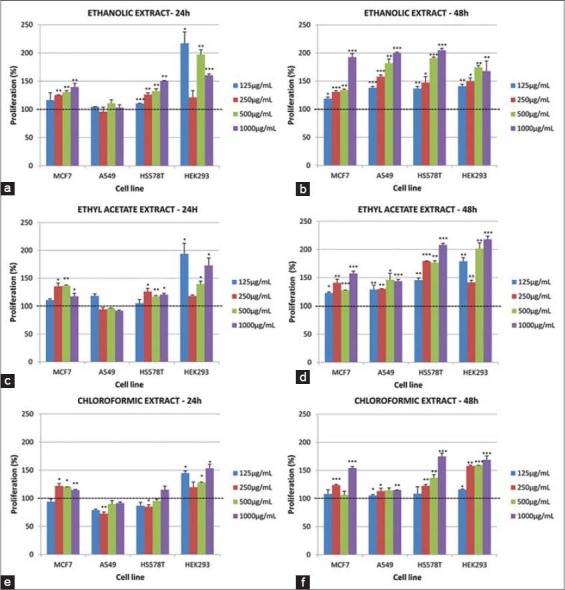
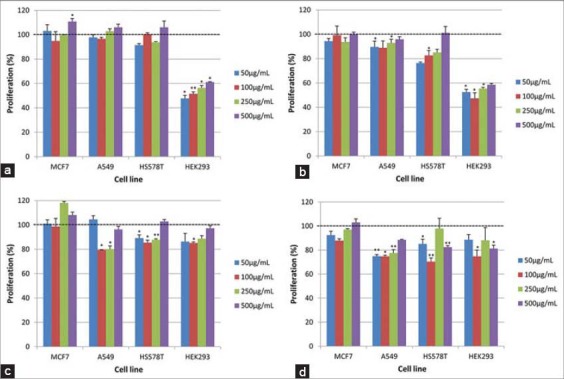
Background: Aiming the continuity of the studies of Austroplenckia populnea, Brazilian species of the Celastraceae family, in the present study, it was investigated the effect of crude extracts obtained with ethanol, ethyl acetate and chloroform and two purified constituents, proanthocyanidin A and 4'-O-methylepigallocatechin, both isolated from its samaras, on cancer cell proliferation assays.
Materials and methods: The human cancer cells lines MCF-7 (ductal breast carcinoma), A549 (lung cancer), HS578T (ductal breast carcinoma) and non-cancer HEK293 (embryonic kidney cells) were treated with different concentrations of extracts and constituents and the effect was observed through the acid phosphatase method. The chemical structures of the purified compounds were identified by the respective IR and (1)H and (13)C nuclear magnetic resonance spectral data.
Results: While crude extracts from samaras of the folk medicine A. populnea can trigger cell proliferative effects in human cell lines, the purified compounds (proanthocyanidin A and 4'-O-methyl-epigallocatechin) isolated from the same extracts can have an opposite (anti-proliferative) effect.
Conclusion: Based on the results, it was possible to suggest that extracts from samaras of A. populnea should be further investigated for possible cancer-promoting activities; and the active extracts can also represent a source of compounds that have anti-cancer properties.
Keywords: Austroplenckia populnea; Celastraceae; cancer cell proliferation; samaras.
Conflict of interest statement
Figures
References
-
- Rates SM. Plants as source of drugs. Toxicon. 2001;39:603–13. - PubMed
-
- Kupchan SM, Maruyama M, Hemingway RJ, Hemingway JC, Shibuya S, Fujita T, et al. Eupacunin, a novel antileukemic sesquiterpene lactone from Eupatorium cuneifolium. J Am Chem Soc. 1971;93:4914–6. - PubMed
-
- Gomes JP, Cardoso CR, Varanda EA, Molina J, Fernandez MF, Olea N, et al. Antitumoral, mutagenic and (anti) estrogenic activities of tingenone and pristimerin. Braz J Pharmacogn. 2011;21:963–71.
-
- Niero R, de Andrade SF, Cechinel Filho V. A review of the ethnopharmacology, phytochemistry and pharmacology of plants of the Maytenus genus. Curr Pharm Des. 2011;17:1851–71. - PubMed
-
- Shirota O, Morita H, Takeya K, Itokawa H. Cytotoxic aromatic triterpenes from Maytenus ilicifolia and Maytenus chuchuhuasca. JNat Prod. 1994;57:1675–81. - PubMed
LinkOut - more resources
Full Text Sources
Other Literature Sources