


What effect can manual therapy have on a patient's pain experience?
- PMID: 26401979
- PMCID: PMC4976880
- DOI: 10.2217/pmt.15.39
What effect can manual therapy have on a patient's pain experience?
Abstract
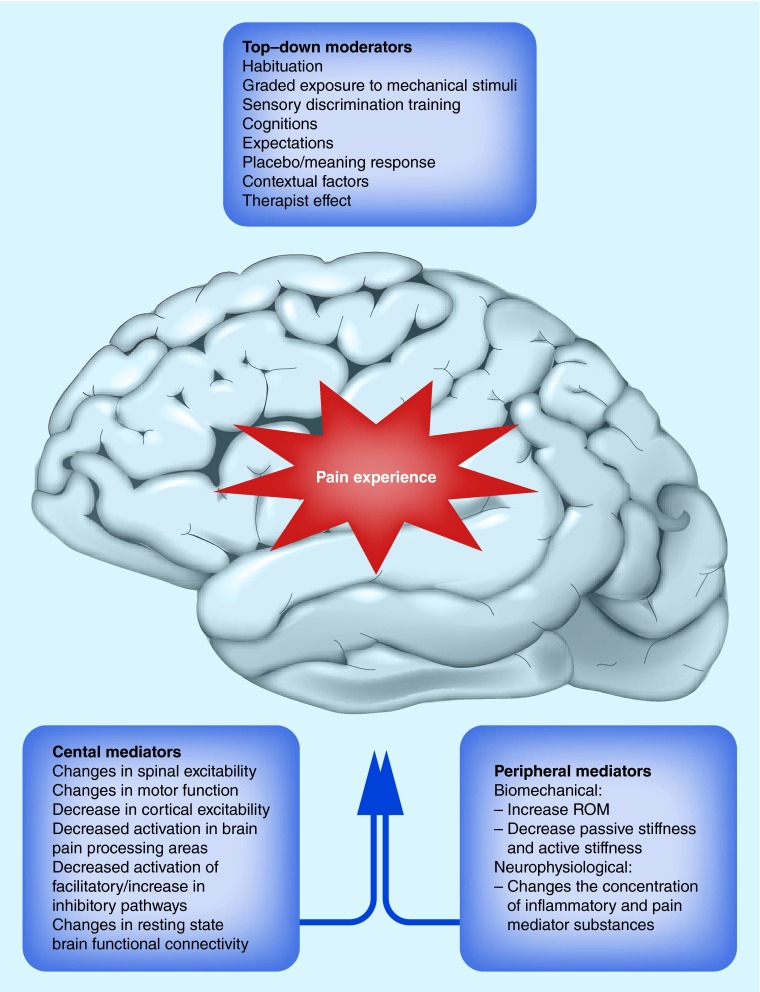
Manual therapy (MT) is a passive, skilled movement applied by clinicians that directly or indirectly targets a variety of anatomical structures or systems, which is utilized with the intent to create beneficial changes in some aspect of the patient pain experience. Collectively, the process of MT is grounded on clinical reasoning to enhance patient management for musculoskeletal pain by influencing factors from a multidimensional perspective that have potential to positively impact clinical outcomes. The influence of biomechanical, neurophysiological, psychological and nonspecific patient factors as treatment mediators and/or moderators provides additional information related to the process and potential mechanisms by which MT may be effective. As healthcare delivery advances toward personalized approaches there is a crucial need to advance our understanding of the underlying mechanisms associated with MT effectiveness.
Keywords: biomechanical; clinical reasoning; effectiveness; expectation; neurophysiological; placebo; preference; psychological; treatment mediation; treatment moderation.
Conflict of interest statement
Financial & competing interests disclosure This work was supported by funding from the National Institutes of Health National Center for Complementary and Integrative Health (R01AT006334 – MD Bishop, J Bialosky; F32 AT007729 – CW Gay) and National Center for Medical Rehabilitation Research (K12HD055929 – JM Beneciuk). The authors have no other relevant affiliations or financial involvement with any organization or entity with a financial interest in or financial conflict with the subject matter or materials discussed in the manuscript apart from those disclosed. No writing assistance was utilized in the production of this manuscript.
Figures
References
-
- Merskey H. Logic, truth and language in concepts of pain. Qual. Life Res. 1994;3(Suppl. 1):S69–S76. - PubMed
-
- Melzack R, Casey KL. Sensory, motivational and central control determinants of chronic pain: a new conceptual model. In: Kenshalo DR, editor. The Skin Senses. Thomas; IL, USA: 1968. pp. 423–443.
Publication types
MeSH terms
Substances
Grants and funding
LinkOut - more resources
Full Text Sources
Other Literature Sources
Medical
Research Materials
