. 2015;48(4):1095-107.
doi: 10.3233/JAD-150137.

The 12 Years Preceding Mild Cognitive Impairment Due to Alzheimer's Disease: The Temporal Emergence of Cognitive Decline

Affiliations
Free PMC article

The 12 Years Preceding Mild Cognitive Impairment Due to Alzheimer's Disease: The Temporal Emergence of Cognitive Decline

Panagiota Mistridis et al. J Alzheimers Dis. 2015.
Free PMC article

Abstract

Background: The identification of the type and sequence of cognitive decline in preclinical mild cognitive impairment (MCI) prior to Alzheimer's disease (AD) is crucial for understanding AD pathogenesis and implementing therapeutic interventions.

Objective: To model the longitudinal courses of different neuropsychological functions in MCI due to AD.

Methods: We investigated the prodromal phase of MCI over a 12-year period in 27 initially healthy participants with subsequent MCI preceding AD (NC-MCI) and 60 demographically matched healthy individuals (NC-NC). The longitudinal courses of cognitive performance (verbal and visual episodic memory, semantic memory, executive functioning, constructional praxis, psychomotor speed, language, and informant-based reports) were analyzed with linear mixed effects models.

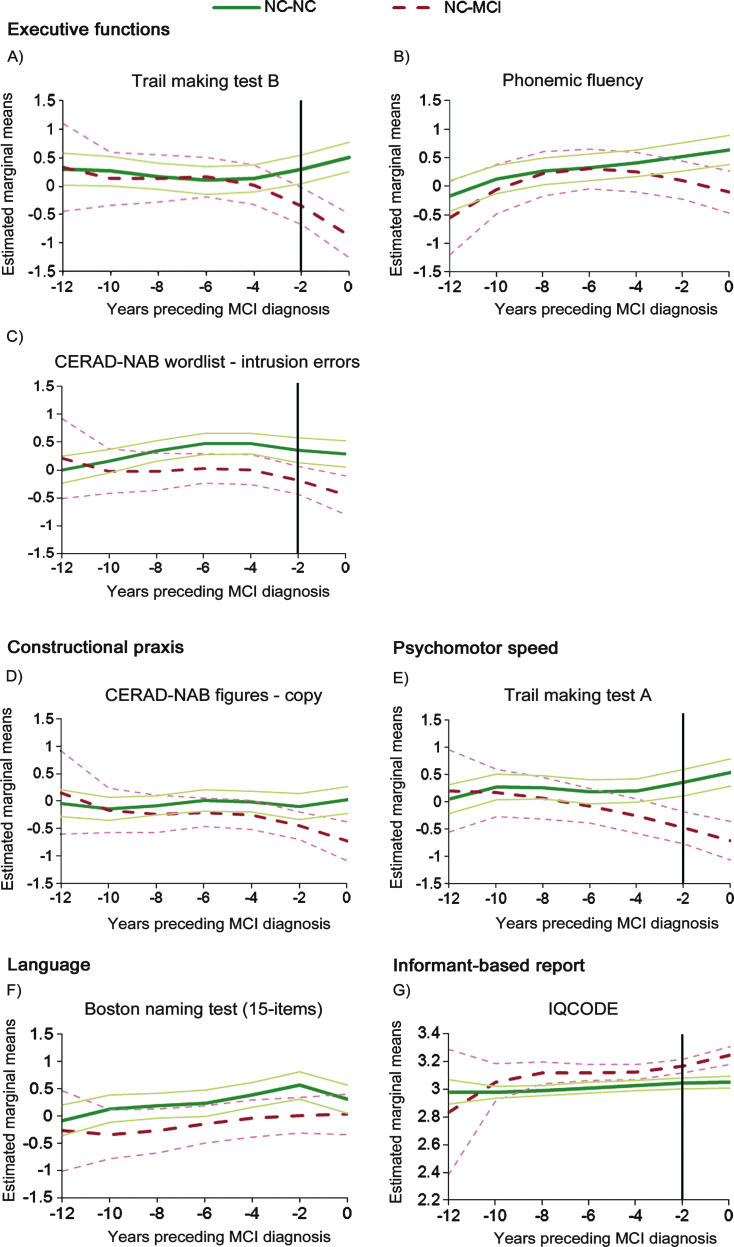
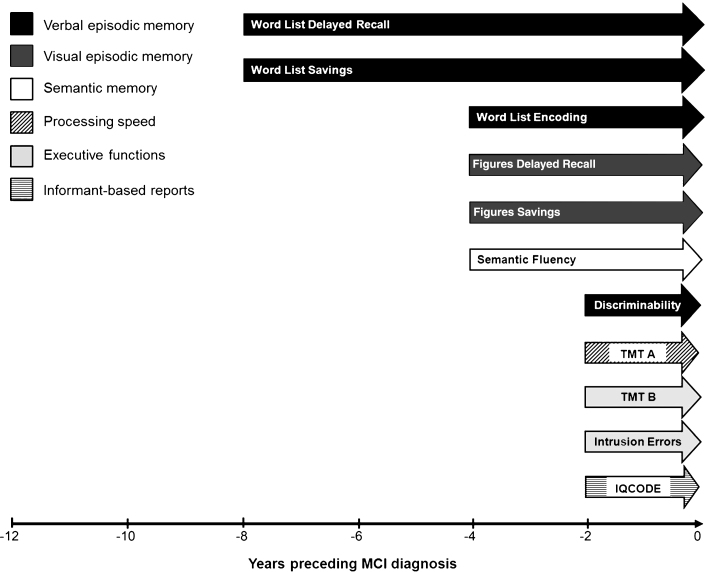
Results: The sequence with which different cognitive functions declined in the NC-MCI relative to the NC-NC group began with verbal memory and savings performance approximately eight years, and verbal episodic learning, visual memory, and semantic memory (animal fluency) circa four years prior to the MCI diagnosis. Executive functioning, psychomotor speed, and informant-based reports of the NC-MCI group declined approximately two years preceding the MCI diagnosis.

Conclusions: Measurable neuropsychological deterioration occurs up to approximately eight years preceding MCI due to AD.

Keywords: Alzheimer’s disease; cognitive decline; linear mixed effects models; longitudinal course; mild cognitive impairment; neuropsychology; prodromal.


Figures
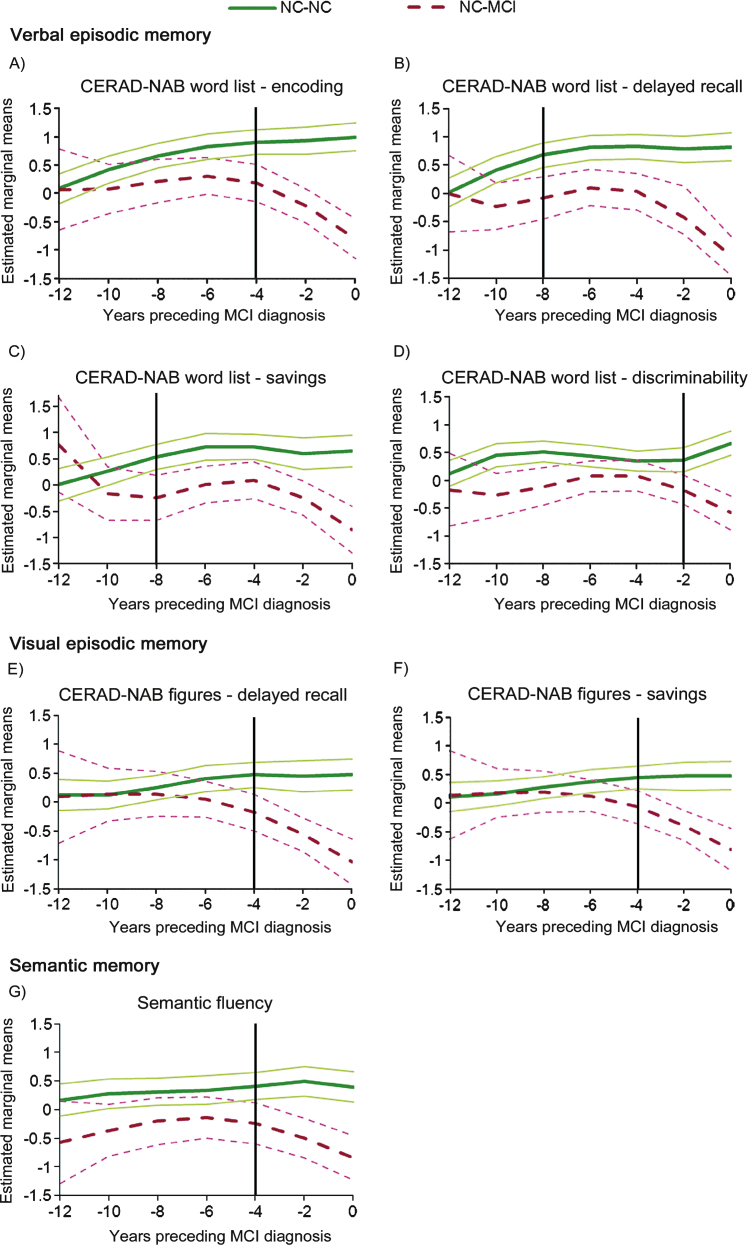
Fig.1
Fig.1
Cubic splines estimated from linear mixed effects models (with 95% confidence intervals) of the longitudinal courses of NC-NC and NC-MCI’s verbal and visual episodic and semantic memory functioning during the 12 years preceding the diagnosis of MCI due to AD. Cubic splines were computed for data at each observation visit, i.e., every two years preceding the MCI diagnosis. The vertical solid lines indicate the estimated timepoints at which the NC-NC and NC-MCI groups differed. NC-NC, cognitively healthy participants who remained healthy throughout the entire observation period; NC-MCI, initially healthy participants who progressed to MCI; MCI, mild cognitive impairment; CERAD-NAB, Consortium to Establish a Registry for Alzheimer’s Disease - Neuropsychological Assessment Battery [31].
Fig.2
Fig.2
Cubic splines estimated from linear mixed effects models (with 95% confidence intervals) of the longitudinal courses of NC-NC and NC-MCI’s neuropsychological functioning and informant-based report of cognitive functioning during the 12 years preceding the diagnosis of MCI due to AD. Cubic splines were computed for data at each observation visit, i.e., every two years preceding the MCI diagnosis. The vertical solid lines indicate the estimated timepoints at which the NC-NC and NC-MCI groups differed. NC-NC, cognitively healthy participants who remained healthy throughout the entire observation period; NC-MCI, initially healthy participants who progressed to MCI; MCI, mild cognitive impairment; CERAD-NAB, Consortium to Establish a Registry for Alzheimer’s Disease - Neuropsychological Assessment Battery [31]; IQCODE, Informant Questionnaire on Cognitive Decline in the Elderly [19].
Fig.3
Fig.3
Temporal order of different neuropsychological declines in the preclinical phase of MCI due to AD. MCI, mild cognitive impairment. Vertical bars indicate first (approximate) timepoints at which performance of future MCI patients diverged from participants who remained cognitively healthy.

References

    1. Duara R, Loewenstein DA, Greig MT, Potter E, Barker W, Raj A, Schinka J, Borenstein A, Schoenberg M, Wu Y, Banko J, Potter H. Pre-MCI and MCI: Neuropsychological, clinical, and imaging features and progression rates. Am J Geriatr Psychiatry. 2011;19:951–960. - PMC - PubMed
    1. Caselli RJ, Reiman EM, Locke DC, Hutton ML, Hentz JG, Hoffman-Snyder C, Woodruff BK, Alexander GE, Osborne D. Cognitive domain decline in healthy apolipoprotein E ɛ4 homozygotes before the diagnosis of mild cognitive impairment. Arch Neurol. 2007;64:1306–1311. - PubMed
    1. Mungas D, Beckett L, Harvey D, Tomaszewski Farias D, Reed B, Carmichael O, Olichney J, Miller J, DeCarli C. Heterogeneity of cognitive trajectories in diverse older persons. Psychol Aging. 2010;25:606–619. - PMC - PubMed
    1. Albert MS, Blacker D, Moss MB, Tanzi R, McArdle JJ. Longitudinal change in cognitive performance among individuals with mild cognitive impairment. Neuropsychology. 2007;21:158–169. - PubMed
    1. Grober E, Hall CB, Lipton RB, Zonderman AB, Resnick SM, Kawas C. Memory impairment, executive dysfunction, and intellectual decline in preclinical Alzheimer’s disease. J Int Neuropsychol Soc. 2008;14:266–278. - PMC - PubMed

Publication types