. 2016 Mar;37(3):502-7.
doi: 10.3174/ajnr.A4542. Epub 2015 Sep 24.

Stent-Assisted Coil Embolization of Intracranial Aneurysms: Complications in Acutely Ruptured versus Unruptured Aneurysms

Affiliations

Stent-Assisted Coil Embolization of Intracranial Aneurysms: Complications in Acutely Ruptured versus Unruptured Aneurysms

R S Bechan et al. AJNR Am J Neuroradiol. 2016 Mar.

Abstract

Background and purpose: The use of stents in the setting of SAH is controversial because of concerns about the efficacy and risk of dual antiplatelet therapy. We compare complications of stent-assisted coil embolization in patients with acutely ruptured aneurysms with complications in patients with unruptured aneurysms.

Materials and methods: Between February 2007 and March 2015, 45 acutely ruptured aneurysms and 47 unruptured aneurysms were treated with stent-assisted coiling. Patients with ruptured aneurysms were not pretreated with antiplatelet medication but received intravenous aspirin during the procedure. Thromboembolic events and early rebleeds were recorded.

Results: In ruptured aneurysms, 9 of 45 patients had thromboembolic complications. Four patients remained asymptomatic, 4 developed infarctions, and 1 patient died. The permanent complication rate in ruptured aneurysms was 11% (95% CI, 4%-24%). Five of 45 patients (11%; 95% CI, 4%-24%) had an early rebleed from the treated aneurysm after 3-45 days, and in 4, this rebleed was fatal. In 46 patients with 47 unruptured aneurysms, thromboembolic complications occurred in 2. One patient remained asymptomatic; the other had a thalamus infarction. The complication rate in unruptured aneurysms was 2.2% (1 of 46; 95% CI, 0.01%-12%). No first-time hemorrhages occurred in 46 patients with 47 aneurysms during 6 months of follow-up.

Conclusions: The complication rate of stent-assisted coiling with early adverse events in ruptured aneurysms was 10 times higher than that in unruptured aneurysms. Early rebleed accounted for most mortality. In ruptured aneurysms, stent-assisted coil embolization is associated with increased morbidity and mortality and should only be considered when less risky options have been excluded.


Figures

Fig 1.
Fig 1.
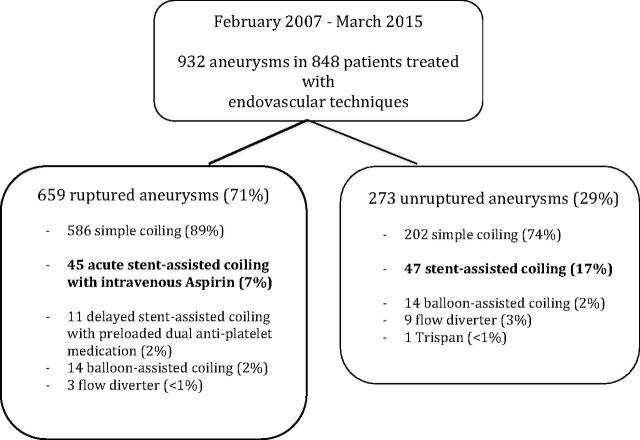
Flow chart of 932 aneurysms in 848 patients treated endovascularly between February 2007 and March 2015.
Fig 2.
Fig 2.
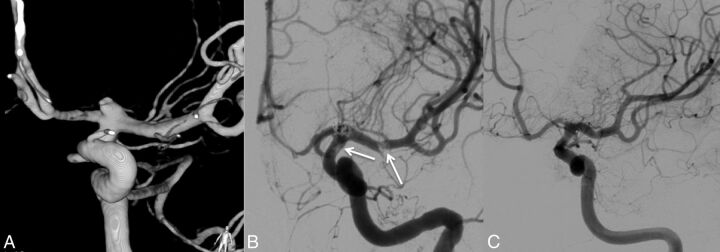
Ruptured carotid tip aneurysm in a 58-year-old woman treated with stent-assisted coiling. A, 3D angiogram shows a wide-neck aneurysm on the carotid tip. B, Anteroposterior left carotid artery angiogram during coiling demonstrates thrombus formation on the proximal and distal ends of the stent (arrows). C, Follow-up angiogram at 6 months shows complete aneurysm occlusion and patent distal internal carotid and middle cerebral arteries.
Fig 3.
Fig 3.
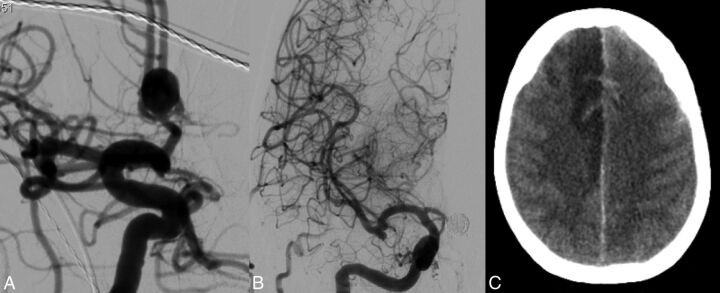
Ruptured anterior communicating artery aneurysm in a 64-year-old woman. A, Anteroposterior right carotid artery angiogram shows a large anterior communicating artery aneurysm with a relatively wide neck. A stent was placed in the right A1–A2. B, After coiling, the right A2 was completely occluded by an in-stent thrombus that did not react to glycoprotein IIb/IIIa antagonist (tirofiban) therapy. C, CT scan the next day demonstrates infarction in the right anterior cerebral artery territory.
Fig 4.
Fig 4.
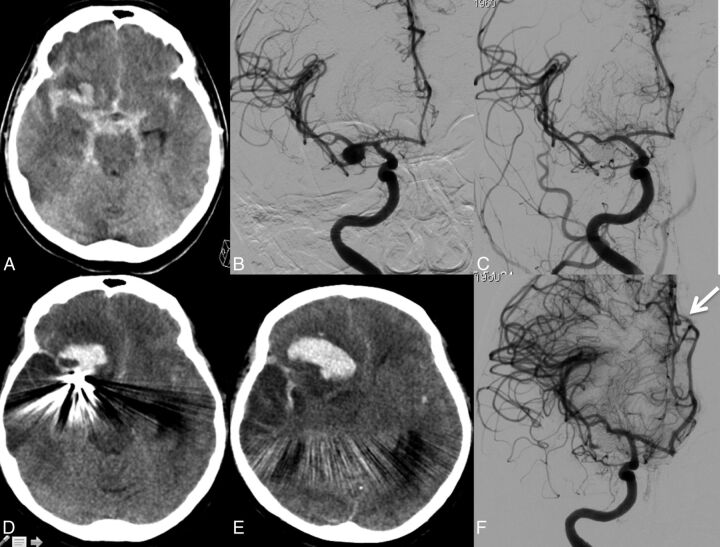
Ruptured middle cerebral artery aneurysm in a 54-year-old woman. A, CT scan on admission with SAH from the right middle cerebral artery aneurysm. B, Anteroposterior carotid artery angiogram shows a wide-neck middle cerebral artery aneurysm. C, Angiogram after stent-assisted coiling demonstrates complete aneurysm occlusion. D and E, CT scan 3 days later reveals recurrent hemorrhage from the aneurysm. F, Repeat angiogram the same day confirms complete occlusion of the aneurysm. Note subfalcine herniation of the anterior cerebral artery resulting from a large hematoma (arrow).
Fig 5.
Fig 5.
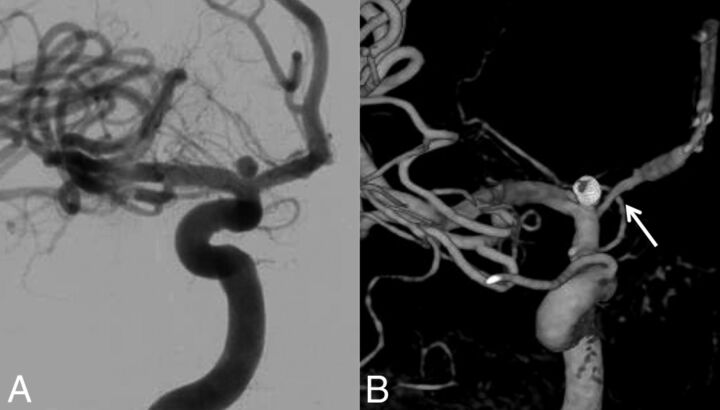
Ruptured small carotid tip aneurysm in a 33-year-old man. A, Anteroposterior carotid angiogram shows the small carotid tip aneurysm. A coil was placed inside the aneurysm, which seemed unstable, and a stent was subsequently placed across the neck in the A1. B, 3D angiogram 1 year later demonstrates severe narrowing of the A1. The patient was asymptomatic.

References

    1. Bodily KD, Cloft HJ, Lanzino G, et al. Stent-assisted coiling in acutely ruptured intracranial aneurysms: a qualitative, systematic review of the literature. AJNR Am J Neuroradiol 2011;32:1232–36 10.3174/ajnr.A2478 - DOI - PMC - PubMed
    1. Shapiro M, Becske T, Sahlein D, et al. Stent-supported aneurysm coiling: a literature survey of treatment and follow-up. AJNR Am J Neuroradiol 2012;33:159–63 10.3174/ajnr.A2719 - DOI - PMC - PubMed
    1. Mocco J, Snyder KV, Albuquerque FC, et al. Treatment of intracranial aneurysms with the Enterprise stent: a multicenter registry. J Neurosurg 2009;110:5–39 10.3171/2008.7.JNS08322 - DOI - PubMed
    1. Chalouhi N, Jabbour P, Singhal S, et al. Stent-assisted coiling of intracranial aneurysms: predictors of complications, recanalization, and outcome in 508 cases. Stroke 2013;44:1348–53 10.1161/STROKEAHA.111.000641 - DOI - PubMed
    1. Piotin M, Blanc R, Spelle L, et al. Stent-assisted coiling of intracranial aneurysms: clinical and angiographic results in 216 consecutive aneurysms. Stroke 2010;41:110–15 10.1161/STROKEAHA.109.558114 - DOI - PubMed