


Vaccine-preventable diseases in humanitarian emergencies among refugee and internally-displaced populations
- PMID: 26406333
- PMCID: PMC4685677
- DOI: 10.1080/21645515.2015.1096457
Vaccine-preventable diseases in humanitarian emergencies among refugee and internally-displaced populations
Abstract
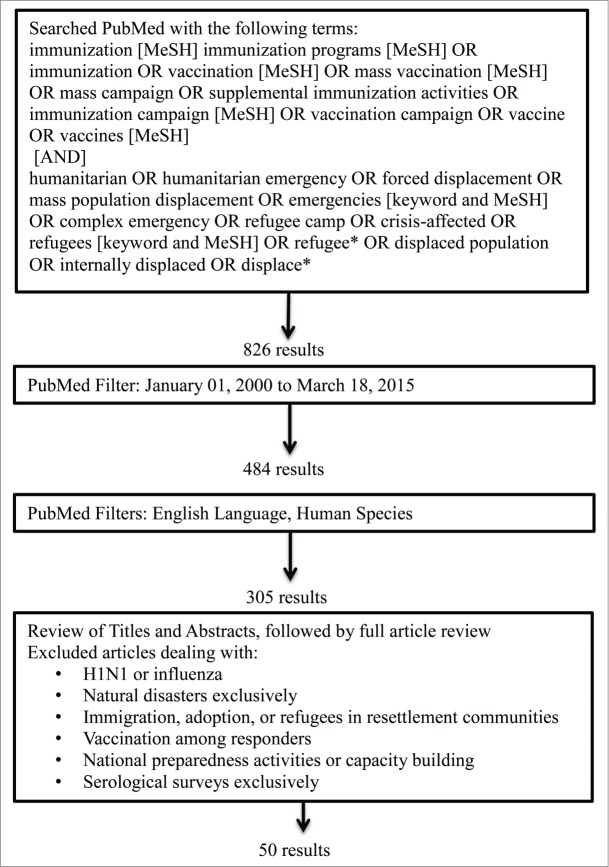
Humanitarian emergencies may result in breakdown of regular health services including routine vaccination programs. Displaced populations including refugees and internally displaced persons are particularly susceptible to outbreaks of communicable diseases such as vaccine-preventable diseases (VPDs). Common VPDs encountered in humanitarian emergencies include measles, polio, and depending on geographical location, meningococcal meningitis, yellow fever, hepatitis A, and cholera. We conducted a review of 50 published articles from 2000 to 2015 concerning VPDs in humanitarian emergencies. This article provides an update on the available literature regarding vaccinations among this highly vulnerable population and describes the unique challenges of VPDs during humanitarian emergencies. Humanitarian emergencies place affected populations at risk for elevated morbidity and mortality from VPDs due to creation or exacerbation of factors associated with disease transmission such as mass population movements, overcrowding, malnutrition, and poor water and sanitation conditions. Vaccination is one of the most basic and critical health interventions for protecting vulnerable populations during emergencies. Growing insecurity, as seen in the increasing number of targeted attacks on health workers in recent years, as well as destruction of cold chain and infrastructure for transportation of supplies, are creating new challenges in provision of life saving vaccines in conflict settings. Population displacement can also threaten global VPD eradication and elimination efforts. While highly effective vaccines and guidelines to combat VPDs are available, the trend of increasing number of humanitarian emergencies globally poses new and emerging challenges in providing vaccination among displaced populations.
Keywords: civil conflicts; displacement; humanitarian emergency; immunizations; internally displaced persons; outbreaks; refugees; vaccines.
Figures
References
-
- Morris K. Agency warns of crisis in beleaguered Democratic Republic of Congo. Lancet 2000; 355:210; PMID:10675131; http://dx.doi.org/10.1016/S0140-6736(05)72089-4 - DOI - PubMed
-
- UNHCR Global Appeal 2015 Update Geneva, Switzerland: United Nations, 2015.
-
- Connolly MA, Gayer M, Ryan MJ, Salama P, Spiegel P, Heymann DL. Communicable diseases in complex emergencies: impact and challenges. Lancet 2004; 364:1974-83; PMID:15567014; http://dx.doi.org/10.1016/S0140-6736(04)17481-3 - DOI - PubMed
-
- Kouadio IK, Kamigaki T, Oshitani H. Measles outbreaks in displaced populations: a review of transmission, morbidity and mortality associated factors. BMC Int Health Human Rights 2010; 10:5; PMID:20298611; http://dx.doi.org/10.1186/1472-698X-10-5 - DOI - PMC - PubMed
-
- SAGE Vaccination in acute humanitarian emergencies: a framework for decision making In: Immunization VaBI, ed. Geneva, Switzerland: World Health Organization, 2013.
Publication types
MeSH terms
Substances
LinkOut - more resources
Full Text Sources
Other Literature Sources
Medical
