


Identification of Loci Associated with Drought Resistance Traits in Heterozygous Autotetraploid Alfalfa (Medicago sativa L.) Using Genome-Wide Association Studies with Genotyping by Sequencing
- PMID: 26406473
- PMCID: PMC4583413
- DOI: 10.1371/journal.pone.0138931
Identification of Loci Associated with Drought Resistance Traits in Heterozygous Autotetraploid Alfalfa (Medicago sativa L.) Using Genome-Wide Association Studies with Genotyping by Sequencing
Abstract
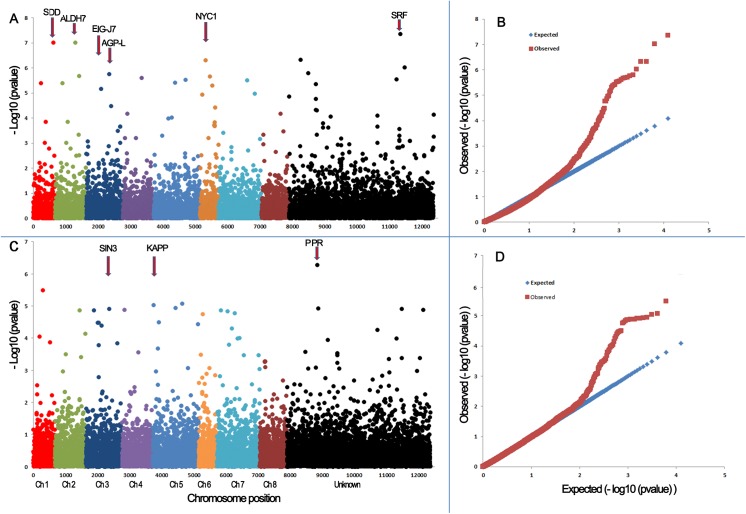
Drought resistance is an important breeding target for enhancing alfalfa productivity in arid and semi-arid regions. Identification of genes involved in drought tolerance will facilitate breeding for improving drought resistance and water use efficiency in alfalfa. Our objective was to use a diversity panel of alfalfa accessions comprised of 198 cultivars and landraces to identify genes involved in drought tolerance. The panel was selected from the USDA-ARS National Plant Germplasm System alfalfa collection and genotyped using genotyping by sequencing. A greenhouse procedure was used for phenotyping two important traits associated with drought tolerance: drought resistance index (DRI) and relative leaf water content (RWC). Marker-trait association identified nineteen and fifteen loci associated with DRI and RWC, respectively. Alignments of target sequences flanking to the resistance loci against the reference genome of M. truncatula revealed multiple chromosomal locations. Markers associated with DRI are located on all chromosomes while markers associated with RWC are located on chromosomes 1, 2, 3, 4, 5, 6 and 7. Co-localizations of significant markers between DRI and RWC were found on chromosomes 3, 5 and 7. Most loci associated with DRI in this work overlap with the reported QTLs associated with biomass under drought in alfalfa. Additional significant markers were targeted to several contigs with unknown chromosomal locations. BLAST search using their flanking sequences revealed homology to several annotated genes with functions in stress tolerance. With further validation, these markers may be used for marker-assisted breeding new alfalfa varieties with drought resistance and enhanced water use efficiency.
Conflict of interest statement
Figures
References
-
- Bouton J. (2007) The economic benefits of forage improvement in the United States. Euphytica 154:263–270.
-
- Hamdy A, Ragab R, Scarascia-Mugnozza E (2003) Coping with water scarcity: water saving and increasing water productivity. Irrigation and Drainage 52: 3–20.
-
- Luo M, Lin L, Hill RD, Mohapatra SS (1991) Primary structure of an environmental stress and absicic acidinducible alfalfa protein. Plant Mol Biol 17: 1267–1269. - PubMed
-
- Luo M, Liu JH, Mohapatra S, Hill RD, Mohapatra SS (1992) Characterization of a gene family encoding abscisicacid- and environmental stress-inducible proteins of alfalfa. J Biol Chem 267: 15367–15374. - PubMed
Publication types
MeSH terms
Substances
LinkOut - more resources
Full Text Sources
Other Literature Sources
Research Materials
