


Re-Infection Outcomes following One- and Two-Stage Surgical Revision of Infected Hip Prosthesis: A Systematic Review and Meta-Analysis
- PMID: 26407003
- PMCID: PMC4583275
- DOI: 10.1371/journal.pone.0139166
Re-Infection Outcomes following One- and Two-Stage Surgical Revision of Infected Hip Prosthesis: A Systematic Review and Meta-Analysis
Abstract
Background: The two-stage revision strategy has been claimed as being the "gold standard" for treating prosthetic joint infection. The one-stage revision strategy remains an attractive alternative option; however, its effectiveness in comparison to the two-stage strategy remains uncertain.
Objective: To compare the effectiveness of one- and two-stage revision strategies in treating prosthetic hip infection, using re-infection as an outcome.
Design: Systematic review and meta-analysis.
Data sources: MEDLINE, EMBASE, Web of Science, Cochrane Library, manual search of bibliographies to March 2015, and email contact with investigators.
Study selection: Cohort studies (prospective or retrospective) conducted in generally unselected patients with prosthetic hip infection treated exclusively by one- or two-stage revision and with re-infection outcomes reported within two years of revision. No clinical trials were identified.
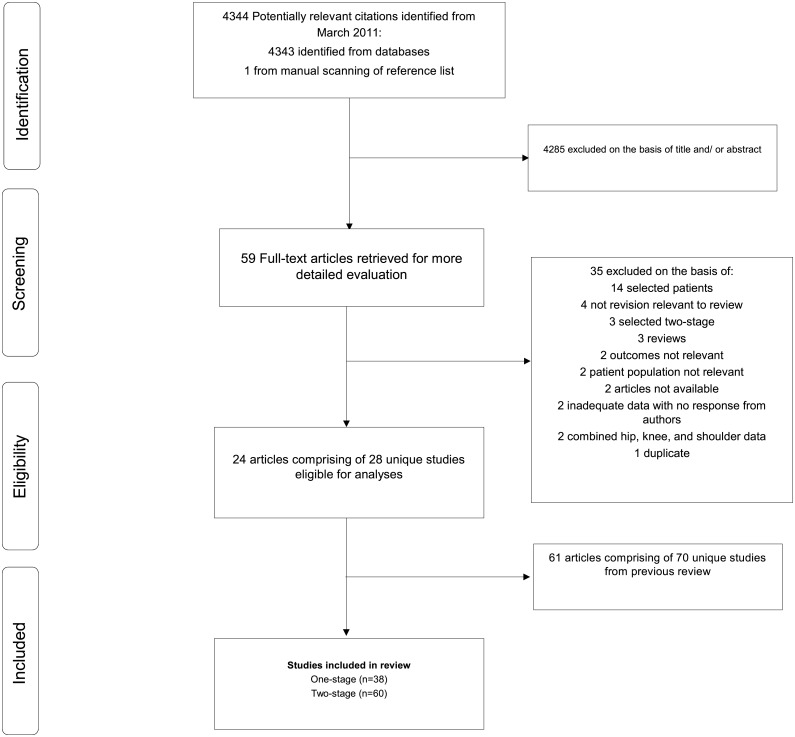
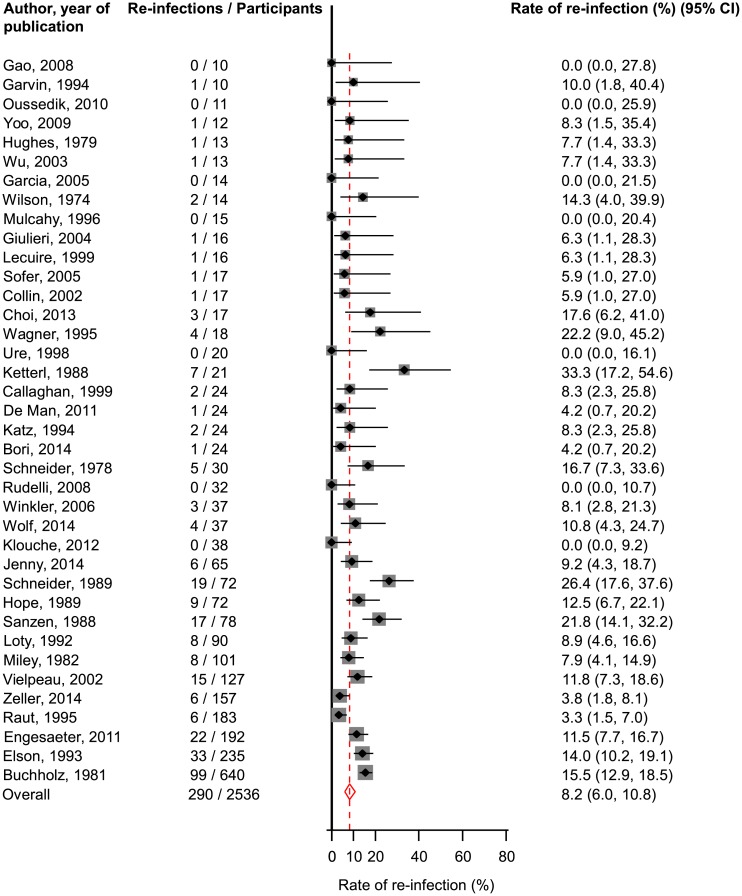
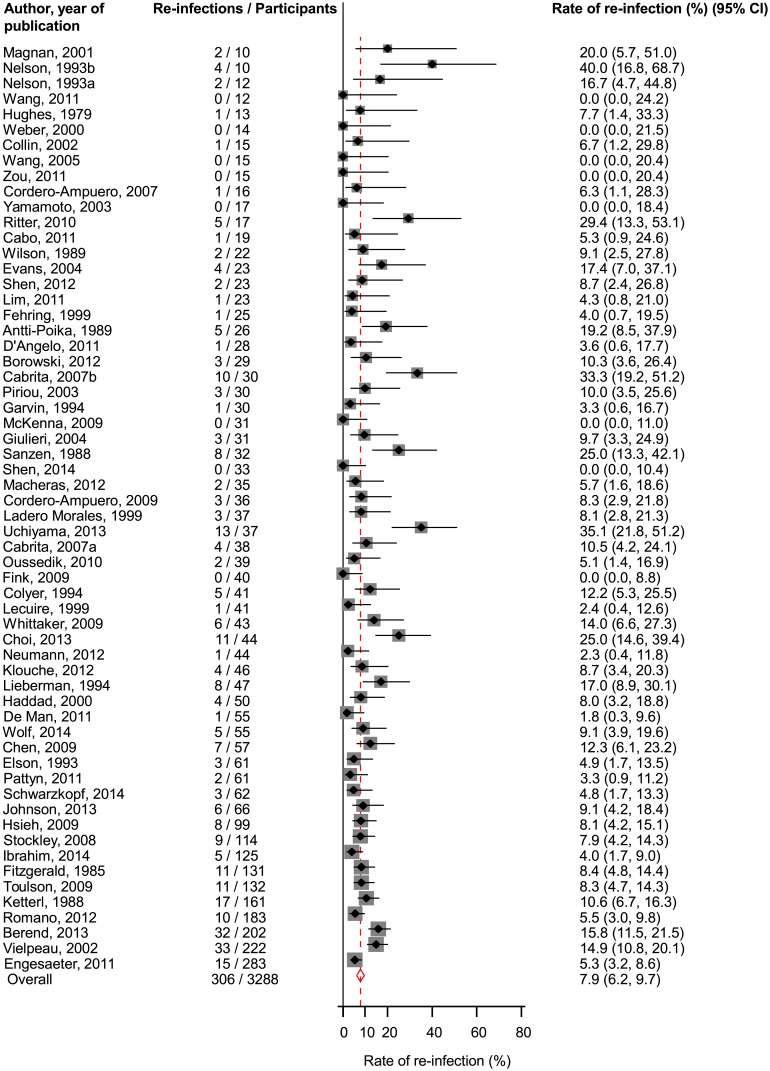
Review methods: Data were extracted by two independent investigators and a consensus was reached with involvement of a third. Rates of re-infection from 38 one-stage studies (2,536 participants) and 60 two-stage studies (3,288 participants) were aggregated using random-effect models after arcsine transformation, and were grouped by study and population level characteristics.
Results: In one-stage studies, the rate (95% confidence intervals) of re-infection was 8.2% (6.0-10.8). The corresponding re-infection rate after two-stage revision was 7.9% (6.2-9.7). Re-infection rates remained generally similar when grouped by several study and population level characteristics. There was no strong evidence of publication bias among contributing studies.
Conclusion: Evidence from aggregate published data suggest similar re-infection rates after one- or two-stage revision among unselected patients. More detailed analyses under a broader range of circumstances and exploration of other sources of heterogeneity will require collaborative pooling of individual participant data.
Systematic review registration: PROSPERO 2015: CRD42015016559.
Conflict of interest statement
Figures
References
-
- Hunter G, Dandy D. The natural history of the patient with an infected total hip replacement. J Bone Joint Surg Am. 1977;59-B(3):293–7. - PubMed
-
- Laffer RR, Graber P, Ochsner PE, Zimmerli W. Outcome of prosthetic knee-associated infection: evaluation of 40 consecutive episodes at a single centre. Clin Microbiol Infect. 2006;12(5):433–9. . - PubMed
Publication types
MeSH terms
Grants and funding
LinkOut - more resources
Full Text Sources
Other Literature Sources
Medical
