. 2015 Sep 25;11(9):e1005119.
doi: 10.1371/journal.ppat.1005119. eCollection 2015 Sep.

Plasmodium Infection Is Associated with Impaired Hepatic Dimethylarginine Dimethylaminohydrolase Activity and Disruption of Nitric Oxide Synthase Inhibitor/Substrate Homeostasis

Affiliations

Plasmodium Infection Is Associated with Impaired Hepatic Dimethylarginine Dimethylaminohydrolase Activity and Disruption of Nitric Oxide Synthase Inhibitor/Substrate Homeostasis

Jessica H Chertow et al. PLoS Pathog. .

Abstract

Inhibition of nitric oxide (NO) signaling may contribute to pathological activation of the vascular endothelium during severe malaria infection. Dimethylarginine dimethylaminohydrolase (DDAH) regulates endothelial NO synthesis by maintaining homeostasis between asymmetric dimethylarginine (ADMA), an endogenous NO synthase (NOS) inhibitor, and arginine, the NOS substrate. We carried out a community-based case-control study of Gambian children to determine whether ADMA and arginine homeostasis is disrupted during severe or uncomplicated malaria infections. Circulating plasma levels of ADMA and arginine were determined at initial presentation and 28 days later. Plasma ADMA/arginine ratios were elevated in children with acute severe malaria compared to 28-day follow-up values and compared to children with uncomplicated malaria or healthy children (p<0.0001 for each comparison). To test the hypothesis that DDAH1 is inactivated during Plasmodium infection, we examined DDAH1 in a mouse model of severe malaria. Plasmodium berghei ANKA infection inactivated hepatic DDAH1 via a post-transcriptional mechanism as evidenced by stable mRNA transcript number, decreased DDAH1 protein concentration, decreased enzyme activity, elevated tissue ADMA, elevated ADMA/arginine ratio in plasma, and decreased whole blood nitrite concentration. Loss of hepatic DDAH1 activity and disruption of ADMA/arginine homeostasis may contribute to severe malaria pathogenesis by inhibiting NO synthesis.


Conflict of interest statement

The authors have declared that no competing interests exist.

Figures
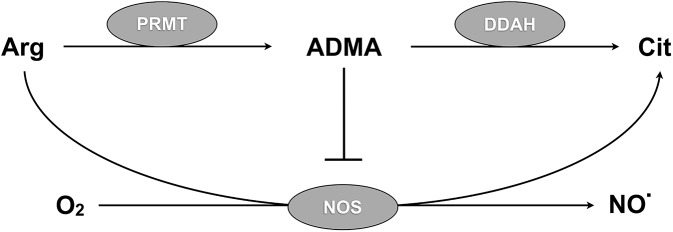
Fig 1
Fig 1. DDAH regulates NO synthesis via ADMA metabolism.
Protein arginine methyltransferases (PRMTs) methylate arginine (Arg) residues on proteins to form asymmetric dimethylarginine (ADMA). Proteolysis releases free ADMA that inhibits nitric oxide synthase (NOS). Dimethylarginine dimethylaminohydrolase (DDAH) metabolizes free ADMA to citrulline (Cit) that can be recycled to arginine. Inactivation of DDAH leads to accumulation of ADMA, inhibition of endothelial NO synthesis, and endothelial dysfunction.
Fig 2
Fig 2. The ADMA/arginine ratio is acutely elevated in African children with severe malaria.
ADMA and arginine concentrations were measured in plasma samples collected at the time of presentation (Day 0) and at follow-up visits 28 days later (Day 28) in children with WHO-defined uncomplicated malaria or severe malaria. Healthy Gambian children served as a reference group. Wilcoxon test was used for pair-wise comparison of admission and day 28 mesurements within individuals (47 paired observations from patients with severe malaria; 65 paired observations from patients with uncomplicated malaria). Mann-Whitney test was used to compare patients with severe malaria (n = 81) versus uncomplicated malaria (n = 75) and to compare patients with uncomplicated malaria versus healthy children (n = 31). Each horizontal line depicts the group median. **** p < 0.0001; ns p > 0.05.
Fig 3
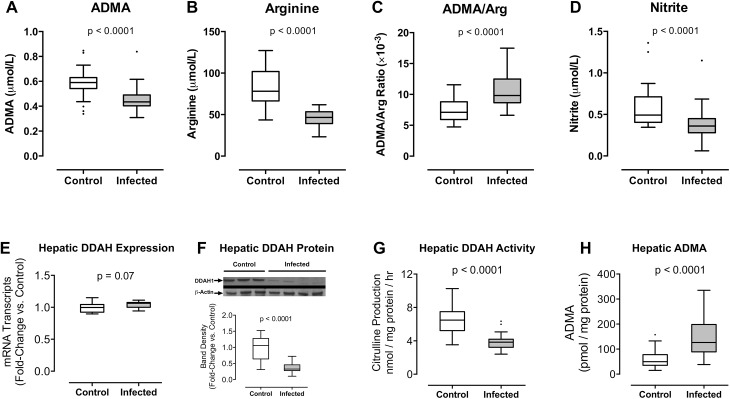
Fig 3. (A-D) Plasmodium berghei ANKA infection increases the plasma ratio of ADMA to arginine in mice.
HPLC was used to determine (A) ADMA, (B) arginine concentrations, and (C) ADMA/Arg ratio in plasma samples; (D) gas phase chemiluminescent assay was used to determine nitrite concentration in blood. Blood was obtained from mice 6 days after inoculation with P. berghei ANKA (n = 23) and from uninfected control mice (n = 28) in 3 independent experiments. (E-H) Plasmodium berghei ANKA infection decreases hepatic DDAH activity in mice. (E) Quantitative RT-PCR was performed to assess hepatic Ddah1 expression 6 days after inoculation with P. berghei ANKA. Values were normalized to Gapdh mRNA transcripts and expressed as fold-change vs. control values. Liver samples were obtained from 12 control mice and 12 infected mice representing 2 independent inoculation experiments. (F) Western blot was used to detect hepatic DDAH1 protein (38 kDa) in liver tissue obtained from mice 6 days after inoculation with P. berghei ANKA and from uninfected control mice. β-actin (42 kDa) was used as an internal control. Densitometry was used to quantify DDAH1 band density normalized to β-actin and expressed as fold-change vs. control values. Data are pooled from 12 control mice and 12 infected mice representing 3 independent experiments. (G) DDAH activity was assessed by quantification of L-citrulline production by liver homogenates in the presence of saturating concentrations of ADMA substrate (2.5 mM). L-citrulline production was calculated on a per-hour basis and normalized to protein content. (H) Intracellular hepatic ADMA was assessed by HPLC in liver homogenates and normalized to protein content. Liver samples were collected from mice 6 days after inoculation with P. berghei ANKA (n = 25) and from uninfected control mice (n = 28). Results were pooled from 3 independent experiments. Boxes indicate median, 25th and 75th percentiles. Values greater than 1.5 times the IQR are plotted as individual points (Tukey’s method). Mann-Whitney test was used to compare groups.

References

    1. World Health Organization. World malaria report 2014 [Internet]. 2014. Available: http://apps.who.int/iris/bitstream/10665/144852/2/9789241564830_eng.pdf?...
    1. Murray CJ, Rosenfeld LC, Lim SS, Andrews KG, Foreman KJ, Haring D, et al. Global malaria mortality between 1980 and 2010: a systematic analysis. The Lancet. 2012;379: 413–431. 10.1016/S0140-6736(12)60034-8 - DOI - PubMed
    1. Dondorp AM, Fanello CI, Hendriksen IC, Gomes E, Seni A, Chhaganlal KD, et al. Artesunate versus quinine in the treatment of severe falciparum malaria in African children (AQUAMAT): an open-label, randomised trial. Lancet. 2010;376: 1647–57. 10.1016/S0140-6736(10)61924-1 - DOI - PMC - PubMed
    1. Yeo TW, Lampah DA, Gitawati R, Tjitra E, Kenangalem E, McNeil YR, et al. Impaired nitric oxide bioavailability and L-arginine reversible endothelial dysfunction in adults with falciparum malaria. J Exp Med. 2007;204: 2693–704. - PMC - PubMed
    1. Anstey NM, Weinberg JB, Hassanali MY, Mwaikambo ED, Manyenga D, Misukonis MA, et al. Nitric oxide in Tanzanian children with malaria: inverse relationship between malaria severity and nitric oxide production/nitric oxide synthase type 2 expression. J Exp Med. 1996;184: 557–67. - PMC - PubMed

Publication types