Biomarkers and mortality in severe Chagas cardiomyopathy
- PMID: 26407513
- PMCID: PMC4586047
- DOI: 10.1016/j.gheart.2015.07.003
Biomarkers and mortality in severe Chagas cardiomyopathy
Abstract
Background: Chagas cardiomyopathy is a chronic sequela of infection by the parasite, Trypanosoma cruzi. Advanced cardiomyopathy is associated with a high mortality rate, and clinical characteristics have been used to predict mortality risk. Though multiple biomarkers have been associated with Chagas cardiomyopathy, it is unknown how these are related to survival.
Objectives: This study aimed to identify biomarkers associated with mortality in individuals with severe Chagas cardiomyopathy in an urban Bolivian hospital.
Methods: The population included individuals with and without T. cruzi infection recruited in an urban hospital in Santa Cruz, Bolivia. Baseline characteristics, electrocardiogram findings, medications, and serum cardiac biomarker levels (B-type natriuretic peptide [BNP], N-terminal pro-B-type natriuretic peptide [NT-proBNP], creatine kinase-myocardial band [CK-MB], troponin I, matrix metalloproteinase [MMP]-2, MMP-9, tissue inhibitor of metalloproteinases [TIMP] 1 and 2, transforming growth factor [TGF] beta 1 and 2) were ascertained. Echocardiograms were performed on those with cardiac symptoms or electrocardiogram abnormalities at baseline. Participants were contacted approximately 1 year after initial evaluation; deaths were reported by family members. Receiver-operating characteristic curves (ROC) were used to optimize cutoff values for each marker. For markers with area under the curve (AUC) >0.55, Cox proportional hazards models were performed to determine the hazards ratio (HR) and 95% confidence interval (CI) for the association of each marker with mortality.
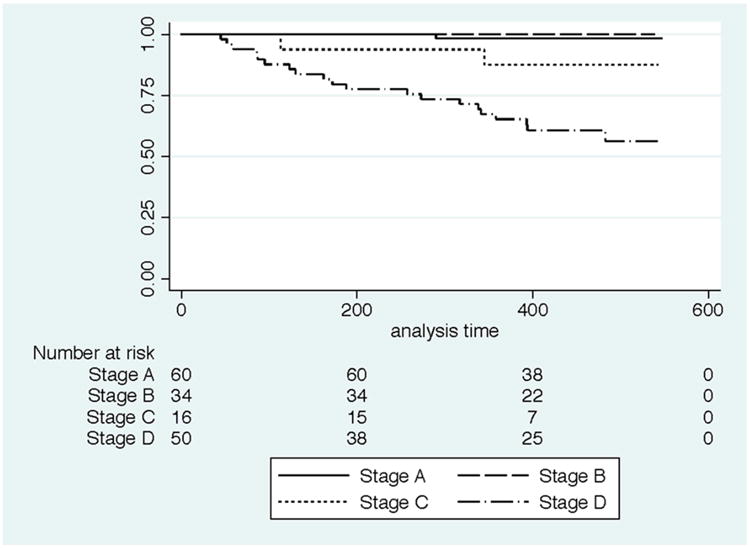
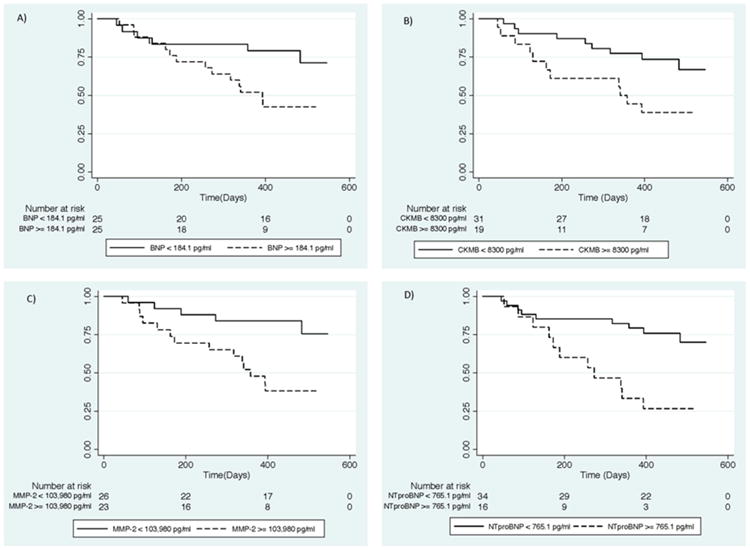
Results: The median follow-up time was 14.1 months (interquartile range 12.5, 16.7). Of 254 individuals with complete cardiac data, 220 (87%) had follow-up data. Of 50 patients with severe Chagas cardiomyopathy at baseline, 20 (40%) had died. Higher baseline levels of BNP (HR: 3.1, 95% CI: 1.2 to 8.4), NT-proBNP (HR: 4.4, 95% CI: 1.8 to 11.0), CK-MB (HR: 3.3, 95% CI: 1.3 to 8.0), and MMP-2 (HR: 4.2, 95% CI: 1.5 to 11.8) were significantly associated with subsequent mortality.
Conclusions: Severe Chagas cardiomyopathy is associated with high short-term mortality. BNP, NT-proBNP, CK-MB, and MMP-2 have added predictive value for mortality, even in the presence of decreased ejection fraction and other clinical signs of congestive heart failure.
Copyright © 2015 World Heart Federation (Geneva). All rights reserved.
Figures
References
-
- Bern C, Montgomery SP. An estimate of the burden of Chagas disease in the United States. Clin Infect Dis. 2009;49(5):e52–4. - PubMed
-
- Andrade SG. The influence of the strain of Trypanosoma cruzi in placental infections in mice. Trans R Soc Trop Med Hyg. 1982;76(1):123–8. - PubMed
-
- Pereira Nunes Mdo C, Barbosa MM, Ribeiro AL, Amorim Fenelon LM, Rocha MO. Predictors of mortality in patients with dilated cardiomyopathy: relevance of chagas disease as an etiological factor. Revista espanola de cardiologia. 2010;63(7):788–97. Epub 2010/07/09. - PubMed
-
- Bestetti RB, Otaviano AP, Fantini JP, Cardinalli-Neto A, Nakazone MA, Nogueira PR. Prognosis of patients with chronic systolic heart failure: Chagas disease versus systemic arterial hypertension. International journal of cardiology. 2013;168(3):2990–1. - PubMed
Publication types
MeSH terms
Substances
Grants and funding
LinkOut - more resources
Full Text Sources
Other Literature Sources
Medical
Research Materials
Miscellaneous