


Etiological overlap between obsessive-compulsive disorder and anorexia nervosa: a longitudinal cohort, multigenerational family and twin study
- PMID: 26407789
- PMCID: PMC4592656
- DOI: 10.1002/wps.20251
Etiological overlap between obsessive-compulsive disorder and anorexia nervosa: a longitudinal cohort, multigenerational family and twin study
Abstract
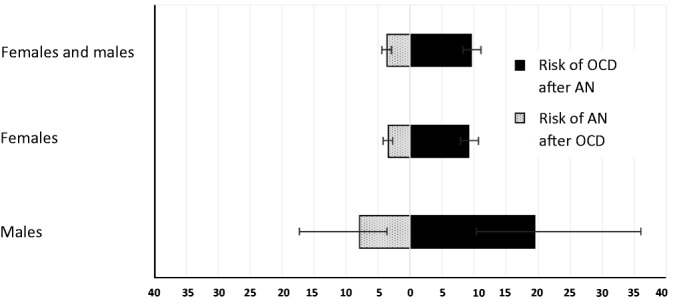
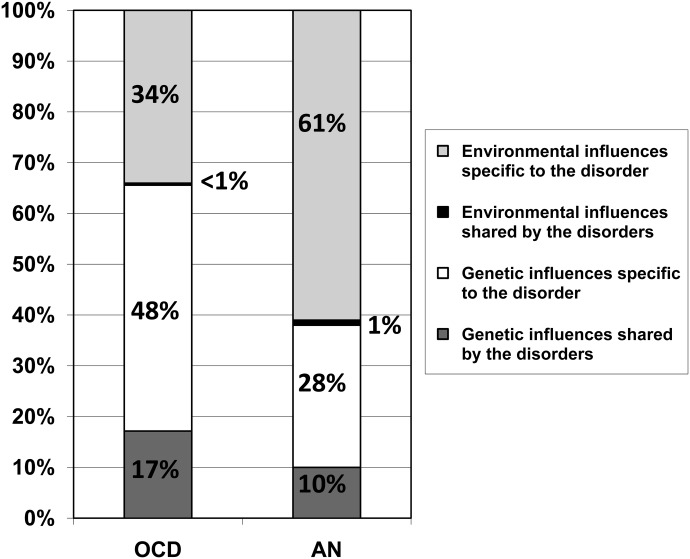
Obsessive-compulsive disorder (OCD) often co-occurs with anorexia nervosa (AN), a comorbid profile that complicates the clinical management of both conditions. This population-based study aimed to examine patterns of comorbidity, longitudinal risks, shared familial risks and shared genetic factors between OCD and AN at the population level. Participants were individuals with a diagnosis of OCD (N=19,814) or AN (N=8,462) in the Swedish National Patient Register between January 1992 and December 2009; their first-, second- and third-degree relatives; and population-matched (1:10 ratio) unaffected comparison individuals and their relatives. Female twins from the population-based Swedish Twin Register (N=8,550) were also included. Females with OCD had a 16-fold increased risk of having a comorbid diagnosis of AN, whereas males with OCD had a 37-fold increased risk. Longitudinal analyses showed that individuals first diagnosed with OCD had an increased risk for a later diagnosis of AN (risk ratio, RR=3.6), whereas individuals first diagnosed with AN had an even greater risk for a later diagnosis of OCD (RR=9.6). These longitudinal risks were about twice as high for males than for females. First- and second-degree relatives of probands with OCD had an increased risk for AN, and the magnitude of this risk tended to increase with the degree of genetic relatedness. Bivariate twin models revealed a moderate but significant degree of genetic overlap between self-reported OCD and AN diagnoses (ra =0.52, 95% CI: 0.26-0.81), but most of the genetic variance was disorder-specific. The moderately high genetic correlation supports the idea that this frequently observed comorbid pattern is at least in part due to shared genetic factors, though disorder-specific factors are more important. These results have implications for current gene-searching efforts and for clinical practice.
Keywords: Obsessive-compulsive disorder; anorexia nervosa; comorbidity; eating disorders; genetic epidemiology; shared genetic factors.
© 2015 World Psychiatric Association.
Figures
References
-
- Godart NT, Flament MF, Perdereau F, et al. Comorbidity between eating disorders and anxiety disorders: a review. Int J Eat Disord. 2002;32:253–70. - PubMed
-
- Kaye WH, Bulik CM, Thornton L, et al. Comorbidity of anxiety disorders with anorexia and bulimia nervosa. Am J Psychiatry. 2004;161:2215–21. - PubMed
-
- Rubenstein CS, Pigott TA, L’Heureux F, et al. A preliminary investigation of the lifetime prevalence of anorexia and bulimia nervosa in patients with obsessive compulsive disorder. J Clin Psychiatry. 1992;53:309–14. - PubMed
-
- Rasmussen SA, Eisen JL. The epidemiology and differential diagnosis of obsessive compulsive disorder. J Clin Psychiatry. 1994;55(10):5–10. Suppl. - PubMed
-
- Micali N, Hilton K, Natatani E, et al. Is childhood OCD a risk factor for eating disorders later in life? A longitudinal study. Psychol Med. 2011;41:2507–13. - PubMed
LinkOut - more resources
Full Text Sources
Other Literature Sources
