


Global, regional and national consumption of major food groups in 1990 and 2010: a systematic analysis including 266 country-specific nutrition surveys worldwide
- PMID: 26408285
- PMCID: PMC4593162
- DOI: 10.1136/bmjopen-2015-008705
Global, regional and national consumption of major food groups in 1990 and 2010: a systematic analysis including 266 country-specific nutrition surveys worldwide
Abstract
Objective: To quantify global intakes of key foods related to non-communicable diseases in adults by region (n=21), country (n=187), age and sex, in 1990 and 2010.
Design: We searched and obtained individual-level intake data in 16 age/sex groups worldwide from 266 surveys across 113 countries. We combined these data with food balance sheets available in all nations and years. A hierarchical Bayesian model estimated mean food intake and associated uncertainty for each age-sex-country-year stratum, accounting for differences in intakes versus availability, survey methods and representativeness, and sampling and modelling uncertainty.
Setting/population: Global adult population, by age, sex, country and time.
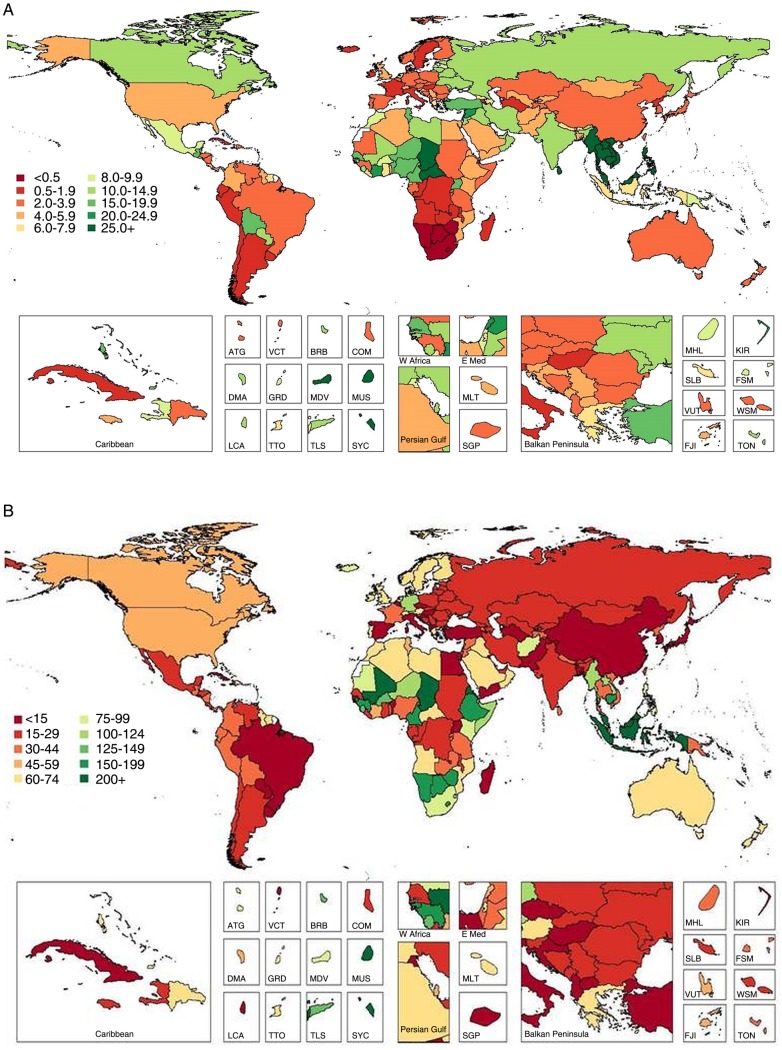
Results: In 2010, global fruit intake was 81.3 g/day (95% uncertainty interval 78.9-83.7), with country-specific intakes ranging from 19.2-325.1 g/day; in only 2 countries (representing 0.4% of the world's population), mean intakes met recommended targets of ≥300 g/day. Country-specific vegetable intake ranged from 34.6-493.1 g/day (global mean=208.8 g/day); corresponding values for nuts/seeds were 0.2-152.7 g/day (8.9 g/day); for whole grains, 1.3-334.3 g/day (38.4 g/day); for seafood, 6.0-87.6 g/day (27.9 g/day); for red meats, 3.0-124.2 g/day (41.8 g/day); and for processed meats, 2.5-66.1 g/day (13.7 g/day). Mean national intakes met recommended targets in countries representing 0.4% of the global population for vegetables (≥400 g/day); 9.6% for nuts/seeds (≥4 (28.35 g) servings/week); 7.6% for whole grains (≥2.5 (50 g) servings/day); 4.4% for seafood (≥3.5 (100 g) servings/week); 20.3% for red meats (≤1 (100 g) serving/week); and 38.5% for processed meats (≤1 (50 g) serving/week). Intakes of healthful foods were generally higher and of less healthful foods generally lower at older ages. Intakes were generally similar by sex. Vegetable, seafood and processed meat intakes were stable over time; fruits, nuts/seeds and red meat, increased; and whole grains, decreased.
Conclusions: These global dietary data by nation, age and sex identify key challenges and opportunities for optimising diets, informing policies and priorities for improving global health.
Keywords: EPIDEMIOLOGY; PUBLIC HEALTH.
Published by the BMJ Publishing Group Limited. For permission to use (where not already granted under a licence) please go to http://group.bmj.com/group/rights-licensing/permissions.
Figures




References
-
- World Health Organization. Global status report on noncommunicable diseases 2010. Geneva, 2011.
-
- Lim SS, Vos T, Flaxman AD et al. . A comparative risk assessment of burden of disease and injury attributable to 67 risk factors and risk factor clusters in 21 regions, 1990–2010: a systematic analysis for the Global Burden of Disease Study 2010. Lancet 2013;380:2224–60. 10.1016/S0140-6736(12)61766-8 - DOI - PMC - PubMed
Publication types
MeSH terms
Grants and funding
LinkOut - more resources
Full Text Sources
Other Literature Sources
Medical
Miscellaneous
