


Prospective and longitudinal long-term employment outcomes after resective epilepsy surgery
- PMID: 26408490
- PMCID: PMC4631069
- DOI: 10.1212/WNL.0000000000002069
Prospective and longitudinal long-term employment outcomes after resective epilepsy surgery
Abstract
Objective: To investigate long-term employment outcomes after resective epilepsy surgery in a national population-based cohort of adults.
Methods: In the Swedish National Epilepsy Surgery Register, all adults who were operated with resective epilepsy surgery from 1995 to 2010 were identified. Two-year follow-up was available for 473/496, 5-year follow-up for 220/240, 10-year follow-up for 240/278, and 15-year follow-up for 85/109 patients.
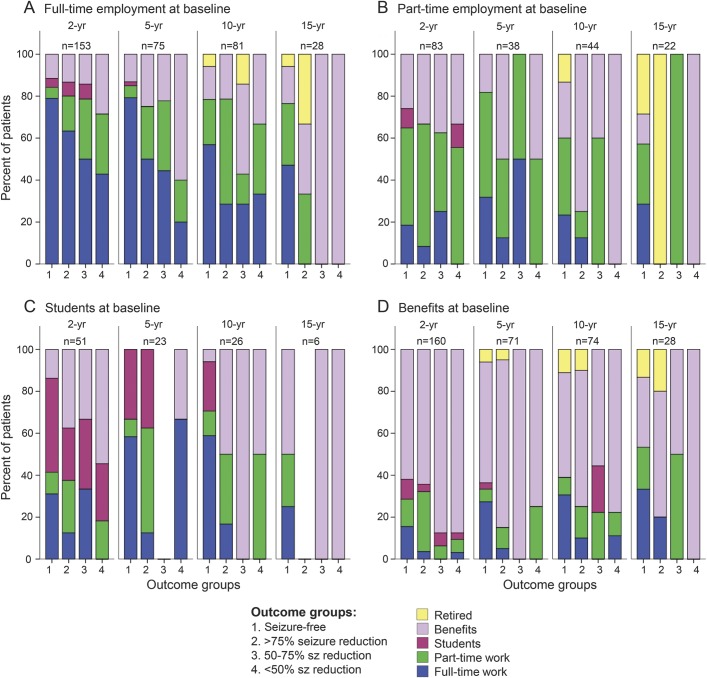
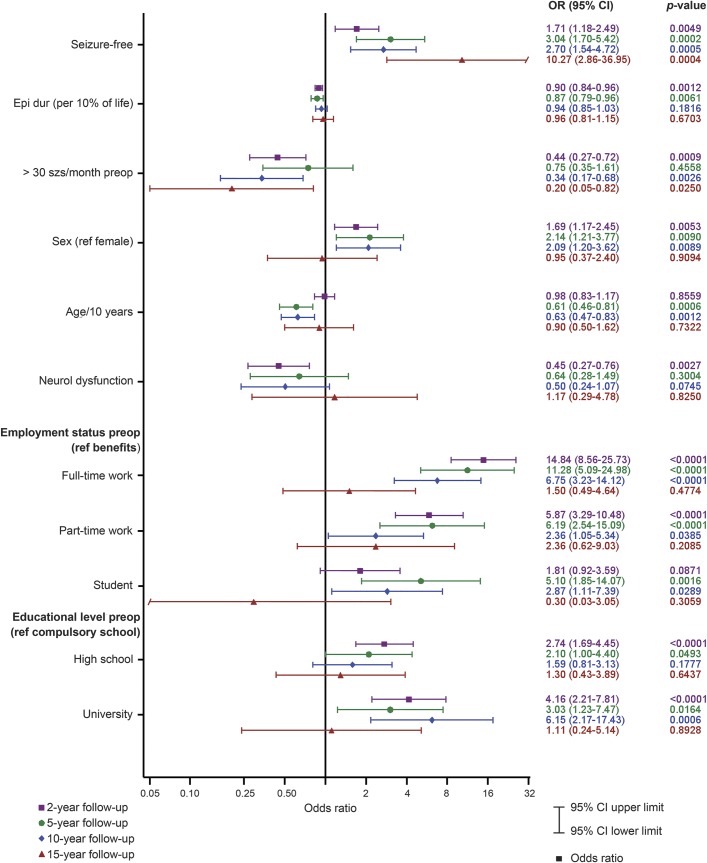
Results: There were no significant changes in employment outcome over time at group level, but for those with full-time employment at baseline, 79%, 79%, 57%, and 47% of seizure-free patients were in full-time work at 2-, 5-, 10-, and 15-year follow-up, compared to patients with benefits at baseline, where 16%, 27%, 31%, and 33% of seizure-free patients worked full time at these time points (p = 0.018 at 10 years). More patients with full-time work had ability to drive, a family of their own, and higher educational status than patients in part-time work or on benefits. Univariate predictors for employment at long term were having employment preoperatively, higher education, favorable seizure outcome, male sex, and younger age at surgery. Multivariate predictors were having employment preoperatively, favorable seizure outcome, and younger age.
Conclusions: The best vocational outcomes occurred in seizure-free patients who were employed or students at baseline, which may reflect a higher general psychosocial level of function. Younger age also predicted better employment outcomes and it therefore seems plausible that early referral for surgery could contribute to better vocational outcomes.
© 2015 American Academy of Neurology.
Figures
References
-
- Augustine EA, Novelly RA, Mattson RH, et al. Occupational adjustment following neurosurgical treatment of epilepsy. Ann Neurol 1984;15:68–72. - PubMed
-
- Wass CT, Rajala MM, Hughes JM, et al. Long-term follow-up of patients treated surgically for medically intractable epilepsy: results in 291 patients treated at Mayo Clinic Rochester between July 1972 and March 1985. Mayo Clin Proc 1996;71:1105–1113. - PubMed
-
- Reeves AL, So EL, Evans RW, et al. Factors associated with work outcome after anterior temporal lobectomy for intractable epilepsy. Epilepsia 1997;38:689–695. - PubMed
-
- Maehara T, Inaji M, Matsuura M. Surgical effects of focus resection for patients with intractable epilepsy. Neurol Med Chir 2013;53:281–286. - PubMed
-
- Chin PS, Berg AT, Spencer SS, et al. Employment outcomes following resective epilepsy surgery. Epilepsia 2007;48:2253–2257. - PubMed
Publication types
MeSH terms
LinkOut - more resources
Full Text Sources
Medical
Molecular Biology Databases
