


Infections after Transplantation of Bone Marrow or Peripheral Blood Stem Cells from Unrelated Donors
- PMID: 26409243
- PMCID: PMC4716871
- DOI: 10.1016/j.bbmt.2015.09.013
Infections after Transplantation of Bone Marrow or Peripheral Blood Stem Cells from Unrelated Donors
Abstract
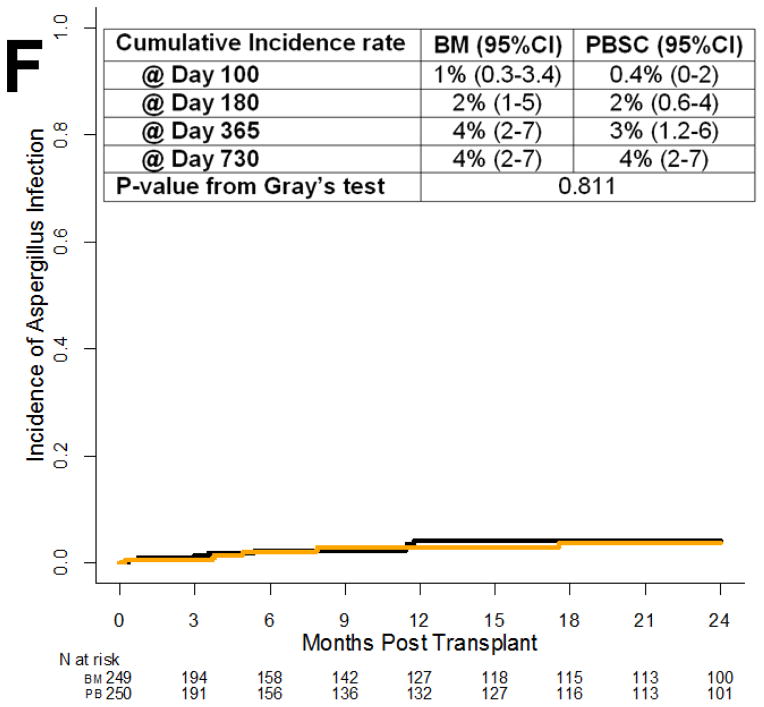
Infection is a major complication of hematopoietic cell transplantation. Prolonged neutropenia and graft-versus-host disease are the 2 major complications with an associated risk for infection, and these complications differ according to the graft source. A phase 3, multicenter, randomized trial (Blood and Marrow Transplant Clinical Trials Network [BMT CTN] 0201) of transplantation of bone marrow (BM) versus peripheral blood stem cells (PBSC) from unrelated donors showed no significant differences in 2-year survival between these graft sources. In an effort to provide data regarding whether BM or PBSC could be used as a preferential graft source for transplantation, we report a detailed analysis of the infectious complications for 2 years after transplantation from the BMT CTN 0201 trial. A total of 499 patients in this study had full audits of infection data. A total of 1347 infection episodes of moderate or greater severity were documented in 384 (77%) patients; 201 of 249 (81%) of the evaluable patients had received a BM graft and 183 of 250 (73%) had received a PBSC graft. Of 1347 infection episodes, 373 were severe and 123 were life-threatening and/or fatal; 710 (53%) of these episodes occurred on the BM arm and 637 (47%) on the PBSC arm, resulting in a 2-year cumulative incidence 84.7% (95% confidence interval [CI], 79.6 to 89.8) for BM versus 79.7% (95% CI, 73.9 to 85.5) for PBSC, P = .013. The majority of these episodes, 810 (60%), were due to bacteria, with a 2-year cumulative incidence of 72.1% and 62.9% in BM versus PBSC recipients, respectively (P = .003). The cumulative incidence of bloodstream bacterial infections during the first 100 days was 44.8% (95% CI, 38.5 to 51.1) for BM versus 35.0% (95% CI, 28.9 to 41.1) for PBSC (P = .027). The total infection density (number of infection events/100 patient days at risk) was .67 for BM and .60 for PBSC. The overall infection density for bacterial infections was .4 in both arms; for viral infections, it was .2 in both arms; and for fungal/parasitic infections, it was .04 and .05 for BM and PBSC, respectively. The cumulative incidence of infection before engraftment was 47.9% (95% CI, 41.5 to 53.9) for BM versus 32.8% (95% CI, 27.1 to 38.7) for PBSC (P = .002), possibly related to quicker neutrophil engraftment using PBSC. Infections remain frequent after unrelated donor hematopoietic cell transplantation, particularly after BM grafts.
Keywords: Aspergillosis; Bacteremia; Cytomegalovirus; Infection; Pre-engraftment; Unrelated donor transplantation.
Copyright © 2016 American Society for Blood and Marrow Transplantation. Published by Elsevier Inc. All rights reserved.
Conflict of interest statement
The authors declare no competing financial interests.
Figures




References
-
- Holtick U, Albrecht M, Chemnitz JM, et al. Comparison of bone marrow versus peripheral blood allogeneic hematopoietic stem cell transplantation for hematological malignancies in adults-a systematic review and meta-analysis. Crit Rev Oncol Hematol. 2014 - PubMed
-
- Stamatovic D, Balint B, Tukic L, et al. Impact of stem cell source on allogeneic stem cell transplantation outcome in hematological malignancies. Vojnosanit Pregl. 2011;68:1026–1032. - PubMed
-
- Korbling M. Peripheral Blood Stem Cells: A Novel Source for Allogeneic Transplantation. Oncologist. 1997;2:104–113. - PubMed
Publication types
MeSH terms
Grants and funding
LinkOut - more resources
Full Text Sources
Other Literature Sources
Medical
