


In vitro effect photodynamic therapy with differents photosensitizers on cariogenic microorganisms
- PMID: 26410025
- PMCID: PMC4584123
- DOI: 10.1186/s12866-015-0524-3
In vitro effect photodynamic therapy with differents photosensitizers on cariogenic microorganisms
Abstract
Background: Antimicrobial photodynamic therapy has been proposed as an alternative to suppress subgingival species. This results from the balance among Streptococcus sanguis, Streptococcus mutans and Candida albicans in the dental biofilm. Not all the photosensitizers have the same photodynamic effect against the different microorganims. The objective of this study is to compare in vitro the photodynamic effect of methylene blue (MB), rose Bengal (RB) and curcumin (CUR) in combination with white light on the cariogenic microorganism S. mutans, S. sanguis and C. albicans.
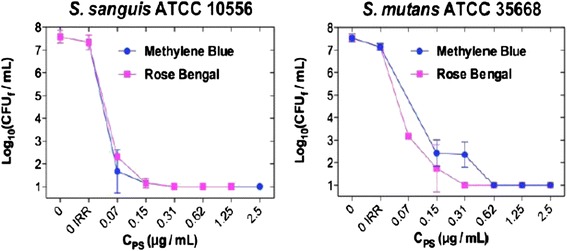
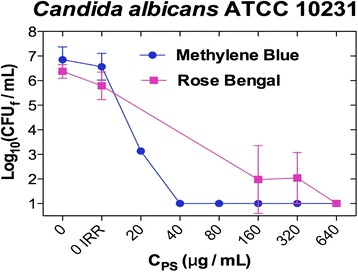
Results: Photodynamic therapy with MB, RB and CUR inhibited 6 log 10 the growth of both bacteria but at different concentrations: 0.31-0.62 μg/ml and 0.62-1.25 μg/ml RB were needed to photoinactivate S. mutans and S. sanguis, respectively; 1.25-2.5 μg/ml MB for both species; whereas higher CUR concentrations (80-160 μg/ml and 160-320 μg/ml) were required to obtain the same reduction in S. mutans and S. sanguis viability respectively. The minimal fungicidal concentration of MB for 5 log10 CFU reduction (4.5 McFarland) was 80-160 μg/ml, whereas for RB it ranged between 320 and 640 μg/ml. For CUR, even the maximum studied concentration (1280 μg/ml) did not reach that inhibition. Incubation time had no effect in all experiments.
Conclusions: Photodynamic therapy with RB, MB and CUR and white light is effective in killing S. mutans and S. sanguis strains, although MB and RB are more efficient than CUR. C. albicans required higher concentrations of all photosensitizers to obtain a fungicidal effect, being MB the most efficient and CUR ineffective.
Figures
References
-
- Marsh PD. Microbiologic aspects of dental plaque and dental caries. Dent Clin North Am. 1999;43(4):599–614. - PubMed
-
- Orasmo EMW, Otani C, Khouri S. In vitro AFM evaluation of Streptococcus mutans membrane exposed to two mouthwashes. JAPS. 2013;3:024–8.
Publication types
MeSH terms
Substances
LinkOut - more resources
Full Text Sources
Other Literature Sources
Medical
Molecular Biology Databases
Miscellaneous
