


The type I interferons: Basic concepts and clinical relevance in immune-mediated inflammatory diseases
- PMID: 26410416
- PMCID: PMC4666791
- DOI: 10.1016/j.gene.2015.09.058
The type I interferons: Basic concepts and clinical relevance in immune-mediated inflammatory diseases
Abstract
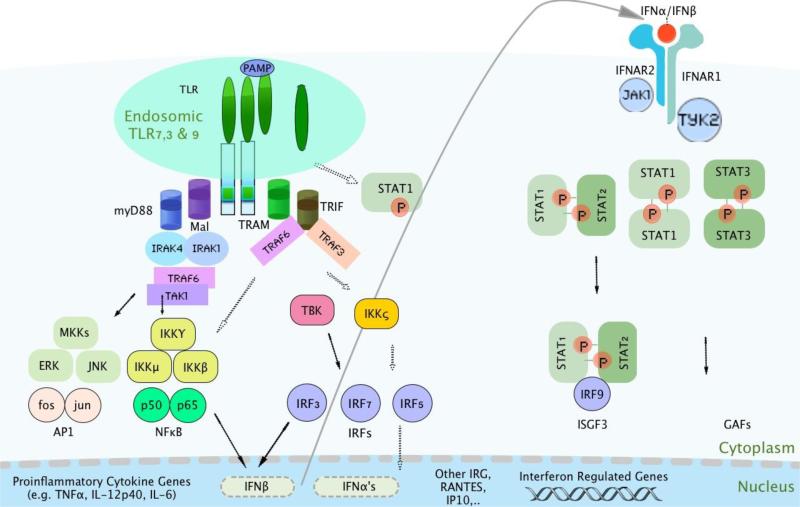
There is increasing scientific and clinical interest in elucidating the biology of type I Interferons, which began approximately 60 years ago with the concept of "viral interference", a property that reduces the ability of a virus to infect cells. Although our understanding of the multiple cellular and molecular functions of interferons has advanced significantly, much remains to be learned and type I Interferons remain an active and fascinating area of inquiry. In this review, we cover some general aspects of type I interferon genes, with emphasis on interferon-alpha, and various aspects of molecular mechanisms triggered by type I interferons and toll-like receptor signaling by the Janus activated kinase/signal transducer activation of transcription (JAK-STAT) pathway and interferon regulatory factor pathway. We will also describe the role of type I interferons in autoimmune and inflammatory diseases, and its potential use as therapeutic agent.
Keywords: Autoimmune diseases; Idiopathic inflammatory myopathies; Interferon alpha; Interferon beta; Interferon signature; Multiple sclerosis; Rheumatoid arthritis; Systemic lupus erythematosus.
Copyright © 2015 Elsevier B.V. All rights reserved.
Figures
References
-
- Aaronson DS, Horvath CM. A road map for those who don't know JAK-STAT. Science. 2002;296:1653–5. - PubMed
-
- Alexopoulou L, Holt AC, Medzhitov R, Flavell RA. Recognition of double-stranded RNA and activation of NF-kappaB by Toll-like receptor 3. Nature. 2001;413:732–8. - PubMed
-
- Arduini RM, Strauch KL, Runkel LA, Carlson MM, Hronowski X, Foley SF, Young CN, Cheng W, Hochman PS, Baker DP. Characterization of a soluble ternary complex formed between human interferon-beta-1a and its receptor chains. Protein science : a publication of the Protein Society. 1999;8:1867–77. - PMC - PubMed
-
- Aringer M, Crow MK. A bridge between interferon-alpha and tumor necrosis factor in lupus. The Journal of rheumatology. 2008;35:1473–6. - PubMed
-
- Aringer M, Graninger WB, Steiner G, Smolen JS. Safety and efficacy of tumor necrosis factor alpha blockade in systemic lupus erythematosus: an open-label study. Arthritis and rheumatism. 2004;50:3161–9. - PubMed
Publication types
MeSH terms
Substances
Grants and funding
LinkOut - more resources
Full Text Sources
Other Literature Sources
Medical
