


Drugs for the treatment of nausea and vomiting in adults in the emergency department setting
- PMID: 26411330
- PMCID: PMC6517141
- DOI: 10.1002/14651858.CD010106.pub2
Drugs for the treatment of nausea and vomiting in adults in the emergency department setting
Abstract
Background: Nausea and vomiting is a common and distressing presenting complaint in emergency departments (ED). The aetiology of nausea and vomiting in EDs is diverse and drugs are commonly prescribed. There is currently no consensus as to the optimum drug treatment of nausea and vomiting in the adult ED setting.
Objectives: To provide evidence of the efficacy and safety of antiemetic medications in the management of nausea and vomiting in the adult ED setting.
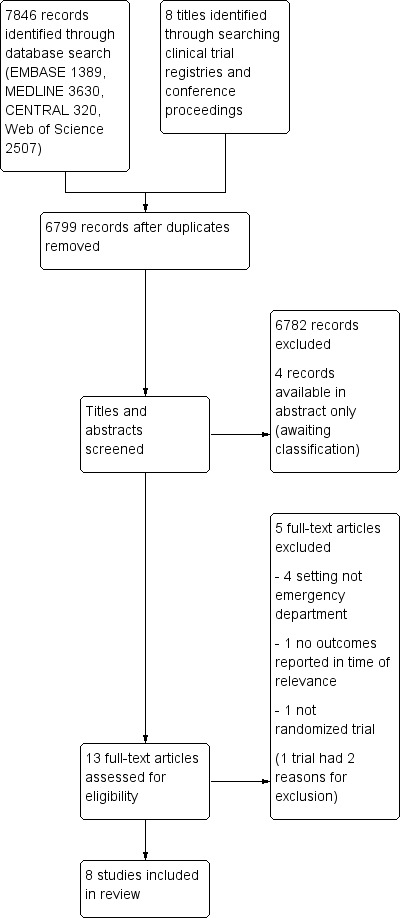
Search methods: We searched the Cochrane Central Register of Controlled Trials (CENTRAL; 2014, Issue 8), MEDLINE (OvidSP) (January 1966 to August 2014), EMBASE (OvidSP) (January 1980 to August 2014) and ISI Web of Science (January 1955 to August 2014). We also searched relevant clinical trial registries and conference proceedings.
Selection criteria: We included randomized controlled trials (RCTs) of any drug in the treatment of nausea and vomiting in the treatment of adults in the ED. Study eligibility was not restricted by language or publication status.
Data collection and analysis: Two review authors independently performed study selection, data extraction and assessment of risk of bias in included studies. We contacted authors of studies to obtain missing information if required.
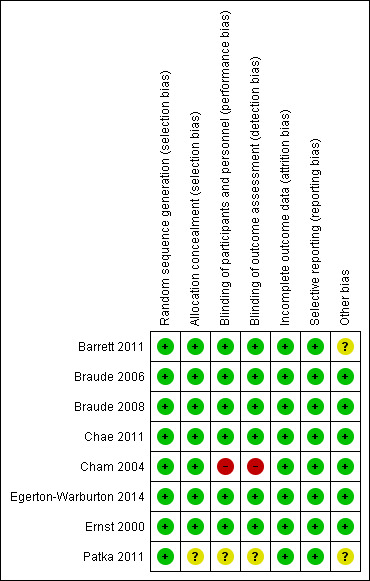
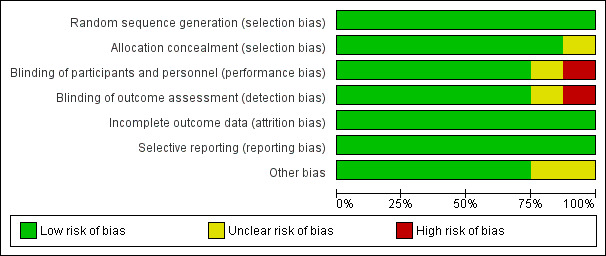
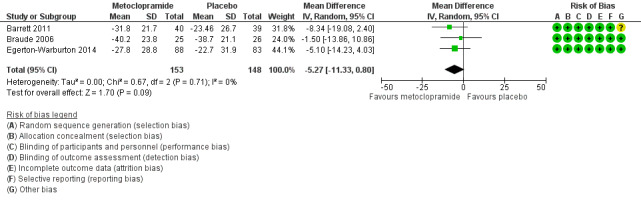
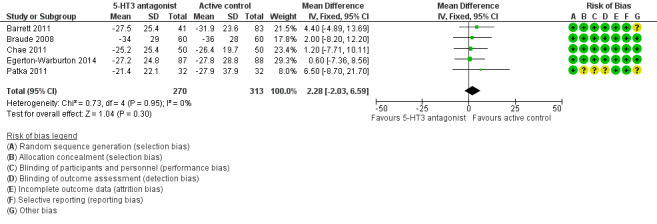
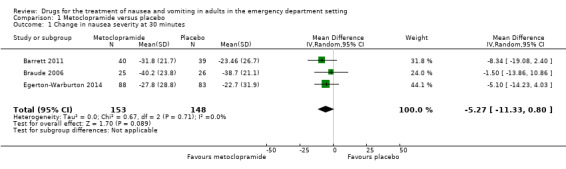
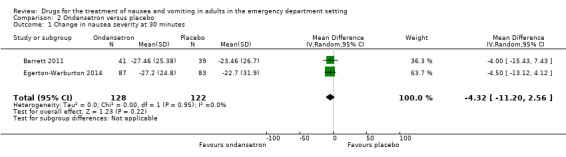
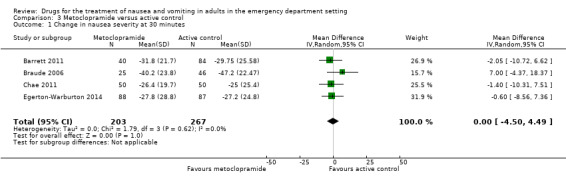
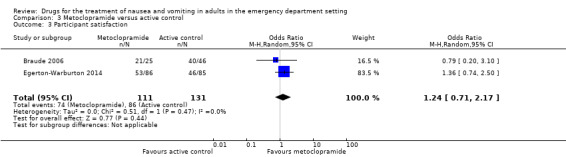
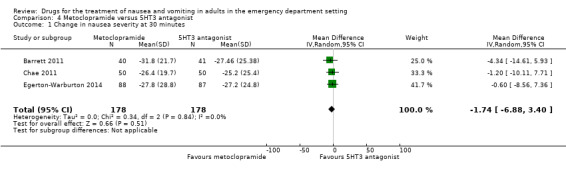
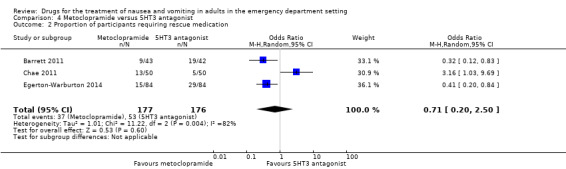
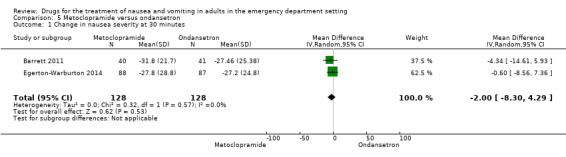
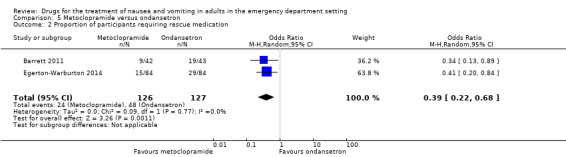
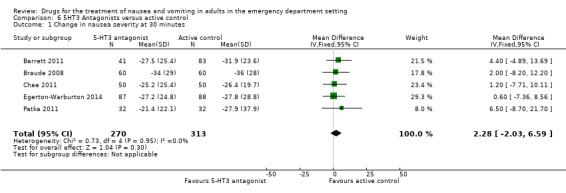
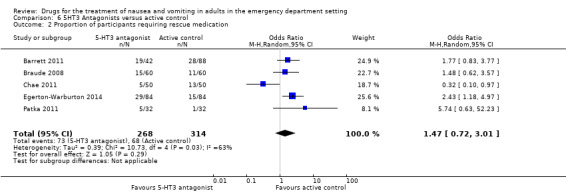
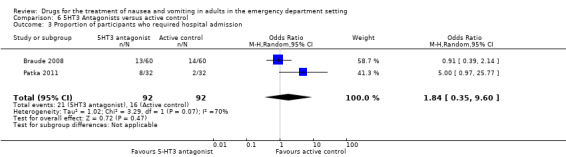
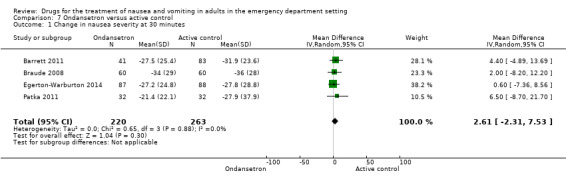
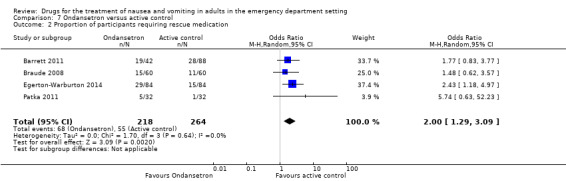
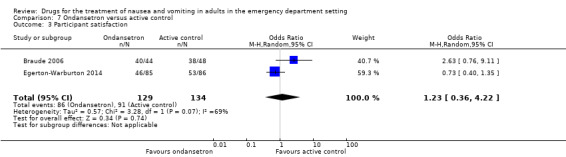
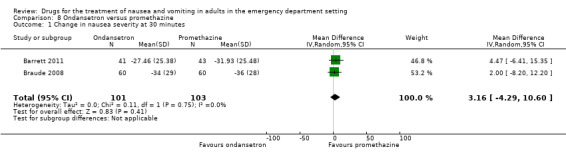
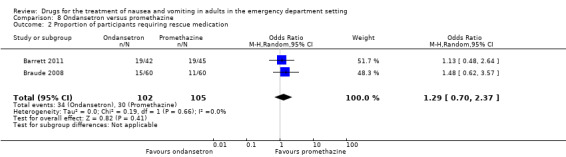
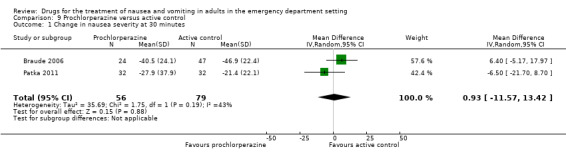
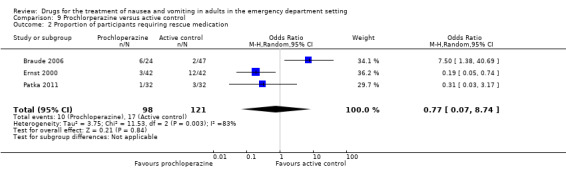
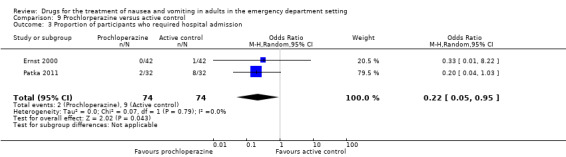
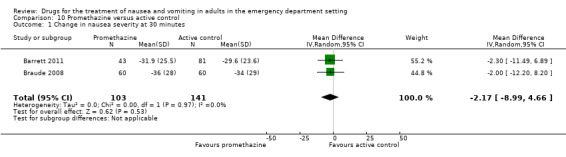
Main results: We included eight trials, involving 952 participants, of which 64% were women. Included trials were generally of adequate quality, with six trials at low risk of bias, and two trials at high risk of bias. Three trials with 518 participants compared five different drugs with placebo; all reported the primary outcome as mean change in visual analogue scale (VAS) (0 to 100) for nausea severity from baseline to 30 minutes. Trials did not routinely report other primary outcomes of the change in nausea VAS at 60 minutes or number of vomiting episodes. Differences in mean VAS change from baseline to 30 minutes between placebo and the drugs evaluated were: metoclopramide (three trials, 301 participants; mean difference (MD) -5.27, 95% confidence interval (CI) -11.33 to 0.80), ondansetron (two trials, 250 participants; MD -4.32, 95% CI -11.20 to 2.56), prochlorperazine (one trial, 50 participants; MD -1.80, 95% CI -14.40 to 10.80), promethazine (one trial, 82 participants; MD -8.47, 95% CI -19.79 to 2.85) and droperidol (one trial, 48 participants; MD -15.8, 95% CI -26.98 to -4.62). The only statistically significant change in baseline VAS to 30 minutes was for droperidol, in a single trial of 48 participants. No other drug was statistically significantly superior to placebo. Other included trials evaluated a drug compared to "active controls" (alternative antiemetic). There was no convincing evidence of superiority of any particular drug compared to active control. All trials included in this review reported adverse events, but they were variably reported precluding meaningful pooling of results. Adverse events were generally mild, there were no reported serious adverse events. Overall, the quality of the evidence was low, mainly because there were not enough data.
Authors' conclusions: In an ED population, there is no definite evidence to support the superiority of any one drug over any other drug, or the superiority of any drug over placebo. Participants receiving placebo often reported clinically significant improvement in nausea, implying general supportive treatment such as intravenous fluids may be sufficient for the majority of people. If a drug is considered necessary, choice of drug may be dictated by other considerations such as a person's preference, adverse-effect profile and cost. The review was limited by the paucity of clinical trials in this setting. Future research should include the use of placebo and consider focusing on specific diagnostic groups and controlling for factors such as intravenous fluid administered.
Conflict of interest statement
Jeremy S Furyk: none known.
Robert Meek and Diana Egerton‐Warburton are authors of one of the trials included in this review (Egerton‐Warburton 2014).
JF and RM independently appraised the study for inclusion, risk of bias and data extraction.
There were no disagreements in this process, or need for independent arbiter.
Figures
Comment in
-
For Adults With Nausea and Vomiting in the Emergency Department, What Medications Provide Rapid Relief?Ann Emerg Med. 2016 Dec;68(6):717-718. doi: 10.1016/j.annemergmed.2016.02.041. Epub 2016 Apr 26. Ann Emerg Med. 2016. PMID: 27130801 No abstract available.
References
References to studies included in this review
Barrett 2011 {published and unpublished data}
-
- Barrett T, Dipersio D, Jenkins C, Jack M, McCoin N, Storrow A. A randomized, placebo‐controlled trial of ondansetron, metoclopramide, and promethazine in adults. American Journal of Emergency Medicine 2011;29(3):247‐55. [PUBMED: 20825792] - PubMed
Braude 2006 {published data only}
-
- Braude D, Soliz T, Crandall C, Hendey G, Andrews J, Weichenthal L. Antiemetics in the ED: a randomized controlled trial comparing 3 common agents. American Journal of Emergency Medicine 2006;24(2):177‐82. [PUBMED: 16490647] - PubMed
Braude 2008 {published data only}
-
- Braude D, Crandall C. Ondansetron versus promethazine to treat acute undifferentiated nausea in the emergency department: a randomized, double‐blind, noninferiority trial. Academic Emergency Medicine 2008;15(3):209‐15. [PUBMED: 18304050] - PubMed
Chae 2011 {published data only}
-
- Chae J, Taylor DM, Frauman AG. Tropisetron versus metoclopramide for the treatment of nausea and vomiting in the emergency department: a randomized, double‐blind, clinical trial. Emergency Medicine Australasia 2011;23(5):554‐61. [PUBMED: 21995469] - PubMed
Cham 2004 {published data only}
-
- Cham S, Basire M, Kelly A‐M. Intermediate dose metoclopramide is not more effective than standard dose metoclopramide for patients who present to the emergency department with nausea and vomiting: a pilot study. Emergency Medicine Australasia 2004;16(3):208‐11. [PUBMED: 15228463] - PubMed
Egerton‐Warburton 2014 {published and unpublished data}
-
- Egerton‐Warburton D, Meek R, Mee MJ, Braitberg G. Antiemetic use for nausea and vomiting in adult emergency department patients: randomized controlled trial comparing ondansetron, metoclopramide and placebo. Annals of Emergency Medicine 2014;64(5):526‐32. [DOI: 10.1016/j.annemergmed.2014.03.017; PUBMED: 24818542] - DOI - PubMed
Ernst 2000 {published data only}
-
- Ernst A, Weiss S, Park S, Takakuwa K, Diercks D. Prochlorperazine versus promethazine for uncomplicated nausea and vomiting in the emergency department: a randomized, double‐blind clinical trial. Annals of Emergency Medicine 2000;36(2):89‐94. [PUBMED: 10918098] - PubMed
References to studies excluded from this review
Agorastos 1981 {published data only}
-
- Agorastos I, Zissis N, Kaprinis I, Goulis G. Double‐blind evaluation of domperidone in acute vomiting and dyspeptic disorders. Journal of International Medical Research 1981;9(2):143‐7. [PUBMED: 7014284] - PubMed
Cohen 1999 {published data only}
-
- Cohen N, Alon I, Almoznino‐Sarfian D, Gorelik O, Chachasvili S, Litvinjuk V, et al. Sulpiride versus metoclopramide in nononcologic patients with vomiting or nausea. Journal of Clinical Gastroenterology 1999;21(1):59‐62. [PUBMED: 10405234] - PubMed
Ordog 1984 {published data only}
-
- Ordog G, Vann P, Owashi N, Wasserberger J, Herman LS, Balasubramaniam S. Intravenous prochlorperazine for the rapid control of vomiting in the emergency department. Annals of Emergency Medicine 1984;13:253‐8. [PUBMED: 6703431] - PubMed
Roy 1991 {published data only}
-
- Roy P, Patel N, Miller A. A comparison of controlled release metoclopramide and domperidone in the treatment of nausea and vomiting. British Journal of Clinical Practice 1991;45(4):247‐51. [PUBMED: 1810356] - PubMed
Sussman 1999 {published data only}
-
- Sussman G, Shurman J, Creed M, Larsen L, Ferrer‐Brechner T, Noll D, et al. Intravenous ondansetron for the control of opioid‐induced nausea and vomiting. Clinical Therapeutics 1999;21(7):1216‐27. [PUBMED: 10463519] - PubMed
References to studies awaiting assessment
Friedland 2008 {published data only (unpublished sought but not used)}
-
- Friedland H, David S, Renae B, Amit S, Latisse M, Monica S, et al. A randomized trial comparing the efficacy of low dose iv granisetron (0.1mg) versus iv prochlorperazine (10mg) in the treatment of acute nausea and vomiting. Proceedings of the Annual Meeting of the Society for Academic Emergency Medicine (SAEM); 2008 May 29‐June 1; Washington. Washington: Academic Emergency Medicine, 2008.
Haensel 2007 {published data only (unpublished sought but not used)}
-
- Haensel C, Smith D, Pollack M, Owens L. Ondansetron versus metoclopramide for nausea and vomiting in the emergency department. Proceedings of the Annual Meeting of the Society for Academic Emergency Medicine; 2007 May 16‐19; Chicago. Chicago: Academic Emergency Medicine, 2007.
Thacker 2003 {published data only (unpublished sought but not used)}
-
- Thacker J, Miner J, Biros M. Droperidol versus metoclopramide for the treatment of nausea. Proceedings of the American College of Emergency Physicians; 2003 Oct 12‐13; Boston. Boston: American College of Emergency Physicians, 2003.
Thacker 2004 {published data only (unpublished sought but not used)}
-
- Thacker J, Miner J. Droperidol dosing for nausea and vomiting. Proceedings of the American College of Emergency Physicians; 2004 Oct 16‐18; San Francisco. San Francisco: American College of Emergency Physicians, 2004.
Additional references
AGA 2001
-
- AGA. American Gastroenterological Association medical position statement: nausea and vomiting. Gastroenterology 2001;120(1):261‐2. [DOI: ] - PubMed
Billio 2010
Bork 2011
-
- Bork B, Ditkoff J, Hang BS. Nausea and vomiting. In: Tintinalli JE editor(s). Tintinalli's Emergency Medicine: a Comprehensive Study Guide. 7th Edition. New York: McGraw Hill Medical, 2011. [ISBN: 0071484809]
Carlisle 2006
Carpenter 1990
-
- Carpenter DO. Neural mechanisms of emesis. Canadian Journal of Physiology and Pharmacology 1990;68:230‐6. [PUBMED: 2178747] - PubMed
Dorman 2010
Egger 1997
Ezzo 2006
Fedorowicz 2011
Guyatt 2008
Hendey 2005
Higgins 2011
-
- Higgins JPT, Green S (editors). Cochrane Handbook for Systematic Reviews of Interventions Version 5.1.0 [updated March 2011]. The Cochrane Collaboration, 2011. Available from www.cochrane‐handbook.org.
Jordan 2007
-
- Jordan K, Sippel C, Schmoll H. Guidelines for antiemetic treatment of chemotherapy‐induced nausea and vomiting: past, present, and future recommendations. Oncologist 2007;12:1143‐50. [PUBMED: 17914084] - PubMed
Kris 2006
-
- American Society of Clinical Oncology, Kris MG, Hesketh PJ, Somerfield MR, Feyer P, Clark‐Snow R, Koeller JM, et al. American Society of Clinical Oncology guideline for antiemetics in oncology: update. Journal of Clinical Oncology 2006;24(18):2932‐47. [PUBMED: 16717289] - PubMed
LaValley 2003
-
- LaValley J, Crandall C, Braude D. Nausea and vomiting management in US emergency departments (abstract). Academic Emergency Medicine 2003;10:461.
Lee 2009
Maranzano 2005
-
- Maranzano E, Feyer P, Molassiotis A, Rossi R, Clark‐Snow R, Olver I, et al. Evidence‐based recommendations for the use of antiemetics in radiotherapy. Radiotherapy & Oncology 2005;76(3):227‐33. [PUBMED: 16150504] - PubMed
Mathews 2010
Mee 2011
Perkins 2009
Quigley 2001
RevMan 2014 [Computer program]
-
- The Nordic Cochrane Centre, The Cochrane Collaboration. Review Manager (RevMan). Version 5.3. Copenhagen: The Nordic Cochrane Centre, The Cochrane Collaboration, 2014.
Zun 2010
-
- Zun LS, Singh A. Nausea and vomiting. In: Marx JA editor(s). Rosen's Emergency Medicine: Concepts and Clinical Practice. Philadelphia: Mosby Elsevier, 2010. [ISBN: 978‐0‐323‐05472‐0]
References to other published versions of this review
Publication types
MeSH terms
Substances
LinkOut - more resources
Full Text Sources
Medical
